
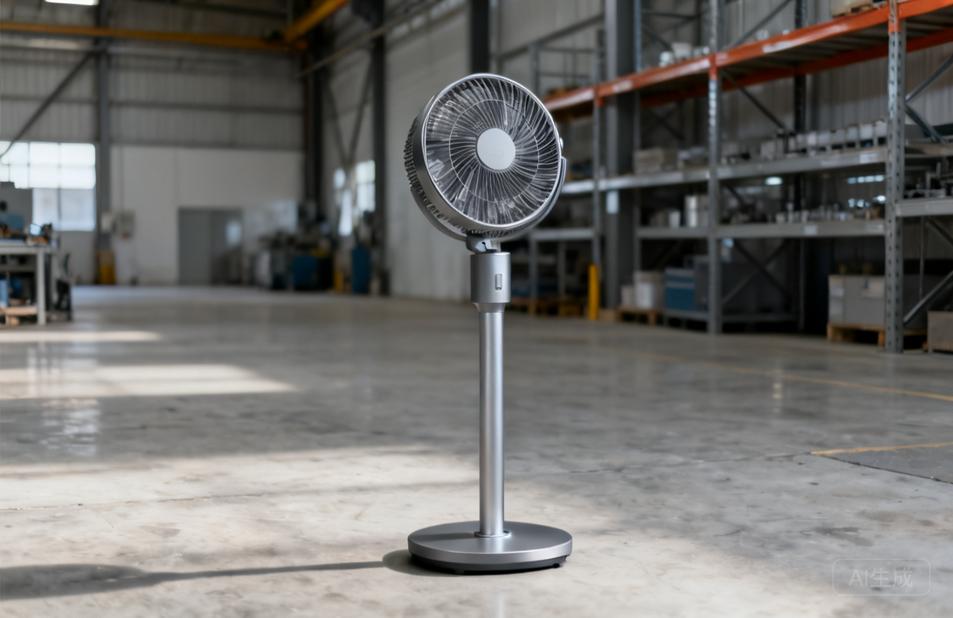
A standing air circulator China factory is a manufacturing source that produces pedestal-style air circulators, typically combining a height-adjustable stand, a large-diameter fan head, and a motor designed for directional, long-throw airflow. Buyers use these factories for wholesale supply, private label programs, and OEM or ODM projects, and should confirm specifications in the datasheet for each model.
This guide focuses on how to investigate and compare factories rather than on a single product. Because fan performance, materials, controls, and certification status vary widely by model and by market, treat any supplier claim as provisional until it is supported by a current datasheet, test report, or sample you have inspected.
What a Standing Air Circulator Factory Actually Produces
The term covers a broad family of products. A standing air circulator is usually distinguished from a conventional pedestal fan by its blade and grille design, which is intended to move a focused column of air over a longer distance rather than create a wide, gentle breeze. Typical configurations include:
- Pedestal units with a telescopic or fixed stand and a tilting, sometimes oscillating, fan head.
- AC-motor versions, which are common in volume programs, and DC-motor versions with more speed steps and lower energy use at low settings.
- Manual controls, remote control, timer functions, and in some ranges smart or app-based controls.
- Metal, plastic, or mixed housings, with blade materials and grille construction affecting durability and cleaning.
Factories often produce several of these variants on shared tooling. Ask which platform a quoted model is built on, and whether the housing, motor, and control board are standard or project-specific.
Key Engineering Checks Before You Compare Prices
Airflow and motor design
Request the measured airflow, air speed, and power input for each speed setting, together with the test method used. A useful quotation names the motor type, insulation class, bearing system, and rated voltage and frequency for the destination market. Where the same model is offered in 50 Hz and 60 Hz versions, confirm that blades, capacitors, and speed settings are matched to each.
Structure and stability
Pedestal products are prone to wobble and tip-over concerns. Check base weight and footprint, pole locking method, head tilt mechanism, and whether a safety grille is fixed with a tool or by hand. Ask how the factory tests stability and grille retention, and inspect a sample at full height and maximum speed.
Controls and user safety
Confirm that control electronics, wiring, and enclosure design suit the target market’s requirements. Buyers selling into regulated markets should ask for the applicable test reports and certificates for the exact model and voltage version, and should verify that the certificate holder and model references match what they intend to import.
Evaluating the Factory, Not Only the Sample
A good sample does not guarantee consistent production. Build a picture of the factory across these areas:
- Production scope: which processes are in-house (motor winding, injection molding, stamping, assembly) and which are subcontracted. Subcontracting is normal, but the factory should be able to explain how it controls incoming parts.
- Quality system: incoming inspection, in-line checks, and end-of-line functional testing. Ask for the test items recorded per unit and the sampling plan used.
- Traceability: whether finished units carry a production batch or date code that links back to inspection records.
- Documentation: current datasheets, exploded views, spare-parts lists, and packaging specifications. A factory that cannot supply an accurate drawing is harder to work with on OEM projects.
- Change control: how the factory notifies you of component or supplier changes after approval, and whether approval samples are retained.
OEM, ODM, and Private Label: Define the Scope Early
Most sourcing conversations stall because the customization scope is never written down. Before requesting quotations, decide whether you need only your brand on the product and packaging, changes to colors and finishes, a modified control panel, a different plug and voltage version, or an entirely new housing. Each level of change affects tooling, approval steps, and the documentation the factory must produce.
For OEM and ODM work, ask who owns the drawings and tooling, how engineering changes are approved, and what the factory needs from you ( artwork files, packaging dielines, label content, and market requirements). Keep the agreed specification in a signed document rather than in chat messages.
Applications and Suitability Limits
Standing air circulators suit workshops, warehouses, garages, gyms, event spaces, and large rooms where directed air movement is more useful than general cooling. In higher-value commercial or hospitality settings, buyers should weigh noise level at each speed, appearance and finish, and ease of cleaning against the lower cost of basic models.
Air circulators are not air conditioners; they move existing air and do not lower room temperature. In humid or dusty environments, consider how grilles and blades will be cleaned and whether the motor enclosure suits the conditions. For outdoor or semi-outdoor use, confirm with the factory whether the specific model is intended for that environment rather than assuming it is.
Information to Send a Factory Before Quotation
A concise brief produces comparable quotes. Include destination market and applicable plug and voltage; preferred motor type and control method; required airflow or air speed range and acceptable noise level; housing, blade, and finish preferences; estimated order quantity per model and per color; branding and packaging requirements; required certificates and test reports; sample quantity and approval process; and any target price band with the cost drivers you are willing to trade off.
Buyer Checklist
- Datasheet matches the quoted model, voltage, and frequency.
- Performance figures include the test method, not just a headline number.
- Certificates and reports reference the exact model and are current.
- Sample inspected at full height and maximum speed for stability and vibration.
- Quality records and batch traceability demonstrated during an audit or video review.
- Customization scope, tooling ownership, and change-control process documented.
- Spare parts, packaging specification, and warranty terms confirmed in writing.
Frequently Asked Questions
How do I verify a standing air circulator China factory before ordering?
Request current datasheets and test reports for the exact model, inspect a sample at full speed, and ask for quality records, batch traceability, and references for similar export markets. An on-site or video factory review helps confirm which processes are in-house.
What is the difference between a standing air circulator and a pedestal fan?
A standing air circulator is designed to move a focused, longer-throw column of air, while a conventional pedestal fan typically produces a wider, softer breeze. Designs vary by model, so compare measured airflow, air speed, and noise data rather than relying on the product name.
Can I order a private label or OEM version?
Many factories offer branding, color, packaging, control panel, and voltage changes, and some offer ODM designs. The scope, tooling implications, and approval steps differ by project, so define them in writing and confirm what the factory can support for your specific model.
Which specifications should I confirm in the datasheet?
Check rated voltage and frequency, power input, motor type, airflow or air speed with the test method, noise level at each speed, height adjustment range, head tilt and oscillation, materials, net weight, and the certificates applicable to your market.
Does an air circulator reduce room temperature?
No. An air circulator moves existing air to increase perceived cooling and air movement; it does not cool the air like an air conditioner. Buyers should match airflow and noise expectations to how and where the product will be used.
Company Information and Technical Inquiries
Company: Dongguan Yanxuan Electrical Appliances Co., Ltd.
Address: No. 3, Liuhua Industrial Road, Dongcheng Subdistrict, Dongguan, Guangdong, China
Phone: +8613253611781
Email: 847317465@qq.com