
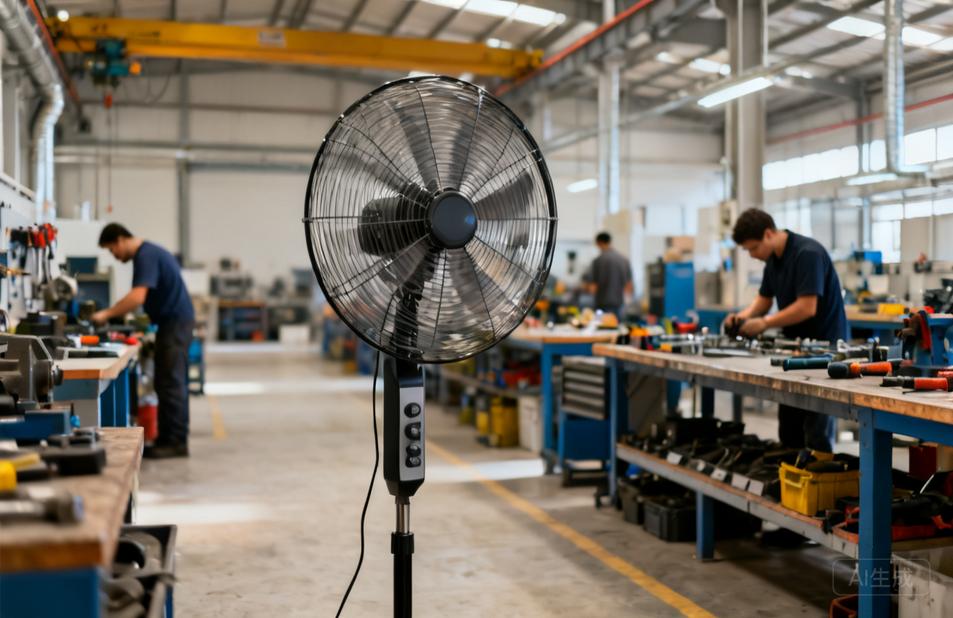
A standing air circulator fan is a pedestal-mounted fan designed to produce a focused, high-velocity air jet that circulates air over longer distances than a conventional pedestal fan. It is used in workshops, warehouses, gyms, and commercial spaces to improve air movement and occupant comfort. Selection depends on throw distance, airflow pattern, motor type, and the operating environment.
What Makes a Standing Air Circulator Different from a Standard Pedestal Fan
Standard pedestal fans typically use wide, soft blades and a loose grille to create a broad, gentle breeze for nearby occupants. A standing air circulator uses a more aerodynamic blade design, a tighter grille, and often a deeper shroud to accelerate air into a concentrated stream. This stream can travel farther before dispersing, so one unit can serve a larger zone or push air toward a distant wall or ceiling to improve overall mixing.
The trade-off is that the airstream is narrower and faster. Directly in its path, the airflow may feel stronger and noisier than a standard fan. Buyers should match the circulator’s airflow pattern to the space rather than assuming a higher velocity always means better comfort.
How a Standing Air Circulator Works
Most standing air circulators use an AC induction motor or a brushless DC (BLDC) motor. AC models are common in industrial settings because they are robust and simple. BLDC models offer variable speed control and often lower energy consumption, but they add cost and electronic components that must be protected from dust and moisture.
The fan draws air in from the rear, accelerates it through the blade set, and discharges it through a shaped grille or nozzle. Head tilt and oscillation are adjusted manually or by a motorized mechanism. Some models include a height-adjustable stand so the airflow can be aimed at seated workers, standing workers, or equipment. Specifications such as airflow rate, throw distance, and noise level vary by model and must be confirmed in the datasheet.
Key Selection Criteria
Airflow and Throw Distance
Airflow rate alone does not describe performance. Ask for the airflow pattern: whether the fan is designed for a concentrated jet or a broader spread. For a large open workshop, a concentrated jet aimed down the length of the building may be more effective than several small fans. For an office or retail area, a softer spread may be preferred.
Motor Type and Speed Control
AC motors are generally suitable for continuous industrial use where variable speed is not required. BLDC motors allow precise speed adjustment and may be preferred where energy use or low-speed operation matters. Confirm the number of speed settings, the control method (dial, remote, or wall switch), and whether the motor has thermal protection.
Build and Ingress Protection
In dusty workshops or humid environments, the motor and wiring need appropriate protection. Check the IP rating if the fan will be exposed to water spray or heavy dust. For clean commercial spaces, a standard enclosure may be sufficient. Grill spacing, blade material, and stand stability also affect safety and durability.
Noise
Higher air velocity generally increases noise. If the fan will operate in a customer-facing or quiet area, request sound pressure level data at the intended speed setting. Noise can also be affected by installation position and nearby surfaces.
Mounting and Adjustability
Standing models usually include a weighted base and a height-adjustable column. Check the base diameter and weight for stability in areas with foot traffic or uneven floors. Oscillation range and tilt angle determine how much area one unit can cover without repositioning.
Typical Applications
- Workshops and factories: Move air through work zones and help reduce heat buildup where open doors or high ceilings limit natural ventilation.
- Warehouses and logistics centers: Improve air mixing in large volumes and reduce stagnant zones.
- Gyms and fitness centers: Provide strong airflow for occupants during exercise, with adjustable speed for different areas.
- Retail and hospitality: Circulate air in large halls or seasonal spaces without installing ductwork.
- Agricultural and livestock buildings: Support general air movement, provided the fan is rated for the humidity and dust present.
Limitations and Trade-offs
A standing air circulator is not an air conditioner or a replacement for mechanical ventilation. It moves existing air and does not reduce temperature or remove contaminants. In hot, humid conditions, moving air can improve perceived comfort through evaporative cooling on the skin, but it will not lower the actual air temperature.
High-velocity airflow can be uncomfortable if directed at people for long periods. In dusty environments, a circulator may lift settled dust unless the space is cleaned regularly. Noise and power consumption also increase with speed, so buyers should consider whether a smaller number of larger, slower fans might be more efficient than multiple high-speed units.
What to Send to a Supplier
To get an accurate recommendation, provide the following information:
- Room dimensions, ceiling height, and a simple layout sketch showing where people work.
- Power supply available (voltage, phase, frequency) and whether a plug or hardwiring is required.
- Environmental conditions: dust, humidity, temperature range, and indoor or outdoor use.
- Noise limits and any certification requirements for the destination market.
- Control preferences: manual, remote, or integration with a building system.
- Quantity, packaging requirements, and any OEM or private-label needs.
Ask for a datasheet that lists airflow, speed settings, power input, noise level, IP rating, and dimensions. Confirm which specifications are model-specific and request test reports where available. Samples can help verify build quality and airflow feel before a bulk order.
Buyer Checklist
- Confirm the fan is intended for the environment (dust, moisture, temperature).
- Check that the airflow pattern matches the space, not just the airflow rate.
- Verify motor protection and speed control method.
- Review base stability and height adjustment for the intended location.
- Ask for noise data at the expected operating speed.
- Confirm voltage, plug type, and certification documents for the target market.
- Request a sample or pre-production unit for evaluation.
Frequently Asked Questions
What is the main difference between a standing air circulator fan and a regular pedestal fan?
A standing air circulator fan produces a more focused, higher-velocity air stream that travels farther, while a regular pedestal fan creates a wider, softer breeze for nearby areas.
Can a standing air circulator fan be used outdoors?
Only if the model is rated for outdoor use with an appropriate IP rating and weather-resistant materials. Most standard models are intended for indoor use.
What should buyers check on the datasheet?
Check airflow rate, throw distance, speed settings, power input, noise level, IP rating, dimensions, and motor type. Confirm which values are model-specific.
Do standing air circulator fans consume a lot of power?
Power consumption varies by model and speed setting. BLDC motors can be more energy-efficient at low speeds, but buyers should compare rated wattage for the intended operating conditions.
Are OEM and private-label options available for standing air circulator fans?
Many manufacturers offer OEM and private-label options, but scope varies. Buyers should discuss customization, packaging, and certification requirements directly with the supplier.
Company Information and Technical Inquiries
Company: Dongguan Yanxuan Electrical Appliances Co., Ltd.
Address: No. 3, Liuhua Industrial Road, Dongcheng Subdistrict, Dongguan, Guangdong, China
Phone: +8613253611781
Email: 847317465@qq.com