
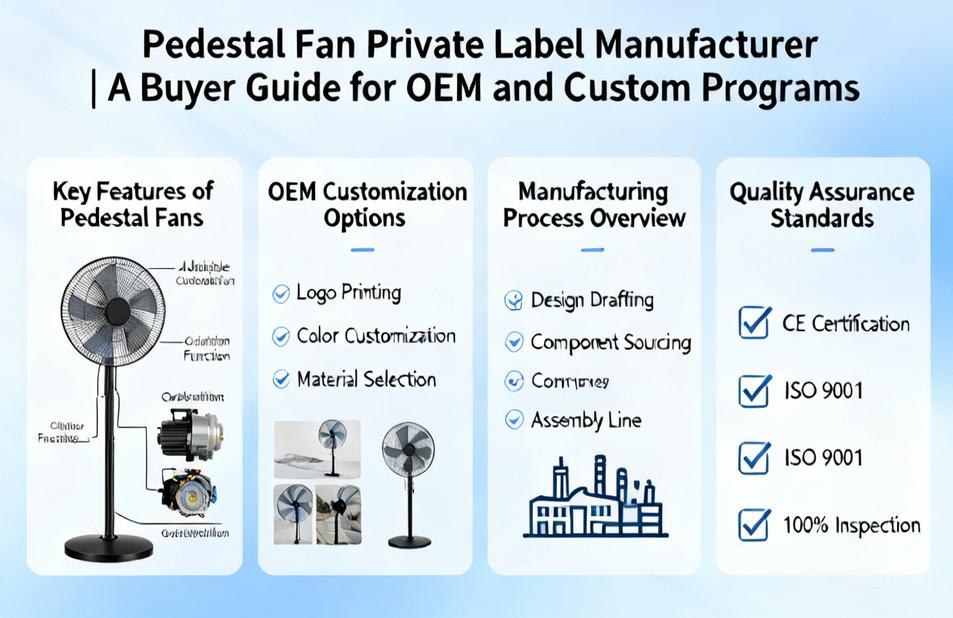
A pedestal fan private label manufacturer helps brands, importers, and distributors bring a customized air circulation product to market without building a production line from scratch. A pedestal fan is a freestanding unit with a tall adjustable stand, a motorized head, and a guard-protected blade assembly. It is commonly used in warehouses, workshops, retail floors, gyms, event venues, agricultural buildings, and residential spaces where portable airflow is needed. For buyers seeking a private label program, the goal is to combine a proven fan platform with their own brand identity, packaging, and market-specific specifications.
Product Overview
A pedestal fan typically consists of a base, a telescopic or fixed pole, a motor housing, a blade set, a front and rear guard, and a control panel or pull-cord switch. Many models offer oscillation, adjustable height, and multiple speed settings. In private label programs, the core mechanical and electrical platform stays largely the same, while the branding, color, packaging, voltage, plug type, and selected components are adapted to the buyer market. This approach allows a buyer to enter a product category with a consistent supply source rather than sourcing generic units from multiple traders.
Key Features Buyers Look For
Different markets prioritize different features. In industrial and commercial settings, durable motor construction, stable base design, and easy maintenance are usually more important than decorative styling. In retail and consumer channels, appearance, noise level, and control ergonomics often matter more. Common features include oscillation, height adjustment, thermal protection, multiple speed settings, and grille safety spacing. Buyers should confirm which features are standard on the platform and which require tooling or component changes before starting a private label discussion.
Motor and Airflow Performance
The motor is the core of the fan. It affects airflow, noise, energy use, and service life. A private label manufacturer should be able to explain the motor type used on each platform and how it performs under continuous operation. Airflow performance should be discussed in terms of the intended application, not just a single number, because blade diameter, guard design, and speed settings all influence real-world air movement.
Controls and Usability
Controls can range from simple pull-cord switches to push-button panels or remote operation. For private label programs, the control interface is often a point of differentiation. Buyers may request specific button layouts, indicator lights, or control labeling in their target language. These changes should be evaluated against tooling cost, minimum order quantity, and production feasibility.
Materials and Construction
Pedestal fans are usually built with metal and plastic components. The guard and pole may be steel with a protective finish, while the base can be metal or weighted plastic. Blade material affects balance, noise, and durability. Buyers should ask the supplier to describe the materials used for each major component and how the finished unit is assembled. For markets with specific safety or performance expectations, material selection and guard design are important topics to confirm during sampling.
Applications and Market Fit
Pedestal fans serve a wide range of applications. Industrial buyers may use them for spot cooling in workshops, warehouses, and production areas. Commercial buyers may place them in retail stores, restaurants, gyms, and event spaces. Agricultural users may need airflow in barns or storage buildings. Residential buyers often choose pedestal fans for living rooms, bedrooms, and patios. A private label program should match the product platform to the target application, because a unit designed for light residential use may not meet the expectations of an industrial buyer.
How to Choose a Pedestal Fan Private Label Manufacturer
Choosing a supplier is not only about price. A reliable manufacturer should be able to discuss platform options, component sourcing, tooling requirements, packaging design, and quality control steps. Buyers should request samples and review them against their own market requirements. It also helps to understand the factory production capacity, lead time planning, and communication process before committing to a program. A supplier that can explain its manufacturing process clearly is usually easier to work with during product development.
Questions to Ask During Supplier Evaluation
- Which fan platforms are available for private label programs?
- What customization options are possible for branding, color, packaging, and voltage?
- How are samples produced and reviewed before mass production?
- What quality control steps are applied during production and before shipment?
- Can the supplier support documentation and labeling requirements for the target market?
Customization Options for OEM and Private Label Programs
Customization can cover branding, product color, packaging, voltage and plug type, control labeling, and selected components. Some buyers request a custom logo on the motor housing or guard, while others focus on retail packaging and user manuals. The level of customization depends on the platform and the manufacturer capability. Buyers should discuss which changes require new tooling and which can be handled through printing, labeling, or component selection. Clear communication at this stage reduces unexpected costs later.
Buying Considerations
Before placing an order, buyers should confirm the product specification, packaging requirements, labeling, and inspection process. It is also important to understand how the supplier handles spare parts and after-sales support. For private label programs, consistency between sample and mass production is critical. Buyers may request pre-shipment inspection or third-party inspection to verify product appearance, function, and packaging. These steps help protect the brand and reduce returns.
Frequently Asked Questions
What is a pedestal fan private label manufacturer?
A pedestal fan private label manufacturer produces pedestal fans that carry the buyer brand instead of the factory brand. The buyer works with the manufacturer to define specifications, packaging, and branding, then sells the product under its own label.
Can I customize voltage and plug type for my market?
Many private label programs allow voltage and plug type customization based on the target market. Buyers should confirm the available options with the supplier and verify that the selected configuration matches local requirements.
How do I evaluate a potential supplier?
Start by reviewing the supplier product platforms, sample process, production capability, and quality control approach. Ask specific questions about materials, components, packaging, and inspection. A supplier that provides clear answers and samples is easier to assess than one that only offers general claims.
What customization options are usually available?
Common options include logo printing, color selection, packaging design, control labeling, voltage and plug configuration, and selected component upgrades. The exact options depend on the platform and the manufacturer capabilities.
Conclusion
Working with a pedestal fan private label manufacturer can help buyers build a branded air circulation product line without managing every stage of production. The key is to match the product platform to the target application, confirm customization options early, and evaluate the supplier on communication, sampling, and quality control. Buyers who plan ahead can reduce development risk and bring a more consistent product to market. If you are exploring an OEM or custom program, contact the supplier with your target specifications, application, and market requirements to request a suitable quote and sample discussion.