
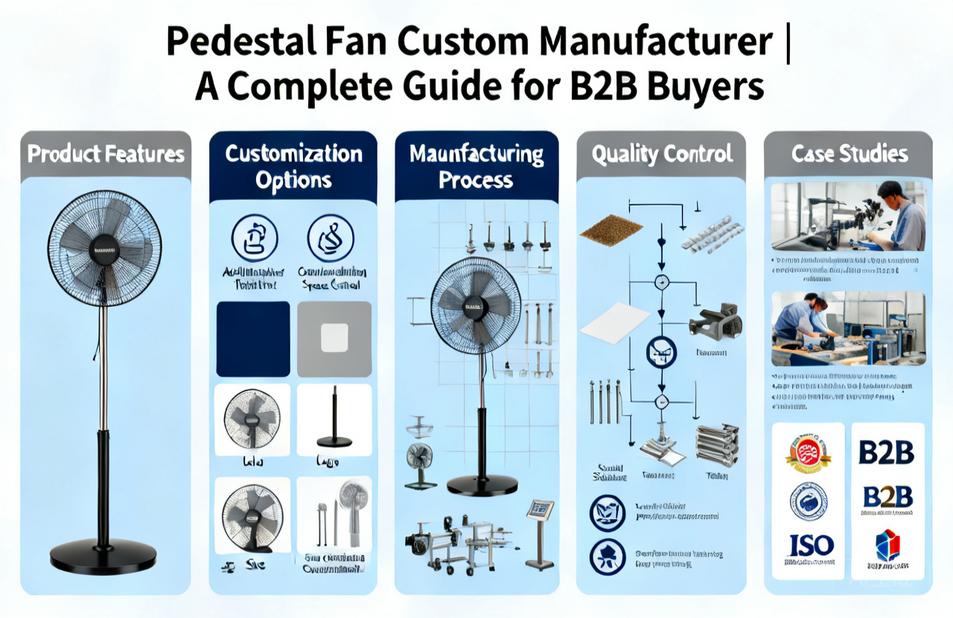
When overseas buyers search for a pedestal fan custom manufacturer, they are usually looking for a supplier who can adjust airflow performance, height, oscillation, motor configuration, and branding to match a specific market or industrial application. A pedestal fan is a freestanding air circulation unit with a motor and blade assembly mounted on a tall stand. It is commonly used in warehouses, workshops, retail spaces, gyms, agricultural buildings, and outdoor covered areas where portable, directional airflow is needed. Unlike ceiling fans, pedestal fans can be moved and angled, which makes them practical for temporary workstations, event spaces, and production zones that require localized cooling.
What a Custom Pedestal Fan Manufacturer Actually Provides
A custom manufacturer is not simply a trading company that puts a logo on a standard unit. In genuine OEM and custom supply relationships, the factory coordinates blade design, motor selection, guard structure, stand height, base type, speed control, and packaging. The buyer may need a unit that runs on a specific voltage and frequency, meets a target noise level, or fits a private-label retail program. A reliable pedestal fan supplier will ask about the end market, usage environment, and expected duty cycle before proposing a configuration. This early technical discussion prevents mismatches between the fan and the application.
Key Features Buyers Should Evaluate
Motor and Speed Control
The motor is the core of any industrial pedestal fan. Buyers should confirm whether the motor is AC or DC, what insulation class is available, and how many speed settings are required. For commercial and industrial use, a motor designed for continuous operation is generally preferred over a light-duty motor. Speed control may be mechanical, pull-chain, remote, or variable-frequency depending on the target market and price position.
Blade and Guard Design
Blade material, diameter, and pitch affect airflow, power consumption, and noise. Metal blades are common in industrial models, while reinforced plastic blades are often used in retail and household versions. The guard must be robust enough for the environment. In workshops and agricultural buildings, a tighter guard spacing and powder-coated finish can improve durability and safety.
Stand, Base, and Oscillation
Pedestal fans are valued for their adjustable height and oscillation. A stable base is important for high-traffic areas. Buyers should specify the required height range, base diameter, and whether oscillation is manual or motorized. For outdoor covered use, the stand and fasteners should be treated for moisture exposure.
Materials and Construction
Common construction materials include powder-coated steel for the guard and stand, aluminum or copper motor windings, and ABS or metal blades. Buyers should clarify the expected corrosion resistance and cleaning method. In food processing or dusty environments, easy-clean surfaces and sealed motors may be preferred. A custom pedestal fan manufacturer should be able to explain which materials suit indoor, outdoor, humid, or dusty conditions without overstating performance.
Industrial and Commercial Applications
Pedestal fans serve many B2B applications beyond simple cooling. In warehouses, they support air movement in aisles and loading areas. In manufacturing plants, they help remove heat from workstations. In gyms and event venues, they provide portable comfort. In poultry and livestock buildings, they contribute to ventilation and air circulation. In retail and hospitality, they can be branded and styled to match store design. Each application has different priorities: airflow volume, noise, durability, portability, or appearance.
How to Choose the Right Pedestal Fan for Your Market
The selection process should start with the application, not the catalog. Buyers should define the room size, ceiling height, ambient temperature, and whether the fan will run continuously. Next, confirm the electrical standard for the destination market, including voltage, frequency, and plug type. Then consider airflow direction, oscillation angle, and noise limits. For private-label programs, decide whether the fan needs custom colors, logo printing, retail packaging, or user manuals in a specific language. A pedestal fan factory that asks these questions is more likely to deliver a product that sells well and generates fewer returns.
Customization Options for OEM and Private Label
Customization can range from simple branding to full product development. Typical options include custom motor specifications, blade diameter and pitch, stand height, base weight, color matching, logo placement, remote control layout, packaging design, and instruction manual localization. Some buyers require a specific carton drop-test standard or retail-ready display packaging. Others need a fan that matches an existing product family. When discussing customization, buyers should provide clear target specifications and avoid assuming that every change is free. Tooling, minimum order quantity, and sampling requirements should be agreed in writing.
Buying Considerations and Supplier Selection
When comparing pedestal fan suppliers, evaluate manufacturing capability, quality control process, communication responsiveness, and experience with your target market. Ask for details about motor testing, assembly line checks, and final inspection. A good supplier will be transparent about lead times, sample availability, and warranty terms. It is also useful to discuss after-sales support and spare parts availability, especially for industrial buyers who cannot afford long downtime. Avoid suppliers who cannot explain their production process or who promise unrealistic performance without technical documentation.
Frequently Asked Questions
Can a pedestal fan manufacturer produce fans for different voltages and plug types?
Yes. Many factories can configure motors and power cords for different markets. Buyers should specify the destination country, voltage, frequency, and plug standard before sampling. This helps avoid compliance and compatibility problems later.
What is the difference between OEM and custom pedestal fan production?
OEM usually means the fan is built to the buyer’s brand and specifications, while custom production may involve changes to performance, structure, or packaging. In practice, the two often overlap. The key is to define which elements are standard and which are modified.
How do I evaluate a pedestal fan factory before placing a bulk order?
Request a sample, review the motor and assembly quality, check packaging, and ask about quality control procedures. Communicate with the engineering team, not only the sales representative, to confirm technical capability.
Can pedestal fans be used in industrial environments?
Yes, when the model is selected for the environment. Industrial pedestal fans may need a more durable motor, stronger guard, and corrosion-resistant finish. Buyers should explain the working conditions so the supplier can recommend a suitable configuration.
Conclusion
Choosing a pedestal fan custom manufacturer is a technical and commercial decision. Buyers should focus on application requirements, motor quality, construction, customization capability, and supplier reliability. A clear specification and open communication with the factory reduce risks and improve long-term supply performance. If you are developing a private-label or OEM pedestal fan program, contact the supplier with your target market, electrical standard, and customization needs so they can propose a suitable configuration.