
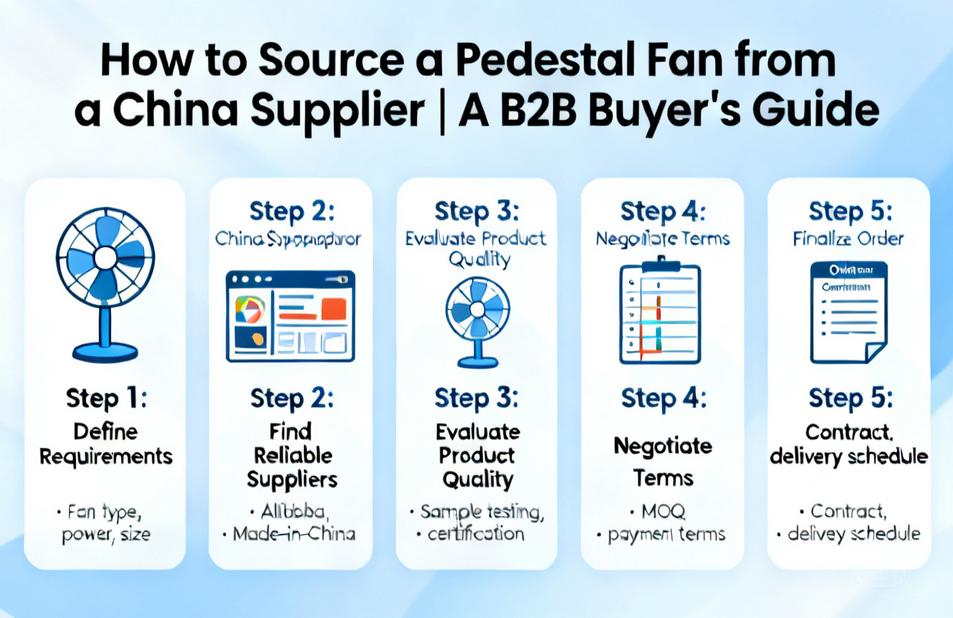
A pedestal fan is a freestanding, height-adjustable air circulation unit that sits on a weighted base and delivers directional airflow across workshops, warehouses, retail floors, and semi-open production areas. For international buyers, working with a China supplier of pedestal fans can offer access to flexible manufacturing capacity, OEM options, and a broad range of motor and blade configurations. This guide explains what to evaluate when sourcing pedestal fans for commercial and industrial use, how to match a model to your application, and how to select a reliable manufacturer or factory partner.
Product Overview and Working Principle
A pedestal fan typically consists of a motor-driven axial impeller, a protective grille, an adjustable stand, and a round or cross-shaped base. The motor rotates the blades, pulling air from behind the unit and pushing it forward in a focused stream. Most models allow tilting and height adjustment, so the airflow can be directed toward workstations, aisles, or operator positions. Unlike ceiling fans, a pedestal fan can be relocated as production layouts change, which makes it practical for temporary lines, seasonal cooling, and areas without ducted ventilation.
Common configurations include oscillating and non-oscillating heads, single-speed and multi-speed control, and metal or plastic blade options. Power supply, plug type, and control method vary by market, so buyers should confirm the electrical specification required for their destination before placing an order.
Key Features Buyers Usually Compare
Purchasing teams and facility managers generally compare pedestal fans on airflow delivery, motor durability, adjustability, noise level, and ease of maintenance. Important selection points include:
- Motor type and duty cycle: Continuous-duty motors are preferred for long shifts in workshops and warehouses.
- Blade design: Blade count, diameter, and pitch influence airflow volume and the spread of the air stream.
- Speed control: Multi-speed or variable control helps balance cooling needs against energy use and noise.
- Oscillation: Oscillating heads cover a wider area; fixed heads concentrate airflow on a specific zone.
- Height and tilt range: Adjustable stands suit seated operators as well as standing workstations.
- Grille and guard: Finger-safe guards and removable grilles simplify cleaning and reduce maintenance time.
Materials and Construction
Construction choices affect service life and suitability for different environments. Metal blades and steel grilles are common in industrial settings where durability is a priority. Powder-coated finishes help resist corrosion in humid or dusty areas. Bases may be weighted with concrete, cast iron, or sand-filled plastic to improve stability at higher speeds. For washdown or food-adjacent areas, buyers may request stainless steel components, sealed motors, or designs that reduce exposed fasteners. These material decisions should be discussed with the supplier early, because they influence tooling, assembly, and cost.
Industrial and Commercial Applications
Pedestal fans are used across many environments where fixed ventilation is insufficient or impractical. Typical applications include:
- Manufacturing floors and assembly lines that generate heat or fumes
- Warehouses and loading docks with high ceilings and large open areas
- Workshops, garages, and maintenance bays
- Agricultural buildings and greenhouses requiring air movement
- Retail spaces, gyms, event venues, and temporary structures
- Hospitality and food service areas, subject to local hygiene requirements
Because air movement supports worker comfort and can help reduce heat stress, many buyers treat pedestal fans as part of a broader ventilation or cooling plan rather than a standalone purchase.
How to Choose the Right Pedestal Fan
The right model depends on the space, the people or processes being cooled, and the power available. Buyers should start by defining the coverage area and the required air velocity at the target distance. A larger blade diameter generally moves more air but may require a more powerful motor. In noisy environments, a lower-speed setting with a larger blade can be a better compromise than a small high-speed unit. Consider whether the fan will run continuously, whether it needs to be portable between zones, and whether operators will adjust it frequently. If the fan is part of a safety or comfort program, document the airflow expectations so the supplier can recommend a suitable configuration rather than a generic model.
Customization and OEM Options
Many China suppliers offer OEM and custom manufacturing for pedestal fans. Customization can cover voltage and frequency, plug type, power cord length, motor specification, blade material, grille style, base weight, control panel layout, and packaging. Buyers may also request private label branding, user manuals in the target language, and retail-ready cartons. When discussing a custom project, provide clear drawings or samples, target market requirements, and expected annual volume. A factory with in-house tooling and assembly is often better positioned to handle non-standard configurations, but buyers should still verify production capability and quality control steps before committing to a large order.
Buying Considerations for Importers
Before placing an order, confirm the electrical standard, certification requirements, and labeling rules for the destination country. Ask for the bill of materials, motor specification, and a sample for evaluation. Review packaging to ensure the product survives ocean freight and meets retail or warehouse handling needs. Clarify warranty terms, spare parts availability, and whether replacement motors, blades, and switches can be supplied separately. For ongoing programs, discuss production lead time, minimum order quantity, and how design changes are handled. These details reduce the risk of returns, compliance issues, and downtime after delivery.
Supplier Selection: What to Check
Choosing a pedestal fan supplier is not only about price. Evaluate whether the company is a manufacturer or a trading company, what production equipment it operates, and how it manages incoming materials and final inspection. Request factory profiles, production process descriptions, and references to similar export projects where available. A supplier that communicates clearly about specifications, tolerances, and packaging is usually easier to work with over the long term. If you need OEM or custom models, confirm engineering support and sample development timelines in writing. It is also prudent to discuss how the supplier handles quality complaints and whether they can support mixed container loads with other ventilation products.
Frequently Asked Questions
Can I order pedestal fans with my own brand and packaging?
Yes. Many manufacturers offer OEM and private label services, including branded nameplates, cartons, and manuals. Provide your artwork and target market requirements so the supplier can confirm tooling and minimum order quantities.
What information should I provide to get an accurate quotation?
Share the required voltage and frequency, plug type, blade diameter, motor duty, control method, base style, packaging preference, and estimated annual volume. If you have a target airflow or application, include that as well.
Are pedestal fans suitable for continuous operation in industrial settings?
Some models are built for continuous duty, but this depends on motor design and operating conditions. Discuss the expected daily runtime and environment with the supplier so they can recommend an appropriate motor and maintenance schedule.
How do I compare suppliers when specifications look similar?
Look beyond the datasheet. Compare motor construction, material thickness, base stability, quality control procedures, and communication responsiveness. Request samples and review packaging and documentation before committing to volume orders.
Conclusion
Sourcing a pedestal fan from a China supplier is a practical option for buyers who need flexible specifications, OEM support, and scalable production. The key is to define your application, confirm the electrical and compliance requirements, and evaluate suppliers on manufacturing capability rather than price alone. If you are planning a purchase or a custom project, contact suppliers with your airflow needs, target market, and volume so they can recommend a suitable configuration and guide you through sampling and production.