
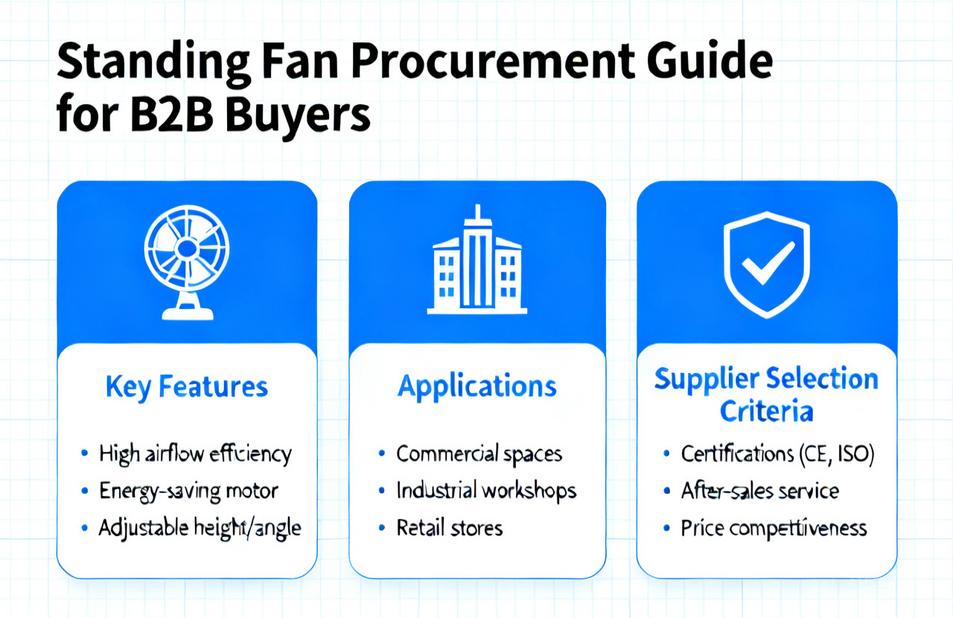
A standing fan, also known as a pedestal fan, is a free-standing air circulating device with an adjustable height column and a rotating head. It is widely used in residential, commercial, and light industrial spaces where flexible, floor-level airflow is required without permanent installation. For overseas buyers sourcing in volume, understanding the construction, performance variables, and customization options of standing fans is essential to match product specifications with target markets and end-user expectations.
Product Overview and Working Principle
A typical standing fan consists of a motor-driven impeller (blade assembly), a guard grille, an oscillating mechanism, a height-adjustable pole, and a weighted base. When powered, the motor rotates the blades to draw air from behind and push it forward, creating a directed airflow. Many models include oscillation, which moves the fan head horizontally to cover a wider area, and some offer remote control, timer, or multiple speed settings. Because the unit stands on the floor, it is suitable for rooms or work areas where wall or ceiling mounting is impractical.
Key Features B2B Buyers Should Evaluate
Purchasing decisions for standing fans often hinge on a balance of airflow performance, energy consumption, noise level, and durability. Important features include:
- Motor type: AC motors are common and cost-effective; DC motors generally offer higher energy efficiency and quieter operation but may increase unit cost.
- Blade design and material: The number, shape, and pitch of blades affect airflow and noise. Materials range from plastic to metal, with metal blades often chosen for industrial environments.
- Oscillation angle: A wider oscillation range improves air distribution but may add mechanical complexity.
- Speed control: Mechanical switches, push buttons, or electronic touch controls are available. The choice affects user experience and target price segment.
- Height adjustment: Telescopic poles allow users to set the fan head at different levels, which is useful in mixed-use spaces.
- Safety features: Overheat protection, sturdy base, and fine guard spacing are important for markets with strict safety expectations.
Materials and Construction Considerations
The materials used in a standing fan influence its weight, stability, corrosion resistance, and perceived quality. Common choices include:
- Base: Heavy plastic or metal bases improve stability and reduce vibration. Some designs use a round or cross-shaped base for a smaller footprint.
- Pole: Painted steel or stainless steel poles are typical. For humid or coastal environments, buyers may specify corrosion-resistant finishes.
- Grille: Metal wire guards are common; plastic guards are lighter but may be less durable in commercial settings.
- Blades: Aluminum, steel, or engineering plastics. Each material has trade-offs in weight, noise, and cost.
When sourcing from a manufacturer, it is advisable to request material specifications and samples to verify suitability for the intended market and application.
Industrial and Commercial Applications
While standing fans are often associated with homes, they also serve industrial and commercial purposes where permanent HVAC systems are absent or insufficient. Typical industrial applications include:
- Warehouse and logistics areas: Portable airflow for workers in large open spaces.
- Workshops and assembly lines: Spot cooling or air circulation in non-air-conditioned facilities.
- Agricultural buildings: Ventilation in livestock or storage areas, provided the fan is rated for the environment.
- Event tents and temporary structures: Quick deployment for guest comfort.
- Commercial spaces: Retail floors, gyms, and restaurants may use standing fans for supplemental air movement.
For these applications, buyers often look for models with higher airflow capacity, robust guards, and motors designed for extended run times. It is important to confirm that the fan is appropriate for the specific environment, as standard residential models may not withstand dust, moisture, or continuous operation.
How to Choose the Right Standing Fan for Your Market
Selecting a standing fan for import or distribution requires matching product characteristics with local demand and regulations. Consider the following factors:
1. Target Market and Use Case
Will the fan be sold for household use, office use, or industrial settings? This determines the required durability, airflow, and safety features. For example, a light-duty home fan may not meet the needs of a factory floor.
2. Performance Requirements
Define airflow, speed settings, and noise limits based on end-user expectations. While exact performance figures should come from the supplier, buyers can request test data or samples to evaluate.
3. Power Supply and Plug Type
Voltage, frequency, and plug standards vary by country. Ensure the fan is compatible with the destination market. Some suppliers offer dual voltage or region-specific configurations.
4. Certifications and Compliance
Check local safety and electromagnetic compatibility requirements. Reputable suppliers can provide documentation for the relevant standards, though buyers should verify independently. Never assume a product is certified without evidence.
5. Cost and Logistics
Consider unit cost, packaging volume, and shipping weight. A fan with a compact base and knock-down design may reduce freight costs, but assembly requirements should be acceptable to the end user.
Customization and OEM Options
Many standing fan suppliers offer OEM and custom services to help buyers differentiate their product line. Common customization options include:
- Branding: Logo printing on the motor housing, base, or packaging.
- Color matching: Custom colors for blades, guards, and poles to align with brand identity.
- Packaging design: Retail-ready boxes with multilingual instructions.
- Control features: Remote control, timer, or smart connectivity can be added depending on the supplier’s capabilities.
- Voltage and plug: Modified for specific regions.
When discussing customization, provide clear specifications and target quantities. A reliable manufacturer will confirm feasibility, tooling requirements, and sample lead times. Be cautious of suppliers who promise extensive customization without verifying their production capacity.
Supplier Selection and Buying Considerations
Choosing the right supplier is as important as selecting the product. Here are practical steps for B2B buyers:
- Evaluate manufacturing experience: Look for a factory with a track record in air movement products, not just general electronics.
- Request samples: Test a sample for airflow, noise, stability, and build quality before placing a bulk order.
- Review quality control: Ask about incoming material inspection, in-process checks, and final testing procedures.
- Clarify communication: Ensure the supplier can provide clear technical documentation and respond to queries promptly.
- Check references: If possible, request references from other buyers in similar markets, though direct client lists may be confidential.
Remember that price should not be the only criterion. A low-cost fan that fails prematurely can damage your brand reputation and increase after-sales costs. A professional supplier will be transparent about specifications, limitations, and lead times.
Frequently Asked Questions
What is the difference between a standing fan and a pedestal fan?
Standing fan and pedestal fan are often used interchangeably. Both refer to a free-standing fan with a height-adjustable pole and a floor base. The term may vary by region, but the product type is essentially the same.
Can standing fans be used in industrial environments?
Some standing fans are suitable for light industrial use, such as workshops and warehouses, if they are designed for continuous operation and have adequate protection against dust and moisture. However, standard residential models may not be appropriate. Buyers should confirm the fan’s IP rating and duty cycle with the supplier.
What customization options are available for bulk orders?
Common customizations include logo branding, custom colors, packaging design, and voltage/plug configuration. More advanced options like remote control or smart features may be available depending on the manufacturer’s capabilities. Always request a sample to verify customization quality.
How do I verify the quality of a standing fan before ordering?
Order a sample and test it under conditions similar to its intended use. Check for airflow, noise, vibration, and stability. Review the supplier’s quality control documentation and ask for component specifications. If possible, visit the factory or use a third-party inspection service.
Conclusion
Sourcing standing fans for your market requires a clear understanding of product features, applications, and supplier capabilities. By focusing on performance, materials, compliance, and customization options, you can select models that meet end-user needs and stand out in a competitive market. Whether you need standard models or custom OEM solutions, working with an experienced manufacturer or supplier can streamline the process and reduce risks. For specific requirements regarding specifications, applications, or custom projects, contact a reliable supplier to discuss your needs and request a sample for evaluation.