
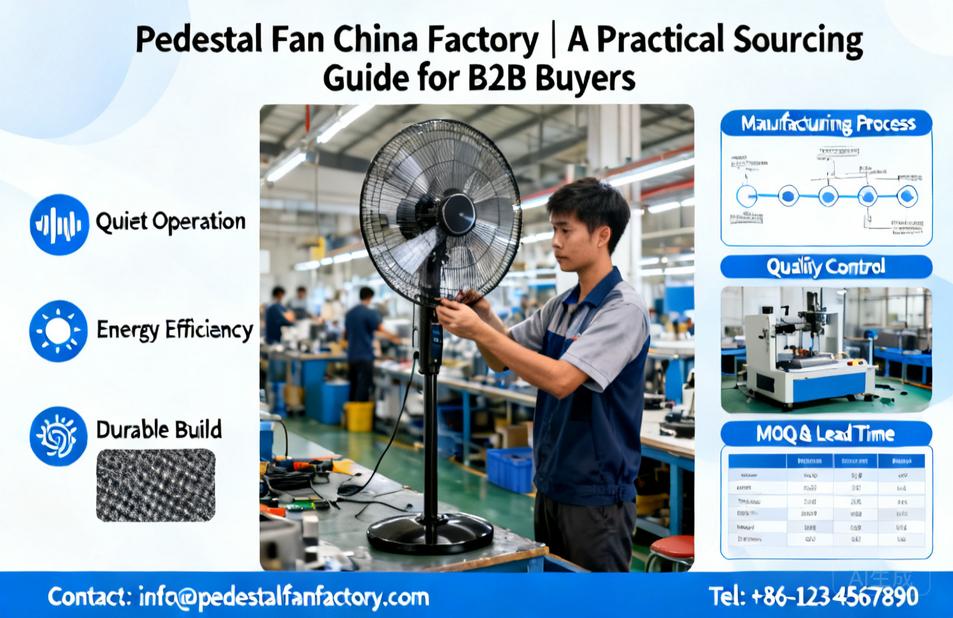
A pedestal fan from a China factory is a freestanding air circulation unit with a height-adjustable stand, a tilting head, and a guarded blade assembly, commonly used in warehouses, workshops, assembly lines, retail floors, and semi-open commercial spaces. For overseas buyers, sourcing from a China-based manufacturer is not only about unit cost; it is about matching airflow performance, motor durability, safety design, and packaging to the actual operating environment. This guide explains how these fans are built, where they are used, and what to check before placing an order with a supplier or OEM partner.
Product Overview: What Buyers Usually Mean by a Pedestal Fan
In B2B sourcing, the term covers several configurations. A standard pedestal fan uses a round base, a telescopic or fixed pole, and a motor head with a wire guard. Industrial versions may use larger blade diameters, heavier bases, and higher-power motors for continuous duty. Some models are oscillating, some are fixed-direction, and some are designed for wall or floor mounting with a pedestal option. Buyers often search for industrial pedestal fan, stand fan, floor standing fan, and heavy duty pedestal fan when comparing specifications. The core function is the same: move a large volume of air across a workspace at low noise and with stable operation over long hours.
How a Pedestal Fan Works and What Matters in Daily Use
A pedestal fan pulls air through the rear guard, accelerates it across the blades, and directs it forward through the front guard. The motor drives the blade assembly, while the oscillation mechanism, if fitted, sweeps the head across a set angle. For industrial application, the important variables are airflow delivery, motor temperature rise, bearing type, and balance of the blade assembly. A well-balanced blade and a rigid pole reduce vibration, which in turn protects the motor and extends service life. Buyers should ask for airflow curves, noise levels, and duty cycle information rather than relying on a single wattage figure.
Materials and Construction
Common builds use metal or engineering plastic for the guard, blades, and motor housing, with a powder-coated or painted finish for corrosion resistance. Base plates are often cast iron or weighted steel for stability, especially on taller models. Some suppliers offer stainless steel components for humid or washdown-adjacent environments. Because material choices affect weight, freight cost, and service life, buyers should confirm the actual construction rather than assume that all pedestal fans share the same build quality. A China factory with in-house metal stamping, motor assembly, and injection molding can usually control consistency better than a trading-only supplier.
Typical Industrial Applications
- Warehouse and logistics centers needing general air movement across aisles.
- Manufacturing and assembly workshops where heat and fumes accumulate.
- Commercial spaces such as showrooms, gyms, and covered outdoor areas.
- Agricultural and food processing facilities where portable air circulation is required.
- Event, rental, and temporary site use where quick setup and mobility matter.
In these environments, the fan is often part of a broader ventilation plan. It may support existing exhaust systems, complement HVLS fans, or provide localized cooling for operators. Buyers should define whether the goal is comfort cooling, air mixing, or drying, because each goal leads to different airflow and placement requirements.
How to Choose the Right Pedestal Fan for Your Project
Start with the space. Measure the area, ceiling height, and distance the air must travel. For open warehouses, larger blade diameters and higher airflow are usually more effective than small high-speed units. Next, confirm the power supply available on site, including voltage, frequency, and plug type. Then review the duty cycle: a fan used eight hours a day in a workshop has different requirements from one used occasionally in a retail store. Consider noise limits if the fan operates near workstations or customer areas. Finally, check the base footprint and mobility, especially if the fan must be moved between zones. A supplier that asks these questions before quoting is usually better prepared to recommend a suitable model.
Customization and OEM Options
Many China factories offer OEM and custom programs for pedestal fans. Typical customization includes voltage and frequency, plug type, power cord length, blade color, guard finish, logo printing, and packaging design. Some buyers request specific airflow targets, oscillation angles, or control methods such as remote operation or variable speed. When discussing a custom project, provide clear drawings, target performance, and destination market requirements. Avoid assuming that a custom feature is standard; confirm tooling, minimum order quantity, and sample lead time in writing. A factory with existing tooling can often adapt a platform model more efficiently than starting from scratch.
Buying Considerations for Importers
Price should be evaluated together with motor quality, guard rigidity, base stability, and packaging strength. For container shipments, carton dimensions and loading quantity affect total landed cost. Ask for a packing list and loading plan before confirming the order. For markets with strict electrical safety rules, confirm that the product is designed to meet the applicable standards and request the relevant documentation. Do not rely on verbal claims. Instead, review spec sheets, sample test reports, and pre-shipment inspection options. If the order is seasonal, plan production and shipping windows early, since fan demand often peaks before summer in many regions.
How to Select a Reliable Supplier or Factory
Begin with a short list of manufacturers that already produce pedestal fans and related air movement products. Review their factory profile, production equipment, and quality control process. Ask how they handle motor testing, blade balancing, and final inspection. A supplier that can explain these steps clearly is more likely to deliver consistent quality. Request samples for evaluation, and compare airflow, noise, vibration, and finish across two or three suppliers. Check communication responsiveness and willingness to support OEM or custom requests. Visit the factory or use a third-party inspection service for larger orders. Long-term partnerships are usually built with factories that understand your market requirements and can repeat production reliably.
Frequently Asked Questions
What is the difference between a pedestal fan and an industrial stand fan?
The terms overlap. A pedestal fan generally refers to a freestanding fan with an adjustable pole. An industrial stand fan usually emphasizes heavier construction, higher airflow, and continuous-duty motor design for workshop or warehouse use. Buyers should confirm the actual specifications rather than rely on the name.
Can a China factory produce pedestal fans with custom voltage and plug types?
Yes, many manufacturers offer OEM and custom options for voltage, frequency, plug type, and cord length. Provide the destination country and electrical requirements so the factory can match the correct configuration and documentation.
How do I evaluate airflow and motor quality before ordering?
Ask for airflow data, motor specifications, and duty cycle information. Request a sample and test it under conditions similar to your application. Check vibration, noise, and temperature rise during extended operation, and compare results across suppliers.
What should I include in a pedestal fan inquiry?
Include the application, required airflow or coverage area, power supply, duty cycle, noise limits, base and height requirements, target quantity, packaging needs, and any OEM or custom requirements. Clear input helps the supplier recommend a suitable model and quote accurately.
Conclusion
Choosing a pedestal fan China factory is a matter of matching product design to the real operating environment, then verifying the manufacturer behind the offer. Focus on airflow, motor durability, construction stability, electrical configuration, and packaging, and treat OEM or custom requests as a separate technical discussion. For buyers who want to compare models, discuss industrial applications, or explore custom production, contacting a manufacturer directly with detailed requirements is the most practical next step.