
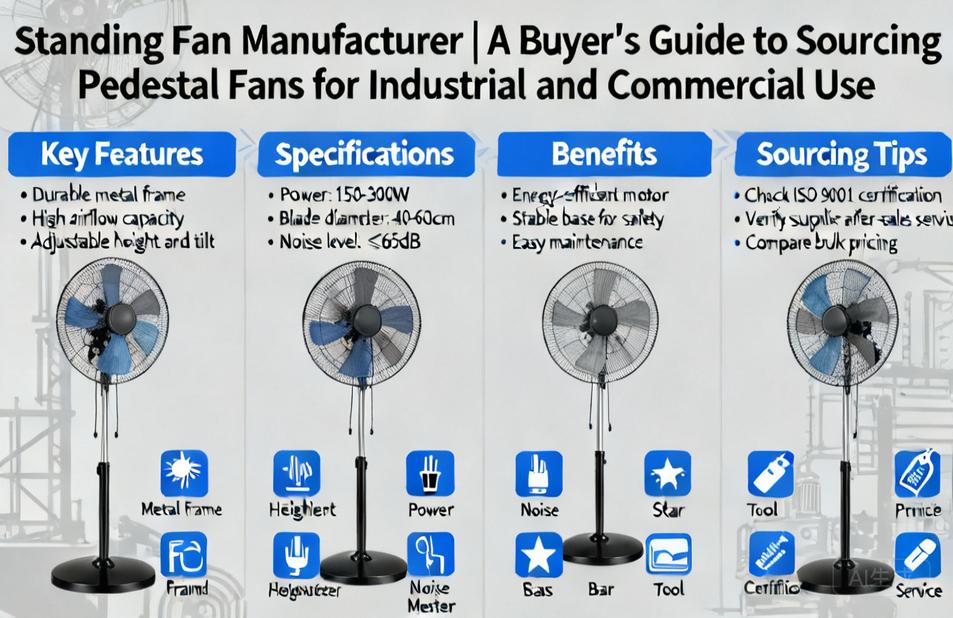
A standing fan, also known as a pedestal fan, is a freestanding air circulation device with an adjustable height stand, designed to deliver airflow across open spaces without wall or ceiling mounting. When sourcing from a standing fan manufacturer, buyers are typically looking for reliable airflow performance, stable construction, and the flexibility to adapt voltage, plug type, and control features for different markets. These fans are widely used in workshops, warehouses, retail floors, offices, agricultural facilities, and temporary work areas where permanent HVAC installation is impractical or too costly.
Product Overview and How Standing Fans Work
A pedestal fan consists of a motor-driven blade assembly mounted on a telescopic or fixed stand, with a base that provides stability. The motor rotates the blades to move air, while an oscillation mechanism can sweep the airflow across a wider area. Most models include multiple speed settings and adjustable tilt, allowing the user to direct airflow upward, downward, or horizontally. Unlike ceiling fans, standing fans can be repositioned as floor layouts change, which makes them a practical choice for dynamic work environments.
For B2B buyers, the key distinction is between consumer-grade pedestal fans and commercial or industrial standing fans. Commercial models generally use more robust motors, heavier bases, and durable guards to withstand continuous operation in factories, warehouses, and public spaces. Industrial standing fans may also feature larger blade diameters, higher airflow capacity, and metal construction for demanding environments.
Key Features Buyers Should Evaluate
When comparing standing fan suppliers, the following features typically influence performance, safety, and total cost of ownership:
- Motor type and duty cycle: Motors designed for continuous duty are preferable for commercial and industrial applications. Buyers should ask about insulation class and bearing type without assuming specific ratings.
- Blade design and material: Blade shape affects airflow pattern and noise. Metal blades are common in industrial models, while reinforced plastic blades are used in lighter commercial units.
- Oscillation and tilt range: A wide oscillation angle helps cover more area, while adjustable tilt supports targeted airflow.
- Speed control: Mechanical rotary switches, push-button controls, and remote or electronic controls are available depending on the target market and price positioning.
- Base stability: A weighted or wide base reduces tipping risk in high-traffic areas. Base design also affects assembly and shipping volume.
- Guard and safety features: Fine-mesh guards, thermal protection, and secure cable management are important for workplace safety.
Materials and Construction Considerations
Standing fans are commonly built with metal, engineering plastics, or a combination of both. Metal stands and guards offer rigidity and resistance to impact, which suits industrial environments. Powder coating can improve surface durability and appearance. Plastic components can reduce weight and cost but may not be suitable for harsh conditions. Buyers should confirm material specifications with the manufacturer rather than relying on general marketing descriptions.
Assembly method also matters. Some pedestal fans are designed for tool-free assembly, while others use screws and locking mechanisms. For OEM projects, the assembly process affects packaging size, labor requirements, and end-user experience.
Typical Applications Across Industries
Standing fans serve a broad range of industrial and commercial applications. In manufacturing plants, they support worker comfort and air movement in areas without ducted cooling. In warehouses and logistics centers, pedestal fans help circulate air in large open spaces. Retail stores, gyms, restaurants, and event venues use standing fans for supplemental cooling and air circulation. Agricultural operations may use them in greenhouses, livestock areas, or storage buildings, provided the fan is suitable for the environment. Construction sites and temporary work zones also rely on portable standing fans where fixed ventilation is unavailable.
Because applications vary, a standing fan manufacturer should be able to discuss airflow requirements, ambient conditions, and usage patterns before recommending a model.
How to Choose the Right Standing Fan for Your Market
Selecting a standing fan for distribution or OEM projects involves more than comparing price. Buyers should define the target application, expected runtime, voltage and frequency requirements, and plug standards for each market. Airflow capacity, noise level, and power consumption should be matched to the end user’s needs. For commercial buyers, ease of maintenance and availability of replacement parts can reduce long-term service costs. For consumer-focused product lines, design, color options, and control features may carry more weight.
It is also useful to consider packaging and logistics. Standing fans are relatively bulky, so carton design, knock-down construction, and container loading efficiency can significantly affect landed cost.
Customization and OEM Options
Many standing fan manufacturers offer OEM and custom production services. Typical customization areas include voltage and frequency, plug type, power cord length, motor specifications, blade size, guard design, base style, color, logo, and packaging. Some suppliers also support custom control panels, remote controls, and user manuals in different languages.
When discussing customization, buyers should request clear drawings, samples, or pre-production units before mass production. It is important to confirm which components are standardized and which are modified, as this affects lead time, minimum order quantity, and after-sales support.
Supplier Selection and Buying Considerations
Choosing a reliable standing fan supplier requires evaluating production capability, quality control, and communication. A factory with in-house motor production, blade molding, and assembly may offer better consistency and cost control. Buyers should ask about incoming material inspection, in-line testing, and final quality checks without assuming specific certifications. If the product is intended for a regulated market, confirm which compliance requirements apply and whether the supplier can support the necessary documentation.
Other practical factors include sample lead time, production capacity, willingness to support small trial orders, and responsiveness to technical questions. A supplier that asks about application details and offers engineering feedback is often better positioned to support long-term cooperation than one that only quotes a price.
Frequently Asked Questions
What should I look for in a standing fan manufacturer?
Focus on motor quality, construction durability, quality control processes, customization capability, and communication. Ask for technical details rather than general claims, and request samples or pre-production units for evaluation.
Can standing fans be customized for different voltages and plugs?
Yes. Many manufacturers offer OEM and custom options for voltage, frequency, plug type, cord length, and control configuration. Confirm the exact specifications and applicable market requirements before ordering.
Are standing fans suitable for industrial environments?
Commercial and industrial pedestal fans are available for workshops, warehouses, and similar spaces. Suitability depends on airflow requirements, ambient conditions, duty cycle, and construction. Buyers should match the fan specification to the actual application.
How do I evaluate airflow and noise performance?
Request performance data and, where possible, test a sample under conditions similar to the intended use. Airflow and noise are influenced by blade design, motor speed, guard design, and operating environment.
Conclusion
Sourcing standing fans for commercial, industrial, or consumer markets starts with a clear understanding of the application, market requirements, and expected usage. A capable standing fan manufacturer can support product selection, OEM customization, and consistent production. Buyers who evaluate motor quality, construction, customization options, and supplier communication are better prepared to build a reliable product line. If you are reviewing specifications, applications, or custom requirements, contact the supplier with your target market details and let their engineering team recommend a suitable standing fan solution.