
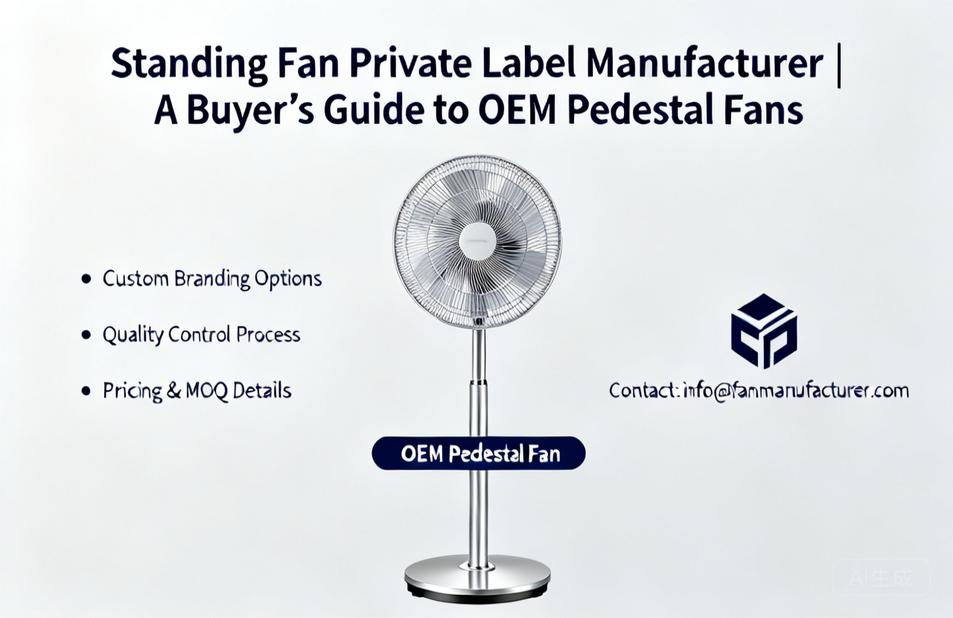
A standing fan private label manufacturer helps importers, distributors, and retail brands bring pedestal fans to market under their own brand without owning a factory. The product itself is a freestanding electric fan mounted on a height-adjustable pedestal, typically used for air circulation and personal cooling in homes, offices, workshops, retail spaces, and light industrial areas. For buyers sourcing private label standing fans, the main challenge is not finding a fan but finding a manufacturing partner that can match the right motor, blade design, control type, and packaging to your market and price position.
Product Overview: What Private Label Standing Fans Include
Standing fans sold under private label usually share a common mechanical structure: a base, a telescopic pole, a motor housing, a guard, blades, and a control panel. The variations that matter to buyers are in the details. Blade diameter, motor type, oscillation angle, speed settings, height range, and control method all affect performance and perceived quality. A private label program typically begins with an existing platform that the factory already produces, then applies your brand, color scheme, packaging, and selected feature changes. This makes private label a practical route for buyers who want differentiation without the cost and risk of a fully new tooling project.
Key Features Buyers Usually Specify
Most private label standing fan programs are built around a few core decisions. Motor choice is one of the most important, because it influences airflow, noise, energy use, and service life. AC motors remain common for cost-sensitive lines, while DC and brushless motor options are often selected for quieter operation and variable speed control. Oscillation is another specification: a wide oscillation angle spreads air across a room, while a narrower angle directs airflow to a specific area. Control type ranges from simple rotary switches to remote control and timer functions. Height adjustment, base weight, and guard design also affect stability and user experience. Buyers should confirm which of these features are standard on the factory platform and which require modification.
Materials and Construction
Material choices have a direct effect on durability, weight, and market positioning. Fan blades are commonly produced in plastic or metal, and the guard may be metal wire or a molded design. The pedestal pole and base can be steel, aluminum, or engineered plastic, depending on the target price and use case. For commercial and light industrial applications, buyers often prioritize a stable base, reinforced pole joints, and a motor housing that can handle longer running hours. Surface finish and color matching are also part of private label work, since these details carry brand identity. Rather than assuming a material is suitable, request samples and confirm the construction details against your intended use and sales channel.
Applications and Market Fit
Standing fans are versatile products, and the right specification depends on where they will be used. In residential retail, appearance, noise level, and remote control features often drive purchase decisions. In offices and commercial spaces, stable airflow and adjustable height matter more. Workshops, warehouses, and light industrial environments require attention to motor duty cycle, base stability, and protection against dust and everyday wear. Event spaces and temporary installations may benefit from easy assembly and transport-friendly packaging. A private label supplier with experience across several of these applications can help you choose a platform that fits your market instead of forcing one model into every channel.
How to Choose a Standing Fan Private Label Manufacturer
Supplier selection should go beyond a catalog and a price list. Start by confirming the factory’s experience with private label and OEM projects, including whether they handle branding, packaging design, and product labeling as part of the service. Ask how they control motor quality, blade balance, and final assembly checks. Review their approach to sample approval and change management, because small specification changes can affect performance and compliance. It is also useful to understand their production capacity and whether they can support repeat orders with consistent specifications. A manufacturer that communicates clearly during sampling is often easier to work with during mass production.
Customization Options to Discuss
Private label customization can range from simple branding to structural changes. Common options include custom colors, logo printing, branded packaging and manuals, selected control panel layouts, and optional accessories such as remote controls or timers. Some factories can also adjust blade design, oscillation range, or pole height within an existing platform. Buyers should separate cosmetic customization from performance-related changes, because the latter usually requires more engineering review and sample validation. Clarify which changes are available at low minimum order quantities and which require new tooling or longer development time.
Buying Considerations Before Ordering
Before placing an order, confirm the exact product configuration in writing, including motor type, blade size, control method, voltage and plug type, packaging style, and labeling requirements. Ask for pre-production samples and check airflow, noise, oscillation, and stability in your own environment. Review the factory’s quality control process for incoming components and finished goods. Consider spare parts availability and after-sales support, especially if you plan to sell through retail or e-commerce channels. Finally, make sure the commercial terms, documentation, and packaging requirements match your destination market.
Frequently Asked Questions
Can a private label manufacturer produce standing fans with my brand and packaging?
Yes, most private label standing fan suppliers offer logo application, custom colors, branded packaging, and market-specific manuals. Confirm the minimum order quantity and artwork approval process before production.
What is the difference between OEM and private label for standing fans?
Private label usually applies your brand to an existing fan platform, while OEM often involves more product-specific development, tooling, or structural changes. Both can be discussed with the same factory, but they require different levels of engineering involvement.
How do I verify standing fan quality before mass production?
Request pre-production samples, check motor performance, blade balance, oscillation, noise, and base stability, and review the factory’s inspection process. Keep approved samples as the reference for bulk production.
Can standing fans be customized for commercial or industrial use?
Some platforms can be adapted with stronger motor options, more stable bases, or different control configurations. Discuss the intended application with the manufacturer so the specification matches the actual working environment.
Conclusion
Choosing a standing fan private label manufacturer is mainly about matching product specification to market demand and working with a supplier that can repeat that specification consistently. Focus on motor and control choices, construction quality, customization scope, and the factory’s private label experience. If you have a target application, preferred feature set, or OEM customization requirement, share the details with a qualified supplier and ask for a specification review before sampling.