
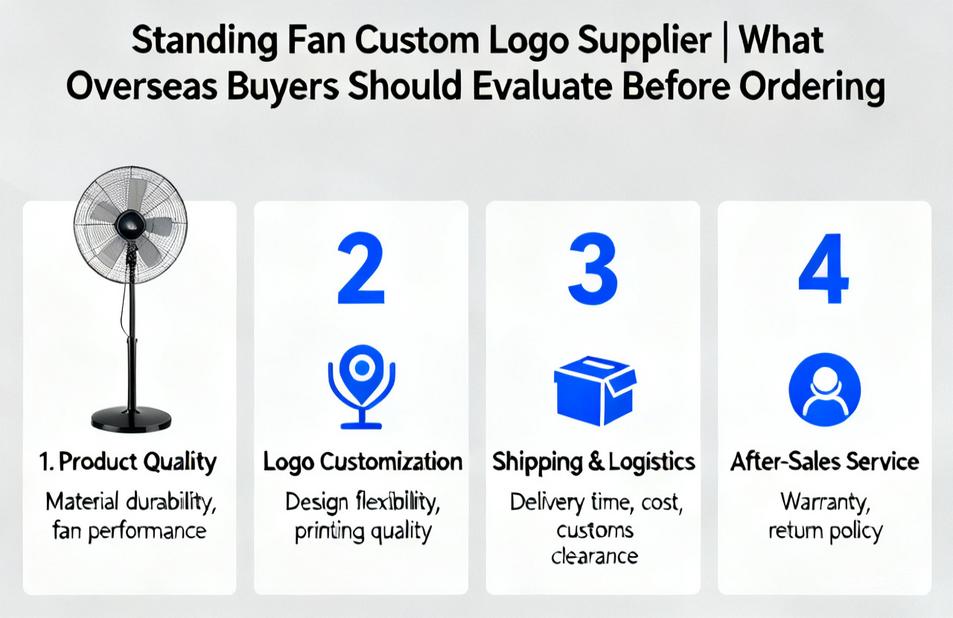
A standing fan custom logo supplier is a manufacturer or trading partner that produces pedestal-style fans and applies a buyer’s branding to the product, packaging, or both. These fans are typically used in warehouses, workshops, retail spaces, offices, gyms, agricultural buildings, and event venues where air movement and brand visibility matter at the same time. For importers, distributors, promotional product companies, and private-label brands, sourcing from a supplier that understands both fan construction and logo customization is essential to delivering a product that performs reliably and represents the brand well.
Product Overview: What a Branded Standing Fan Includes
A standing fan, also called a pedestal fan or floor fan, consists of a motor housing, fan blades, a safety guard, a height-adjustable stand, and a base. Most models offer oscillation, multiple speed settings, and adjustable tilt. When buyers request custom logos, the branding can appear on the motor housing, the front guard badge, the base, the control panel, the remote control, the carton, and the user manual. The exact placement depends on the fan design, the logo format, and the production method the factory uses.
Because standing fans are available in household, commercial, and industrial grades, buyers should first define the intended market. A promotional fan for retail giveaways has different requirements from a heavy-duty floor fan used in a factory. Clarifying the application early helps the supplier recommend the right motor, blade material, guard design, and stand construction.
Key Features Buyers Usually Compare
When evaluating standing fan options, purchasing teams commonly compare airflow performance, motor type, blade design, oscillation range, speed control, noise level, and build quality. Commercial and industrial buyers often prioritize continuous-duty motors, metal guards, and stable bases, while consumer-focused buyers may focus on appearance, remote control, timer functions, and lightweight construction.
- Motor type and duty rating for the intended usage pattern
- Blade material and diameter, which affect airflow and durability
- Guard design and spacing for safety and cleaning access
- Stand height adjustment and base stability
- Control method: mechanical knobs, push buttons, or remote control
- Packaging style for retail, e-commerce, or bulk distribution
Buyers should request samples or detailed specifications rather than relying on photos alone. A supplier that can explain motor construction and assembly details is usually easier to work with during customization.
Materials and Construction Considerations
Standing fans typically use combinations of metal, engineering plastics, and rubber components. The motor housing may be metal or plastic, the guard is often steel wire, and the base may be weighted plastic or metal. For industrial applications, powder-coated metal parts and reinforced guards are common because they resist wear and are easier to clean in dusty environments.
Material choices affect weight, shipping cost, perceived quality, and service life. Buyers sourcing for outdoor or semi-outdoor use should discuss moisture exposure and surface treatment with the supplier. It is also worth confirming which parts are user-serviceable, since replacement blades, guards, and switches can support after-sales service in the target market.
Typical Industrial and Commercial Applications
Standing fans are used across many environments where portable air circulation is needed. Common applications include warehouse aisles, production floors, assembly lines, workshops, garages, greenhouses, livestock buildings, gyms, restaurants, and temporary event spaces. In retail and hospitality settings, branded standing fans can double as promotional displays.
For industrial applications, buyers should match fan size and airflow to the space rather than choosing purely on price. A large open workshop may need multiple high-airflow units, while a small office may only require quiet oscillating fans. The supplier should be able to discuss airflow direction, placement height, and how oscillation affects coverage.
Customization Options for Private Label Buyers
Logo customization is more than printing a name on a product. Buyers can often choose logo method, placement, color matching, packaging design, and accessory branding. Common options include silk-screen printing, pad printing, laser marking on metal parts, embossed badges, and printed cartons. Some suppliers also support custom color schemes, remote control branding, and multilingual manuals.
Before confirming an OEM or custom order, buyers should provide vector logo files, define acceptable color tolerances, and approve a pre-production sample. It is also important to confirm whether the logo will be applied to the fan itself, the packaging, or both, since this affects tooling, minimum order quantities, and inspection criteria.
How to Choose a Reliable Standing Fan Supplier
Selecting a supplier requires more than comparing quotations. A capable manufacturer should be able to explain its production process, quality control points, and experience with export packaging. Buyers should ask for factory information, product specifications, available customization methods, and sample lead times. Where possible, request references from buyers in similar markets or product categories.
Communication quality is a useful indicator. A supplier that asks about the target market, voltage requirements, plug type, packaging format, and branding placement is more likely to deliver a suitable product. Buyers should also clarify warranty terms, spare parts availability, and documentation support before placing bulk orders.
Buying Considerations Before Placing an Order
Several practical factors influence the final purchasing decision. Voltage and plug standards must match the destination market. Packaging must protect the fan during sea freight and meet retail or e-commerce requirements. Order quantities should align with the supplier’s customization capabilities. Inspection criteria should be agreed in writing, covering appearance, function, logo quality, and packaging.
It is also wise to plan for spare parts and after-sales support. Standing fans contain motors, switches, and blades that may require replacement over time. A supplier that can provide compatible components helps distributors maintain customer satisfaction.
Frequently Asked Questions
Can a standing fan supplier apply our logo to both the product and the packaging?
Many suppliers offer logo customization on the fan body, carton, manual, and accessories. The available options depend on the fan design and production method. Buyers should confirm placement, artwork format, and sample approval steps before production.
What information should we provide when requesting an OEM order?
Prepare your target market, voltage and plug requirements, preferred fan size, airflow expectations, branding artwork, packaging style, and estimated order quantity. This helps the supplier recommend a suitable model and customization plan.
How do we evaluate fan quality without testing every unit?
Agree on inspection criteria with the supplier and request samples for evaluation. Review motor construction, guard strength, stand stability, switch function, and packaging protection. A documented quality control process supports consistent results across bulk orders.
Are standing fans suitable for industrial environments?
Yes, provided the model is selected for the application. Industrial buyers should discuss duty cycle, airflow, guard design, and cleaning requirements with the supplier to choose a fan that matches the working environment.
Conclusion
Working with a standing fan custom logo supplier involves matching product performance with branding requirements, packaging needs, and target-market expectations. Buyers should define the application first, compare motor and construction details, confirm customization methods, and evaluate the supplier’s communication and quality control process. If you are planning a private-label or OEM standing fan project, contact the supplier with your specifications, logo artwork, and application details to discuss suitable options.