
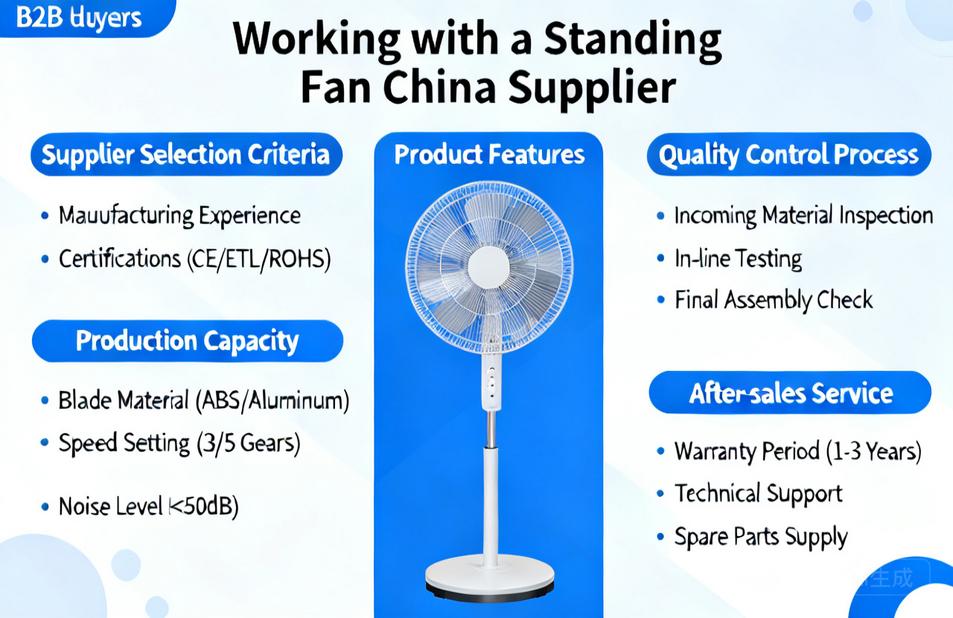
A standing fan is a free-standing air circulation appliance that moves air across a room or work area without permanent installation, and it is widely used in warehouses, workshops, retail spaces, offices, and light industrial environments. For importers and distributors, working with a standing fan China supplier can provide access to broad product ranges, OEM and custom options, and the volume flexibility that professional buyers need. This guide explains how standing fans work, what to evaluate before sourcing, which applications they suit, and how to compare suppliers in a practical way.
Product Overview and How Standing Fans Work
Standing fans, also called pedestal fans or floor fans, combine a fan head mounted on a height-adjustable pole with a weighted base. An electric motor drives the blades to create airflow, while a grille protects users from the rotating blades. Most models offer multiple speed settings, and many include oscillation so the airflow sweeps across a wider area. Controls may be mechanical or electronic, and some versions add remote control, timers, or adjustable tilt and head angles.
Because the unit stands on the floor rather than being fixed to a wall, it can be repositioned as needs change. This flexibility is one reason standing fans are common in buildings where ventilation requirements vary by season or by work zone. Suppliers typically offer blade diameters, voltage options, and plug types suited to different export markets, but buyers should confirm every specification directly rather than assuming a standard configuration.
Key Features B2B Buyers Usually Compare
Purchasing teams tend to compare standing fans on a practical set of features rather than marketing claims. The most relevant points include:
- Motor type and speed settings, which influence airflow control and expected duty level.
- Oscillation range and tilt adjustment, which determine how flexibly airflow can be directed.
- Height adjustment range, so the fan can serve seated or standing users.
- Control method: mechanical switches, push buttons, or electronic controls with optional remote.
- Base design and stability, particularly for high-traffic commercial floors.
- Voltage and frequency options that match the destination market.
For industrial or commercial accounts, buyers also look at how easily the fan can be cleaned and maintained, whether the grille can be removed for blade cleaning, and whether replacement parts are available over the product life cycle.
Materials and Construction
Standing fans are commonly built with metal or plastic components, and the mix affects weight, durability, and appearance. Fan blades may be metal or molded plastic; grilles are often metal wire with a protective coating. The pole may be steel with a powder-coated finish, while bases can be metal, plastic, or a combination. Motor housings need to balance heat dissipation with protection against dust and moisture in the intended environment.
Buyers should ask suppliers for material descriptions and finishing details that match the target market requirements. Rather than relying on generic statements, it is better to confirm the specific construction of the model under consideration, including any parts that are user-serviceable.
Where Standing Fans Are Used
Applications for standing fans extend well beyond home use. In commercial and industrial settings, they are often deployed for spot cooling and air movement in areas where permanent ventilation or air conditioning is limited. Common applications include:
- Warehouses and storage areas where airflow helps reduce heat build-up.
- Workshops and assembly areas where portable airflow can be directed to workstations.
- Retail floors and showrooms that require adjustable comfort for staff and visitors.
- Offices and commercial interiors as supplemental air circulation.
- Temporary or seasonal setups, including events and shared workspaces.
When matching a fan to an application, buyers should consider the size of the space, ceiling height, ambient temperature, and whether the environment contains dust or moisture. In dusty or humid areas, construction and protection details become more important than airflow figures alone.
How to Choose the Right Standing Fan for Your Market
Product selection should start with the end user and the sales channel. A distributor selling to retail customers may prioritise design, ease of assembly, and packaging, while a buyer sourcing for industrial end users may focus on motor durability, stability, and serviceability. Useful selection questions include:
- What airflow and coverage does the intended space require?
- Which voltage, frequency, and plug standard applies in the destination market?
- Is manual control sufficient, or is remote or timer operation expected?
- Does the environment require a heavier base, protective grille, or specific finish?
- What packaging and assembly approach fits the sales channel?
Requesting samples or detailed specification sheets for shortlisted models is a practical way to validate these points before committing to a larger order.
OEM and Custom Options from a China Factory
Many standing fan factories in China support OEM and custom programs for importers and brand owners. Typical customization areas include brand labeling, colour and finish choices, control panel configuration, packaging design, and model configuration to suit a target market. The exact scope depends on the factory and order volume, so buyers should discuss requirements early and confirm which changes are feasible.
A clear customization brief helps avoid misunderstandings. It should cover product specifications, label and packaging requirements, target market standards, and expected inspection points. Buyers should also ask how custom changes affect tooling, sampling, and production planning, without assuming timelines or costs until the supplier confirms them in writing.
Buying Considerations and Supplier Selection
Choosing a standing fan supplier involves more than comparing quotations. Reliable suppliers can explain their production scope, quality control process, and experience with export markets. During evaluation, buyers may ask about factory capabilities, inspection procedures, component sourcing, and after-sales support. It is also reasonable to request documentation relevant to the destination market and to verify claims independently.
Communication quality is a useful signal. A supplier that responds with specific answers, shares realistic product information, and clarifies open points is generally easier to work with than one that offers vague assurances. For buyers sourcing multiple models, confirming whether the supplier can support consistent specifications across repeat orders is equally important. When comparing a China supplier with other options, consider total landed cost, product consistency, and the supplier’s ability to support your brand and market requirements over time.
Frequently Asked Questions
What should I confirm before ordering standing fans from a China supplier?
Confirm the model specifications, voltage and plug configuration, control type, packaging requirements, inspection arrangements, and the documentation needed for your destination market. Ask for written confirmation of these details before placing an order.
Can standing fans be customized with our brand and packaging?
Many factories offer OEM and custom options such as brand labeling, colour selection, and packaging design. The available scope varies by supplier and order volume, so discuss your requirements directly and confirm feasibility in writing.
How do I match a standing fan to an industrial or commercial application?
Start with the space size, airflow needs, ambient conditions, and how often the fan will be moved. Then compare construction, base stability, control options, and serviceability. For dusty or humid areas, discuss protection requirements with the supplier.
How can I evaluate whether a supplier is reliable?
Review the supplier’s product range, ask detailed questions about production and quality control, request relevant documentation, and compare how clearly they communicate. Samples and pre-shipment inspection can also help reduce sourcing risk.
Conclusion
Sourcing standing fans from China works best when buyers define the application, market requirements, and customization needs before comparing suppliers. Focus on construction, controls, voltage options, packaging, and the supplier’s ability to answer technical questions clearly. If you are planning a standing fan program for your market, contact suppliers with your specifications, application details, and OEM or custom requirements so they can advise on suitable models and next steps.