
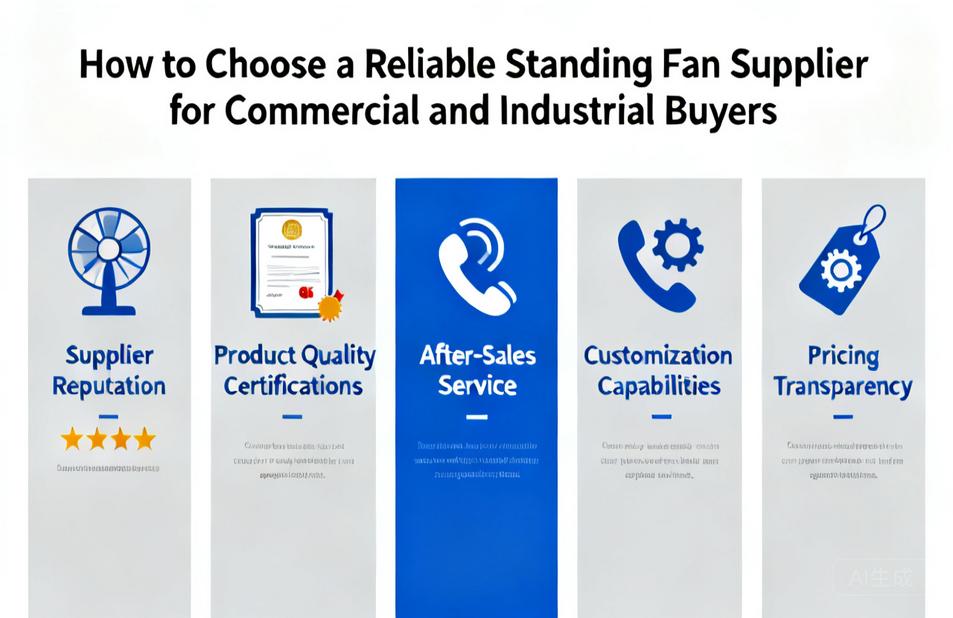
Selecting the right standing fan supplier is a critical decision for importers, distributors, facility managers, and OEM brands looking to source pedestal fans for residential, commercial, or industrial use. A standing fan, also known as a pedestal fan or floor fan, is a freestanding air circulation device with an adjustable height stand, a motor-driven blade assembly, and optional oscillation. It is widely used in homes, offices, workshops, warehouses, retail spaces, and light industrial environments where portable and directional airflow is required. For B2B buyers, the supplier behind the product matters as much as the fan itself, because it affects product consistency, customization potential, documentation, and long-term supply stability.
Product Overview: What Buyers Usually Source
When sourcing from a standing fan supplier, buyers typically deal with several configurations. Common variants include oscillating and non-oscillating models, remote-controlled units, timer-equipped fans, and high-velocity floor fans for larger spaces. Blade diameters, motor types, speed settings, and control methods vary by market and application. Some buyers focus on consumer retail packaging, while others require bulk units for industrial or commercial channels. Understanding the exact configuration before contacting a supplier helps reduce back-and-forth and ensures quotations are comparable.
Typical Components
- Motor assembly with thermal protection where applicable
- Fan blades in metal or engineering plastic
- Adjustable stand and base for stability
- Control panel or remote receiver
- Grill, guard, and mounting hardware
Key Features That Matter to Procurement Teams
Different markets prioritize different features. In many commercial settings, airflow performance and durability are more important than decorative design. In retail channels, appearance, noise level, and packaging often drive purchasing decisions. A capable standing fan supplier should be able to explain which features are suitable for which use case rather than offering a single generic model.
Airflow and Motor Performance
Airflow is usually expressed in cubic meters per hour or cubic feet per minute, depending on the market. Buyers should ask how the motor performs under continuous operation and whether the fan is designed for intermittent or extended use. Motor construction, bearing type, and copper winding quality are common points of discussion during supplier evaluation.
Noise and Speed Control
Noise level is a practical concern in offices, hospitals, and residential applications. Multiple speed settings and a quiet mode can be important selling points. For industrial environments, higher speed and robust airflow may take priority over low noise.
Oscillation and Adjustability
Oscillation range, tilt angle, and height adjustment affect coverage and user convenience. Buyers should confirm whether these functions are mechanical or electronic and how they are controlled.
Materials and Construction
Materials directly influence product life and market positioning. Metal blades and grills are common in industrial or heavy-duty standing fans, while plastic components are typical in consumer models. The stand and base must provide stability, especially for taller units. Buyers should ask suppliers about the grade of materials used, surface treatment, and corrosion resistance where relevant. For markets with specific safety or electrical requirements, the supplier should be able to discuss compliance options without making unverified claims.
Applications and Industrial Use Cases
Standing fans serve a broad range of applications. In residential settings, they provide supplemental cooling in living rooms and bedrooms. In commercial spaces, they support air movement in offices, restaurants, and shops. Industrial applications include workshops, warehouses, and production areas where portable airflow helps with heat management and air circulation. Some buyers also source pedestal fans for event venues, gyms, and agricultural facilities. Matching the fan type to the application prevents over-specification and reduces return rates.
How to Choose a Standing Fan Supplier
Supplier selection should go beyond price per unit. A reliable manufacturer or supplier should demonstrate stable production capacity, clear communication, and the ability to handle OEM or custom requirements. Buyers can start by requesting a product catalog, confirming available models, and asking about lead times for samples and bulk orders. It is also useful to review how the supplier handles quality control, packaging, and documentation.
Questions to Ask Before Ordering
- Can you provide samples for evaluation?
- What are the available voltage and plug standards for our market?
- Do you offer OEM branding and custom packaging?
- How is quality controlled during production?
- What is the minimum order quantity for custom models?
Customization Options for OEM and Private Label Buyers
Many standing fan suppliers offer OEM and custom services, including brand labeling, color matching, packaging design, and control panel customization. Some can also adjust motor specifications, blade design, and stand height for specific markets. Buyers should clarify which parts are customizable and which are standard. Custom tooling or new mold development may involve additional cost and time, so early communication is important. A supplier with experience in export markets can often advise on practical customization that balances cost and market appeal.
Buying Considerations and Supplier Evaluation
When comparing suppliers, buyers should evaluate consistency across batches, response time, and willingness to provide technical details. A factory that understands standing fan design can help resolve issues related to airflow, noise, and durability. It is also wise to discuss spare parts availability, warranty terms, and after-sales support. For long-term partnerships, suppliers that invest in product improvement and maintain transparent communication tend to be more dependable than those competing only on low price.
Frequently Asked Questions
What should I look for in a standing fan supplier?
Look for a supplier that can clearly describe motor type, airflow performance, materials, and available configurations. A good supplier will also answer technical questions, offer samples, and explain OEM or custom options without making vague claims.
Can standing fan suppliers provide OEM and custom branding?
Many suppliers offer OEM services such as logo printing, custom colors, packaging design, and user manual localization. The scope of customization varies, so buyers should confirm details and minimum order quantities before committing.
How do I match a standing fan to my market?
Consider voltage, plug type, noise expectations, airflow requirements, and typical usage conditions. Consumer markets may prioritize appearance and quiet operation, while industrial buyers often focus on durability and air movement.
What information should I prepare before contacting a supplier?
Prepare your target market, required specifications, estimated quantity, packaging needs, and any customization requirements. Clear requirements help suppliers provide accurate quotations and reduce sampling time.
Conclusion
Choosing a standing fan supplier involves more than comparing unit prices. Buyers should assess product configuration, motor and airflow performance, materials, customization capability, and the supplier’s ability to support OEM projects. A supplier that communicates clearly and understands your application can help you build a product line that fits your market. If you are sourcing pedestal fans for commercial, industrial, or private label use, reaching out to a manufacturer with relevant experience can help you clarify specifications, customization options, and supply planning.