
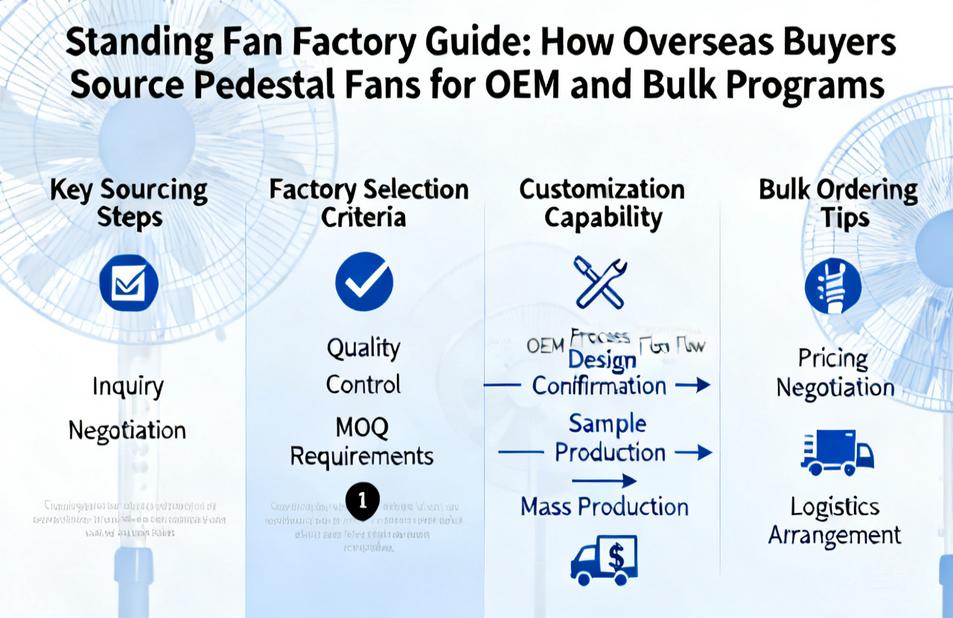
A standing fan factory produces pedestal or stand-mounted electric fans designed to move air across a room without occupying floor or desk space. These units are typically built around a round or cross base, a telescopic pole, a motor housing, a guard-mounted blade set, and an oscillation mechanism. They are widely used in homes, offices, retail spaces, workshops, warehouses, and light industrial areas where portable, height-adjustable airflow is needed. For importers, wholesalers, and brand owners, working directly with a standing fan factory can simplify product development, private label packaging, and repeat-order planning.
What a Standing Fan Factory Typically Produces
A factory focused on pedestal fans usually offers a product range that spans several sizes and control types. Common configurations include 12-inch, 16-inch, and 18-inch blade diameters, with AC motor or DC motor options depending on the target market. Many factories also produce related airflow products such as table fans, wall fans, tower fans, and industrial drum fans, which allows buyers to consolidate multiple SKUs under one supplier relationship.
Because the standing fan category is mature, the real differentiation between factories is rarely the basic concept. It is the level of tooling control, motor consistency, plastic and metal part quality, packaging engineering, and communication during sampling and mass production. A factory that understands export packaging and container loading can reduce damage rates and freight cost per unit, which matters for high-volume programs.
Key Features Buyers Look For
Motor and Airflow Performance
The motor is the core component. Buyers should ask about motor type, copper or aluminum winding, speed settings, and thermal protection. Airflow is influenced by blade design, guard shape, and motor speed rather than blade size alone, so requesting airflow test information from the factory is more useful than relying on size claims.
Oscillation and Height Adjustment
Most pedestal fans offer left-right oscillation and adjustable pole height. The quality of the oscillation gearbox and the locking mechanism on the pole often determines user satisfaction. A standing fan factory with in-house injection molding and metal stamping can control tolerances more tightly than a trading company assembling from mixed sources.
Control Options
Mechanical push-button, pull-cord, rotary knob, remote control, and touch panel are all common. Remote and timer functions are popular in retail channels, while simple mechanical controls remain preferred for workshops and industrial buyers who want fewer failure points.
Materials and Construction
Pedestal fans combine metal, plastic, and electrical components. The guard is usually welded steel wire, sometimes chrome-plated or powder-coated. Blades may be metal or plastic depending on the model and market. The base can be a weighted plastic shell, a metal cross base, or a round base with concrete or sand filling. The pole is generally steel tube with a painted or chrome finish.
For buyers, material selection should match the end use. A lightweight plastic-base fan may suit home retail, while a heavier metal base and metal blade configuration may be better for workshop or semi-industrial environments. The factory should be able to explain which materials are used in each model and why, rather than offering a single generic construction across the entire range.
Typical Applications
- Residential use: living rooms, bedrooms, and home offices where quiet operation and adjustable height are important.
- Commercial use: offices, cafes, salons, and retail floors needing portable air movement.
- Light industrial use: workshops, packaging areas, and warehouses where a robust pedestal fan can supplement ventilation.
- Hospitality and events: temporary cooling for covered outdoor areas, subject to the product’s IP rating and intended environment.
When discussing industrial application with a standing fan factory, be clear about the environment. Dust, humidity, and continuous running hours affect motor selection, guard material, and whether a standard household model is appropriate.
How to Choose a Standing Fan Supplier
Choosing a supplier is not only about unit price. A practical evaluation should cover production capability, component control, quality process, and export experience. Ask whether the factory manufactures motors, blades, guards, and bases in-house or sources them externally. In-house production usually means better consistency but may also mean higher minimum order quantities.
Review the sampling process carefully. A factory that provides detailed sample reports, including photos of internal wiring and motor labeling, is easier to work with than one that only sends a finished unit photo. Also confirm packaging standards, carton drop-test approach, and container loading plans. For OEM and custom programs, clarify who owns the tooling and how changes are documented.
Customization and OEM Options
Most standing fan factories offer some level of OEM and custom service. Typical customization includes brand logo printing, custom color matching, private label packaging, instruction manual localization, plug and voltage configuration for different markets, and model-specific features such as remote control, timer, or additional speed settings.
Deeper customization may involve new blade designs, modified guard shapes, or a different base structure. These projects usually require tooling investment and longer development time. A reliable factory will explain which changes are low-cost and which require new molds, so buyers can plan product roadmaps realistically.
Buying Considerations for Importers
Before placing a bulk order, confirm the target market requirements for voltage, frequency, plug type, and labeling. Ask for the factory’s standard packaging dimensions and gross weight so you can calculate freight accurately. Clarify the warranty policy, spare parts availability, and how to handle after-sales issues such as motor failure or broken blades.
Also consider order quantity and lead time planning. Standing fans are seasonal in many markets, so production slots can fill quickly before peak demand. A supplier that communicates capacity honestly and provides realistic schedules is more valuable than one that promises immediate delivery for every inquiry.
Frequently Asked Questions
What is the difference between a standing fan and a pedestal fan?
They generally refer to the same product category. A standing fan or pedestal fan is a floor-standing unit with an adjustable pole and a elevated fan head, as opposed to a table fan or wall fan.
Can a standing fan factory produce custom voltage and plug types?
Yes, many factories can configure motors and power cords for different voltages, frequencies, and plug standards. Buyers should confirm this during sampling and provide the exact market requirements in writing.
What information should I provide when requesting a quote?
Provide blade size, control type, voltage, plug type, target quantity, packaging preference, and any OEM or custom requirements. Clear specifications reduce back-and-forth and help the factory quote accurately.
How do I evaluate quality before mass production?
Request a pre-production sample and review motor labeling, wiring, oscillation smoothness, guard finish, and packaging. If possible, ask for inspection reports or arrange third-party inspection before shipment.
Conclusion
Sourcing from a standing fan factory is a practical route for importers who need consistent quality, OEM support, and scalable production. Focus on motor quality, construction materials, control options, and the factory’s ability to handle custom packaging and market-specific electrical configurations. Clear specifications and realistic sampling timelines will help you avoid costly revisions later. If you are developing a pedestal fan program, contact a qualified supplier to discuss your target specifications, application, OEM or custom requirements, and order planning.