
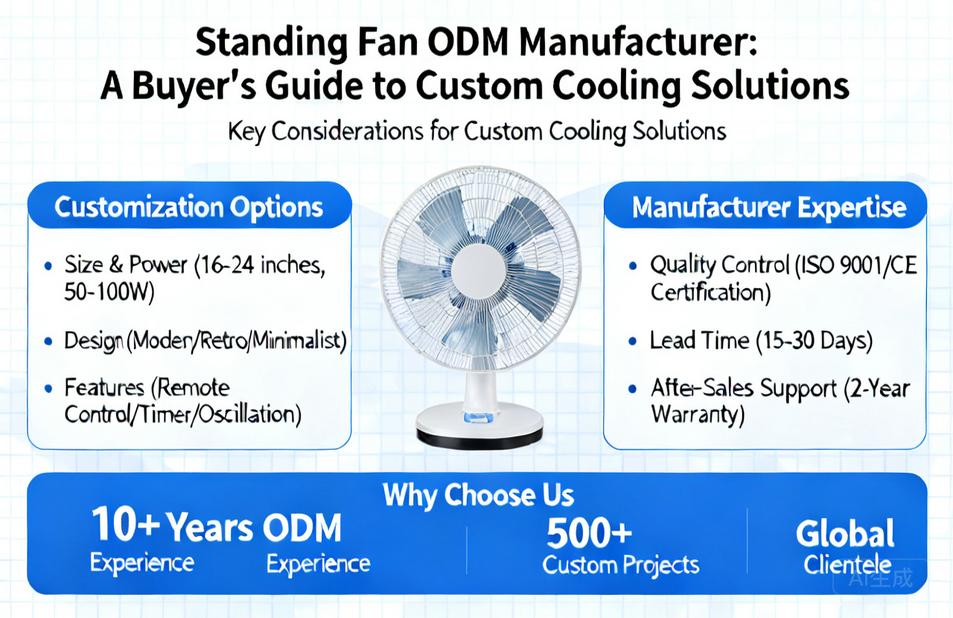
Working with a standing fan ODM manufacturer allows buyers to develop cooling products that match their brand, market positioning, and target applications. A standing fan, also called a pedestal fan, is a freestanding air circulation appliance with an adjustable height stand, a fan head, and a base. It is used in homes, offices, workshops, retail spaces, and light industrial areas where portable floor-level airflow is needed. Unlike a standard catalog purchase, the ODM model lets a buyer influence the design, performance profile, controls, and packaging from an early stage. This guide explains how these fans work, what to evaluate, and how to select a reliable manufacturing partner for OEM and custom projects.
Product Overview and How a Standing Fan Works
A pedestal fan draws air through a guarded fan head and directs it outward using rotating blades driven by an electric motor. The height-adjustable stand raises the airflow above furniture and floor obstructions, which makes the unit useful for room-level air movement rather than localized desk cooling. Most designs include oscillation, multiple speed settings, and a tiltable head. Control options range from simple mechanical switches to remote control and timer functions. For ODM projects, the working principle stays the same, but the buyer can define blade geometry, motor type, control interface, stand design, and color scheme to suit a specific market segment.
Key Features Buyers Usually Specify
When sourcing from a standing fan factory, procurement teams typically focus on features that affect user experience and market fit. Common specifications include:
- Fan head diameter and blade count, which influence airflow coverage and noise character
- Motor type, such as AC or DC, with DC designs often associated with variable speed control
- Oscillation angle and head tilt range for directional flexibility
- Speed settings, timer options, and remote or app-based controls
- Height adjustment range and base stability
- Grill design and safety spacing for finger protection
- Noise level targets for bedroom, office, or commercial use
These are configuration decisions rather than fixed catalog values. A responsible supplier will discuss realistic performance trade-offs instead of promising arbitrary figures.
Materials and Construction
Standing fans are commonly built with metal, engineering plastics, or a combination of both. The motor housing and stand may use steel or aluminum for rigidity, while the blade, grill, and control panel often use molded plastics. Base design matters for stability, especially on taller pedestal models, and may include weighted inserts. Buyers should ask about surface treatment, corrosion resistance for humid environments, and the quality of switches and wiring. For industrial or commercial applications, heavier-duty stand tubes and reinforced bases are often preferred. Material choices should be confirmed against the intended use environment, not selected only on unit cost.
Typical Industrial and Commercial Applications
Although often associated with home cooling, standing fans serve many commercial and light industrial settings. Warehouse aisles, assembly areas, packaging stations, workshops, and garages use pedestal fans for spot air movement where fixed HVAC is insufficient. Retail stores and showrooms use them for seasonal comfort and air circulation. Event spaces, gyms, and temporary work areas benefit from portability. In some industrial applications, the fan is used to support air exchange near workstations rather than as a primary ventilation system. Buyers should match airflow, duty cycle, and enclosure protection to the actual environment, and consult the manufacturer when dust, moisture, or continuous operation is involved.
How to Choose the Right Configuration
Selection should begin with the application rather than the appearance. Define the space size, mounting conditions, expected daily run time, noise tolerance, and control preferences. If the product will be sold under a private label, decide early whether the goal is a value-oriented model, a feature-rich design, or a durable commercial unit. Confirm the voltage and plug type for each destination market, and clarify whether certification support is required. Buyers should also review replacement part availability, packaging requirements, and documentation needs. A clear specification brief reduces back-and-forth during sampling and helps the ODM team propose realistic engineering options.
Customization and OEM Options
A standing fan ODM manufacturer typically supports a range of customization steps. These may include logo placement, color matching, custom packaging, user manual localization, control panel layout, and model naming. Deeper customization can involve blade design, motor selection, stand profile, base shape, and added functions such as timers or remote control. OEM arrangements usually focus on producing a buyer’s design or brand specifications, while ODM work often starts from an existing platform that is adapted to the buyer’s requirements. The right approach depends on expected volume, development budget, and timeline. Buyers should ask which parts are tooling-dependent and which can be adjusted without new molds.
Buying Considerations for Importers
Before committing to a supplier, clarify the scope of responsibility for design validation, sample approval, packaging artwork, and shipping documentation. Request a written specification sheet that lists materials, motor details, control functions, and dimensional data. Discuss quality control points such as incoming component checks, assembly inspection, and finished-product testing. Confirm how changes are handled after sample approval. It is also practical to review the factory’s experience with similar products and export markets, but buyers should verify claims through samples and documentation rather than relying on marketing statements. Keep commercial terms, warranty scope, and spare parts policy in the purchase agreement.
Supplier Selection: What to Look For
Choosing a standing fan supplier is about engineering communication as much as production capacity. A useful partner will ask detailed questions about the target market, user profile, and sales channel. Look for clear processes for sampling, specification changes, and issue resolution. Confirm that the factory can explain its assembly flow and inspection stages in plain terms. For custom projects, check whether the team can propose alternatives when a requested feature affects cost or performance. Buyers should also consider communication responsiveness, documentation quality, and willingness to support long-term model maintenance. These factors often matter more than a single price comparison.
Frequently Asked Questions
What is the difference between OEM and ODM for standing fans?
OEM generally means the factory produces according to the buyer’s design and specifications, while ODM means the manufacturer offers an existing product platform that can be adapted with the buyer’s branding and selected modifications. Many projects combine both approaches.
Can a standing fan be customized for different markets?
Yes. Common market adaptations include voltage and plug type, language on controls and manuals, packaging design, color schemes, and feature sets. Buyers should confirm these requirements before sampling.
How do I evaluate sample quality?
Check stability, noise character, control feel, oscillation smoothness, grill safety spacing, and finish quality. Compare the sample against the approved specification sheet and test it under conditions similar to the intended use.
What information should I provide to get an accurate quotation?
Provide the fan size or airflow target, motor preference, control functions, estimated order quantity, packaging requirements, destination market, and any branding or customization needs. Clear inputs help the supplier quote realistically.
Conclusion
Selecting a standing fan ODM manufacturer is a specification-driven process. Start with the application, define realistic performance and feature requirements, and confirm materials, controls, and market adaptations before moving to samples. A supplier that communicates clearly, documents specifications, and supports customization is better positioned to deliver a product that fits your brand and market. If you are planning a pedestal fan project, contact the supplier with your target specifications, application details, and OEM or customization requirements to discuss the next steps.