
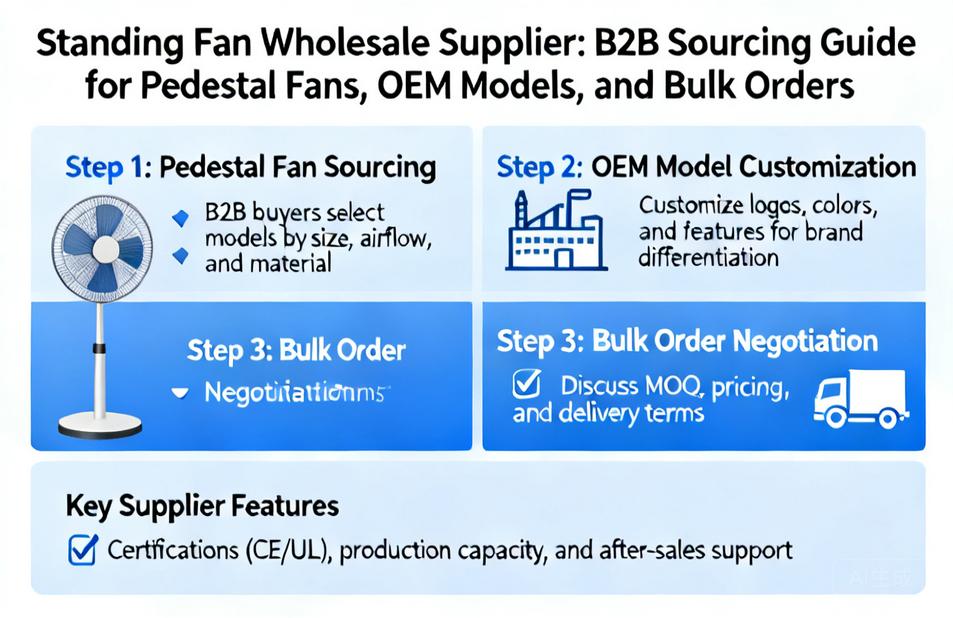
A standing fan wholesale supplier is a B2B source for pedestal and floor-standing fans that are purchased in volume for retail programs, commercial facilities, and industrial ventilation. These fans raise the air outlet above floor level, so a single unit can move air across a room, a workstation, or a sales floor without taking up counter space. For importers, distributors, and procurement teams, working with a standing fan supplier is less about picking one model and more about matching airflow, construction, controls, and packaging to the market where the fan will be sold or used. This guide explains what standing fans are, where they are used, and what to evaluate before placing a bulk order with a manufacturer or factory.
Product Overview: What Counts as a Standing Fan
A standing fan, also called a pedestal fan or floor fan, combines a base, an adjustable pole, a motor housing, and a guarded fan head. Most models offer height adjustment and oscillation, and many allow the head to tilt so airflow can be directed upward or downward. Blade diameters and motor designs vary, and buyers will find AC models, energy-efficient options, and rechargeable versions for areas with unstable power. Because the category covers a wide range of specifications, a reliable standing fan wholesale supplier should be able to clarify which configurations are available and how each one suits a given market or application.
For wholesale buyers, the category usually breaks into household pedestal fans, commercial standing fans for shops and offices, and heavier-duty units for workshops and warehouses. Each segment has different expectations for airflow, noise, control type, and housing finish, so it helps to define the target segment before requesting quotations.
Key Features Buyers Usually Compare
Purchasing teams tend to evaluate standing fans on a consistent set of features. Airflow and motor performance come first, followed by blade size and guard design. Speed control is another differentiator: mechanical switches are simple and inexpensive, while remote control and timer functions appeal to retail buyers looking for convenience features. Oscillation angle, height range, and tilt adjustment affect how usable the fan is in real spaces. Noise level matters in offices, bedrooms, and customer-facing areas, while stability of the base matters anywhere the fan may be bumped or moved frequently.
- Blade diameter and guard spacing, which influence airflow and safety
- Motor type, speed settings, and control method
- Height adjustment range and oscillation mechanism
- Base weight and footprint for stability
- Housing finish and materials suited to the intended environment
Materials and Construction
Standing fans for wholesale distribution are commonly built around metal or engineering plastic components, and the mix affects both durability and cost. Metal guards and poles are typical in commercial and industrial units, while plastic housings appear frequently in household and retail-oriented models. Motor housings need to protect internal components while allowing reasonable heat dissipation. Buyers should ask how the guard, blade, and pole assembly are fixed, because connection quality influences wobble, noise, and long-term reliability. For outdoor or dusty environments, the supplier should explain which construction details suit those conditions rather than making blanket claims.
Applications Across Commercial and Industrial Settings
The same product family serves many markets. In retail, standing fans are sold to households and small businesses. In commercial settings, they support air circulation in shops, restaurants, waiting areas, and offices. In industrial applications, pedestal fans are used in workshops, packaging lines, warehouses, and loading areas where air movement improves comfort or helps with light ventilation. Buyers sourcing for hospitality, education, or gyms often look for adjustable height and oscillation, while industrial buyers may prioritize robust guards, stable bases, and simple controls that are easy to maintain. Clarifying the application early helps a supplier recommend suitable configurations instead of generic models.
How to Choose the Right Standing Fan for Your Market
Selection should start with the end user and the sales channel. A buyer serving discount retail may prioritize cost efficiency and simple controls, while a buyer serving commercial clients may need stronger airflow, metal guards, and longer height adjustment. Voltage and plug standards must match the destination market, and packaging needs to survive the expected shipping and handling conditions. Where noise is a concern, request details on motor and blade design rather than relying on general descriptions. It is also worth confirming spare parts availability, such as blades, guards, and switches, since after-sales support influences repeat business.
Matching Fans to Room Size and Use
Airflow requirements rise with room size, occupancy, and heat load. For a small office or bedroom, moderate airflow with quieter operation is usually appropriate. For a workshop or open sales floor, buyers typically look for larger blade diameters, higher airflow, and more stable bases. If the fan will run for long periods, discuss duty expectations with the supplier so the motor and controls are suited to continuous use.
Customization and OEM Options
Many buyers source standing fans under their own brand, which makes OEM and custom capability an important part of supplier evaluation. Typical customization includes brand labeling, packaging design, color matching, control panel layout, and selected feature combinations. Some factories also support custom voltage, plug type, and language on packaging and manuals for specific markets. Buyers should ask which changes require new tooling, which are handled through existing production options, and how samples are managed before mass production. A supplier that asks detailed questions about the target market and application is generally easier to work with than one that offers a single generic specification.
Buying Considerations for Wholesale Orders
Before confirming a bulk order, define the specification in writing, including blade size, control type, voltage, plug standard, packaging requirements, and labeling. Request samples for evaluation and confirm that the sample matches the production specification. Discuss order quantities, mixed-model options, and documentation needs early, since these affect planning. Inspection criteria should be agreed in advance, covering appearance, assembly quality, and function checks. These steps reduce the risk of mismatches between what was quoted and what is delivered.
How to Select a Reliable Standing Fan Supplier
Supplier selection should go beyond price comparison. Review the manufacturer’s product range, production focus, and experience with the markets you serve. Ask how quality checks are performed, how deviations are handled, and what support is available after shipment. Communication speed and clarity during the inquiry stage often indicate how the relationship will work later. If possible, request references or review existing export experience, and confirm whether the factory can support both standard models and custom programs.
Frequently Asked Questions
What information should I provide when requesting a standing fan quotation?
Provide the target market, intended application, preferred blade size, control type, voltage and plug standard, estimated order quantity, and any branding or packaging requirements. This allows the supplier to quote a relevant configuration instead of a generic model.
Can standing fans be customized for my brand?
Many manufacturers offer OEM and custom options such as brand labeling, packaging design, color selection, and feature configuration. Confirm which options are available for your order quantity and whether any changes require tooling or extended planning.
How do I evaluate sample quality before a bulk order?
Check airflow, noise, oscillation, height adjustment, base stability, and assembly quality under normal use conditions. Compare the sample against the agreed specification and keep a reference unit for production comparison.
Are spare parts available for wholesale orders?
Ask the supplier about availability of commonly replaced parts such as blades, guards, switches, and power cords. Spare parts support affects after-sales service and long-term customer satisfaction.
Conclusion
Sourcing standing fans at wholesale volume works best when the specification, application, and market requirements are defined before inquiries begin. Focus on airflow, construction, controls, stability, and packaging, and treat OEM and customization capability as part of the supplier evaluation. If you are comparing models for retail, commercial, or industrial use, contact the supplier with your target specifications and application details to discuss suitable configurations, OEM options, and customization requirements.