
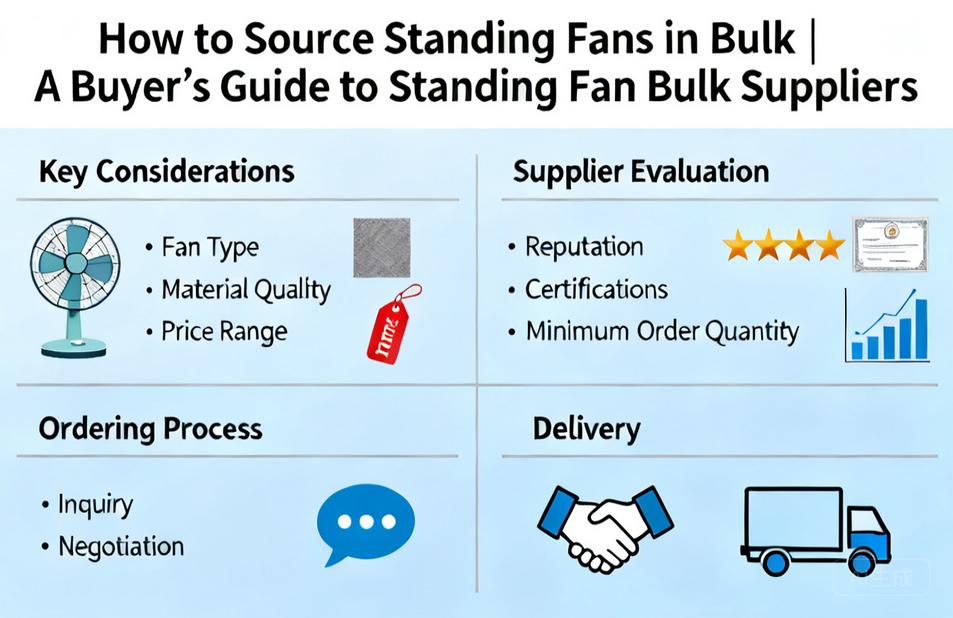
A standing fan bulk supplier helps distributors, retailers, facility managers, and project buyers source pedestal fans in volume for residential cooling, office use, workshops, warehouses, and temporary installations. Unlike small retail purchases, bulk procurement requires a clear understanding of product configuration, motor quality, blade and guard design, control options, packaging, and supplier reliability. This guide explains what standing fans are, how they work, what to evaluate in a supplier, and how to match specifications to your market or application.
What Is a Standing Fan and Where Is It Used?
A standing fan, also called a pedestal fan or floor-standing fan, is a portable air-circulation appliance mounted on a height-adjustable stand. It typically includes a base, a telescopic pole, a motor housing, fan blades, a protective guard, and a control panel. Most models offer oscillation, adjustable tilt, and multiple speed settings, making them suitable for spaces where fixed ceiling fans or HVAC systems are impractical.
Common applications include homes, apartments, offices, shops, restaurants, schools, clinics, workshops, light industrial areas, warehouses, and event spaces. Buyers often purchase standing fans in bulk for seasonal retail programs, hotel and dormitory furnishing, rental equipment, facility maintenance, and humanitarian or disaster-relief distribution. Because these fans are freestanding and easy to relocate, they are especially useful where airflow needs change throughout the day.
Product Overview and Key Features Buyers Should Understand
Standing fans vary widely in motor type, blade size, control method, and construction. A typical pedestal fan uses an AC motor with two or three speeds, though DC motor designs are increasingly available for energy-conscious markets. Blade diameter affects coverage and airflow, while guard design influences safety and cleaning access. Oscillation range, height adjustment, and tilt angle determine how flexibly the fan can direct air.
Motor and Performance
The motor is the most important component for durability and noise. Copper or copper-clad aluminum windings, bearing quality, and thermal protection all affect service life. For bulk orders, ask the supplier to explain motor construction, rated voltage and frequency, power consumption, and speed control method. Do not assume that a higher wattage always means better performance; airflow, noise, and energy efficiency should be evaluated together.
Blade, Guard, and Stand Design
Blade material and shape influence airflow and noise. Common options include plastic and metal blades in various profiles. The guard should be sturdy enough for the target market and easy to remove for cleaning. The stand usually includes a telescopic pole and a weighted base. Buyers should confirm base stability, height range, and whether the fan is suitable for uneven floors or high-traffic areas.
Controls and Convenience Features
Basic models use mechanical dials or push buttons. Higher-level configurations may include remote control, timer, sleep mode, and digital displays. For bulk programs, the right control type depends on the end user. Mechanical controls are simple and robust for workshops, while remote and timer functions appeal to residential and hospitality buyers. Confirm whether spare parts and replacement controls are available.
Materials and Construction
Housing materials commonly include ABS plastic, PP, and painted or powder-coated metal. Plastic housings suit cost-sensitive retail programs, while metal components can improve durability in commercial or light industrial settings. Buyers should ask about material grade, UV stability for outdoor-adjacent use, and corrosion protection for humid environments. The power cord, plug type, and strain relief should match the destination market’s electrical standards. Packaging also matters: bulk buyers need cartons that protect the guard, blades, and base during container transport and warehouse handling.
Applications and Specification Matching
Matching a standing fan to its application prevents returns and complaints. For residential retail, quiet operation, attractive design, and easy assembly are priorities. For offices and shops, stable bases, oscillation, and adjustable height are important. For workshops and warehouses, buyers should focus on airflow, motor durability, guard strength, and simple controls. For hospitality and rental use, remote control, timer settings, and low noise may matter more than maximum airflow.
Voltage and frequency must match the target market. Plug type, cord length, and labeling requirements should be confirmed before production. If the fans will be used in dusty or humid conditions, discuss motor protection and cleaning access with the supplier. Buyers should also consider whether the fan will be assembled locally or shipped fully assembled, as this affects packaging, freight volume, and labor costs.
How to Choose a Standing Fan Bulk Supplier
Choosing a supplier is about more than price per unit. A reliable standing fan supplier should be able to explain product specifications clearly, provide samples for evaluation, and communicate consistently about production and documentation. Look for a manufacturer or factory with experience in air-circulation appliances and a clear quality-control process. Ask how they handle incoming component inspection, motor testing, assembly checks, and final inspection before shipment.
Evaluate whether the supplier can support OEM and custom requirements. Typical customization options include branded packaging, product labels, color matching, control panel layout, plug and voltage configuration, and user manuals in the target language. Some factories can adjust blade size, stand height, or accessory sets for specific markets. Confirm which changes require new tooling or minimum order quantities, and request written specifications before approving samples.
Buying Considerations for Bulk Orders
Bulk procurement should start with a written specification sheet covering model, voltage, frequency, power, speed settings, oscillation, height range, blade diameter, control type, housing material, plug type, packaging, and labeling. Request samples from shortlisted suppliers and test noise, airflow, stability, and assembly quality. Check that the product matches the sample and approved specification before mass production.
Discuss packaging tests, carton marking, container loading plans, and documentation requirements early. Clarify warranty terms, spare parts availability, and how the supplier handles defects or missing components. For seasonal programs, confirm production capacity and scheduling before committing to a delivery window. Avoid suppliers who cannot provide clear answers about components, testing, or customization. A transparent supplier will welcome technical questions and provide consistent information across quotations and samples.
Customization Options for OEM and Private Label Programs
Many buyers need private-label standing fans rather than generic products. Common OEM requests include custom logo placement, retail-ready packaging, color selection, remote-control branding, and market-specific manuals. Some buyers also request different blade guards, base designs, or accessory bundles. Before placing a bulk order, confirm ownership of tooling, approval steps for artwork and labels, and the process for sample sign-off. Customization should be documented in a specification sheet and referenced in the purchase order.
Frequently Asked Questions
What should I check first when sourcing standing fans in bulk?
Start with the target market’s voltage, frequency, and plug type, then define blade size, control type, and noise expectations. Confirm these details in writing and evaluate a sample before discussing volume pricing.
Can a standing fan supplier support OEM and custom packaging?
Many factories offer OEM services such as custom labels, packaging, colors, and manuals. Ask which options are standard, which require new tooling, and what minimum order quantities apply.
How do I compare standing fan quality across suppliers?
Compare motor construction, blade and guard materials, base stability, control durability, and assembly quality. Request samples and check that specifications, labels, and packaging match the approved documents.
What information should be included in a bulk order specification?
Include model number, voltage, frequency, power, speed settings, oscillation, height range, blade diameter, control type, materials, plug type, packaging, labeling, and documentation requirements.
Conclusion
Sourcing standing fans in bulk requires balancing product performance, market requirements, customization, and supplier reliability. Define your application and target market first, then compare suppliers on specifications, quality control, OEM capability, and communication. If you are planning a retail program, facility purchase, or private-label order, contact a standing fan manufacturer or supplier with your voltage, configuration, and customization requirements so they can recommend suitable options and provide samples for evaluation.