
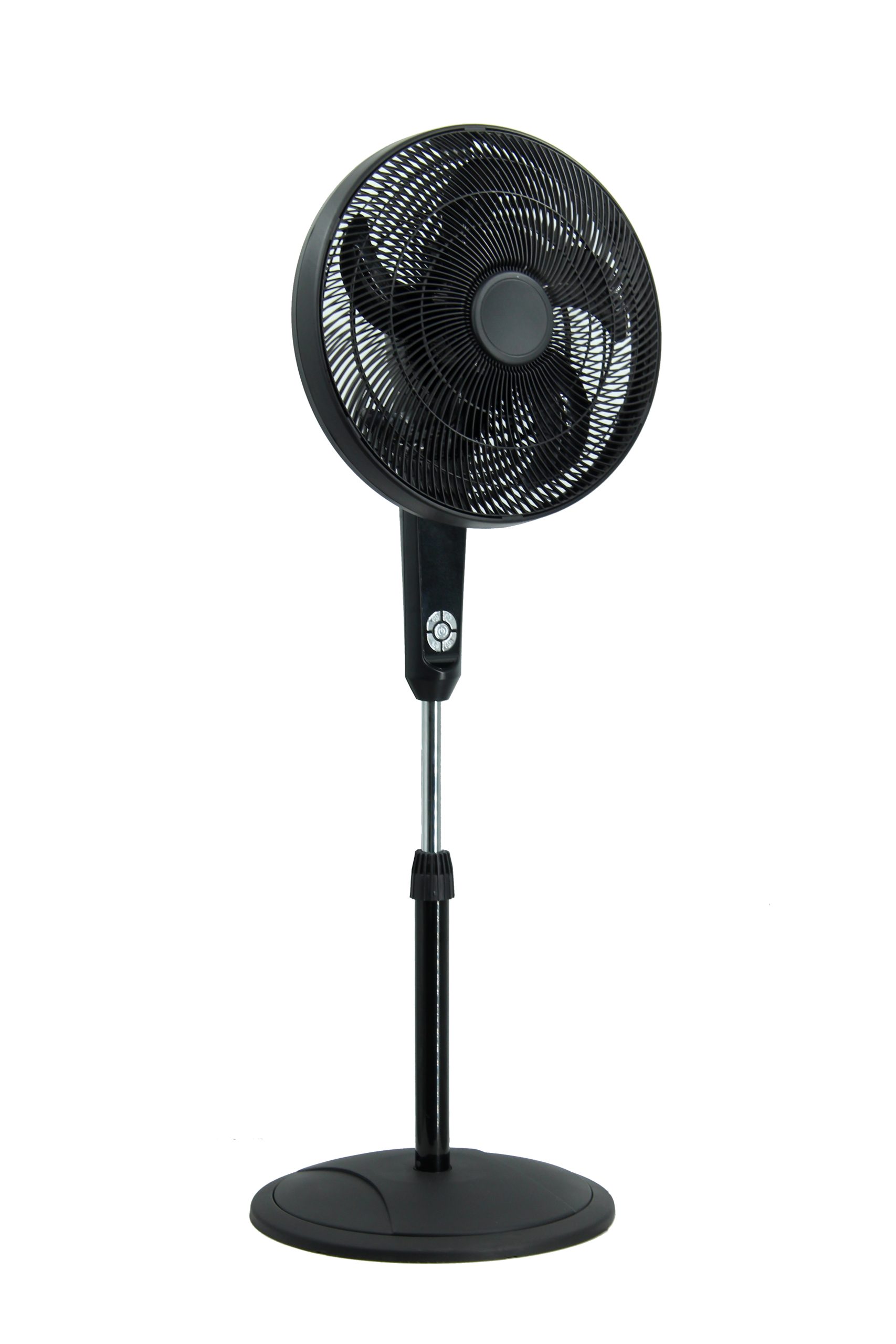
What is a standing air circulator fan?
A standing air circulator fan is a floor-standing cooling device designed to move air throughout an entire room rather than only blowing air in one direction. It uses specially designed blades, a powerful motor, and an optimized airflow system to create continuous air movement. Unlike conventional pedestal fans that mainly focus on direct airflow, an air circulator fan helps distribute air more evenly, so cool or warm air circulates throughout the space.
Standing air circulator fans typically include adjustable height, multiple speed options, and oscillation functions. They are used in bedrooms and living rooms, offices and meeting areas, retail stores and restaurants, warehouses and workshops, gyms and fitness centers, and commercial buildings.
Standing air circulator fan vs. standard pedestal fan
The main difference is airflow purpose. A standard pedestal fan is usually chosen for direct personal cooling. A standing air circulator fan is chosen when the goal is to improve air circulation and ventilation across a larger area. Because it moves air more evenly, it can help reduce indoor heat accumulation and improve overall air freshness. In large spaces, an industrial air circulator fan can provide higher airflow coverage for warehouses, factories, and commercial facilities.
A well-designed airflow system can also help reduce dependence on air conditioning, which is relevant for buyers looking for energy-efficient cooling products.
How to choose a standing air circulator fan
Selection should start with the space and the airflow requirement, not with a single specification. The following attributes are commonly used to compare models:
- Blade diameter and airflow coverage: Smaller diameters suit personal or small-room use; larger diameters and industrial designs suit larger spaces.
- Power and motor type: AC motors are common in household and commercial standing fans. Power ratings vary by model and intended use.
- Speed settings: Some models offer three speeds; others offer more than five speeds for finer control.
- Oscillation: Horizontal auto oscillation and 3D oscillation help distribute air across a wider area.
- Noise level: Noise output varies by model. Lower-noise designs are preferable for bedrooms, offices, and hospitality settings.
- Control type: Mechanical rotary knob, touch control, remote control, and app control are available depending on the model.
- Height adjustment: Adjustable height is useful for living rooms and commercial spaces; some compact circulator models are not height-adjustable.
- Timer and modes: Timers and normal/sleep modes are common on digital models.
- Energy efficiency: Energy efficiency ratings and low power consumption matter for distributors targeting energy-conscious markets.
- Material and build: Plastic housings are common; private mold options are available for OEM/ODM programs.
Application scenarios
Standing air circulator fans are used across residential and commercial environments:
- Household: Bedrooms, living rooms, and home offices where even air distribution and quiet operation matter.
- Hospitality: Hotels and restaurants where guest comfort and noise levels are important.
- Commercial and office: Meeting areas, retail stores, and open-plan offices.
- Industrial and warehouse: Larger spaces that need higher airflow coverage and ventilation support.
- Fitness and public facilities: Gyms and commercial buildings with continuous air movement needs.
Key considerations before buying or sourcing
- Match the fan to the room size: A compact 9-inch or 11-inch circulator is not a substitute for a large industrial circulator in a warehouse.
- Check the actual control and feature set: Not every standing air circulator fan includes a remote, timer, app control, or adjustable height. Confirm the exact model attributes.
- Confirm voltage, plug, and certification requirements for your market: These are destination-market requirements and should be verified with the supplier for each order.
- Consider noise targets: Noise levels differ significantly between models, from around 35–39 dB on some quiet designs to around 57 dB on others.
- Plan for OEM/ODM: Private mold, custom color, and branding options are relevant for distributors and international brands.
- Review packaging and logistics: Package size and gross weight affect shipping cost and retail packaging decisions.
Example product configurations from our range
Our site lists several standing and air circulator fan configurations that illustrate the range of options available:
- 16-inch standing fan (FS-K40BR): 5 blades, 50W AC motor, 3 speeds, 57 dB noise level, oscillating, digital touch and remote control, 12-hour timer, normal/sleep modes, adjustable height, LED display, private mold, color box packaging. Applications include hotel, garage, commercial, and household use.
- 9-inch 3D oscillation DC air circulator fan: 3 blades, 50W, more than five wind speeds, 35–39 dB noise level, oscillating, remote control, app control, energy efficiency rating Class A+, corrugated box packaging. Applications include hotel, household, commercial, and office use.
- 11-inch standing air circulator fan (KFX2306J): 3 blades, 45W, more than five wind speeds, oscillating, mechanical rotary knob control, horizontal auto oscillation, plastic housing. Applications include hotel, office, and household use.
These examples show how blade diameter, power, control type, noise level, and features vary by model. Buyers should confirm the exact specification of the model they intend to order.
FAQ
What is the difference between a standing air circulator fan and a pedestal fan?
A pedestal fan generally directs air toward a specific direction for personal cooling. A standing air circulator fan is engineered to move air throughout a space, creating more balanced air circulation and supporting ventilation.
Can a standing air circulator fan be used in a warehouse or factory?
Yes, but for large spaces an industrial air circulator fan is typically more suitable because it provides higher airflow coverage. Compact household circulators are intended for smaller areas.
Do all standing air circulator fans have remote control or app control?
No. Control type varies by model. Some models use a mechanical rotary knob, some use touch control, and some include remote or app control. Confirm the specific model’s control type before ordering.
Are standing air circulator fans quiet?
Noise levels vary. Some models are designed for lower noise, such as around 35–39 dB, while others are around 57 dB. The right choice depends on the environment, such as a bedroom versus a workshop.
Can standing air circulator fans be customized for OEM or ODM orders?
Some models offer private mold and customized color options. OEM/ODM capability depends on the specific model and order requirements, so it should be confirmed with the supplier.
Do standing air circulator fans help reduce air conditioning use?
Improved air circulation can help distribute cool air more evenly, which may reduce dependence on air conditioning. Actual energy savings depend on the space, climate, and how the fan is used.