
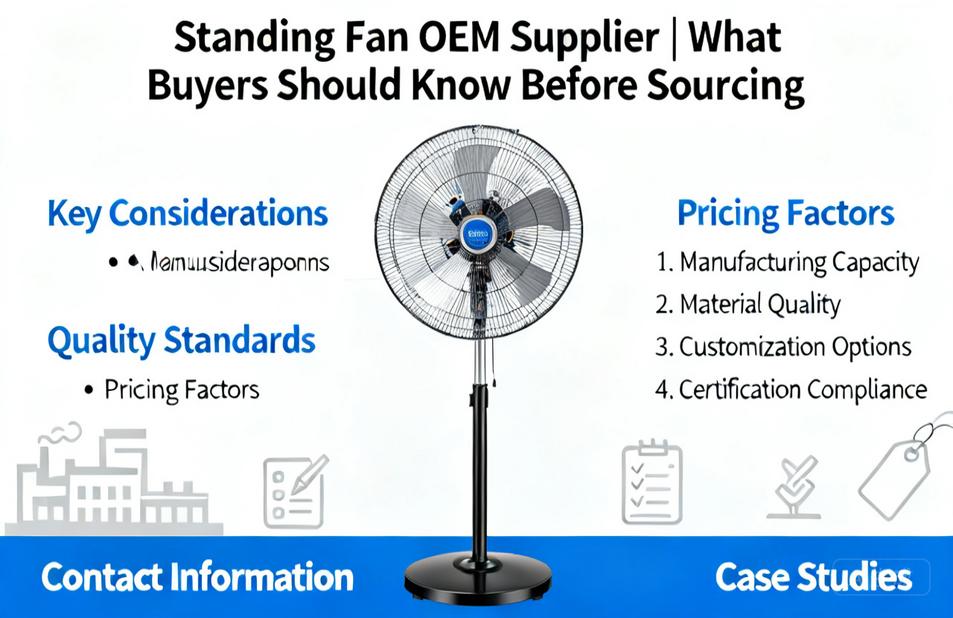
Working with a standing fan OEM supplier means sourcing pedestal or stand-mounted fans that are produced to your brand, packaging, voltage, and performance requirements rather than buying generic stock. These fans are common in homes, offices, shops, workshops, warehouses, and light industrial areas where floor space is limited and airflow needs to be directed at people or work zones. For importers, distributors, and private-label brands, the real challenge is not finding a factory that can assemble a fan, but finding one that understands how to match motor, blade, guard, and control design to the target market and application.
How a Standing Fan Is Usually Built
A typical standing fan combines a base, a telescopic or fixed pole, a motor housing, a blade set, a front and rear guard, and a control section. The fan head can usually be adjusted in height and tilt angle, and many models offer oscillation so the airflow sweeps across a wider area. In OEM production, each of these parts becomes a decision point. The base may be weighted or shaped differently for stability, the pole may use a simple twist lock or a more robust clamping system, and the control panel may be mechanical or electronic depending on the price positioning of the product line.
For buyers, it helps to treat the standing fan as a system rather than a list of parts. A stronger motor paired with an inefficient blade profile may not deliver the airflow the market expects. A lightweight base may reduce shipping cost but create wobble complaints. A well-designed guard can improve safety and appearance, but it also affects tooling cost and assembly time. A reliable OEM partner will discuss these trade-offs openly instead of quoting a single configuration for every market.
Key Features Buyers Usually Specify
Standing fans are often differentiated by a small number of features that matter to end users and to the brand owner. Buyers commonly review the following areas during sampling and supplier evaluation:
- Motor type and speed settings, including whether the fan uses a conventional AC motor or an energy-conscious motor design.
- Blade diameter and blade material, which influence airflow coverage, noise level, and the overall look of the fan.
- Oscillation angle and head tilt range, which determine how much area the fan can reach.
- Height adjustment range, important for both floor use and counter-height applications.
- Control method, from simple rotary switches to remote control and timer functions.
- Guard design and assembly method, which affect safety, cleaning, and service access.
- Base design and stability, especially for markets where the fan is used on uneven floors or in busy retail areas.
Not every market needs every feature. A fan sold through a discount retail channel may prioritize simple controls and low packaging volume. A fan sold to offices or premium retail may need quieter operation, a more refined finish, and more precise speed control. The OEM supplier should be able to adjust the feature set without forcing buyers into a single standard model.
Materials and Construction Considerations
Standing fans are exposed to continuous vibration, dust, and frequent handling, so construction details matter more than they first appear. The motor housing should be rigid enough to reduce resonance. The pole joint should lock securely without excessive play. The blade set should be balanced, because imbalance shows up quickly as noise and wear. The guard should be sturdy enough to resist accidental pressure and easy enough to remove for cleaning where the design allows it.
Buyers should ask how the factory controls consistency across production batches, particularly for moving parts and electrical assemblies. It is reasonable to request samples from more than one production run, review the assembly method, and ask which parts are produced in-house versus sourced from sub-suppliers. This does not require a specific certification or test standard to be assumed; it is a practical way to understand where quality risk sits in the supply chain.
Applications and Market Fit
Although a standing fan is a familiar household product, its application range is wider than many buyers initially consider. In residential use, it provides local cooling in living rooms and bedrooms without occupying a table surface. In offices and shops, it supports air movement in reception areas and sales floors. In workshops, garages, and light industrial areas, it helps move air where fixed ventilation is limited, provided the fan is selected for the environment and used appropriately. For hospitality and event use, portable standing fans can supplement room airflow without permanent installation.
Each application places different demands on the product. A fan for a dusty workshop may need a design that is easy to clean and a motor suited to longer running periods. A fan for a retail display may place more emphasis on finish, color matching, and stable branding. A fan for export markets may need voltage and plug options that match local requirements. Sharing the intended application with a standing fan manufacturer early in the project helps avoid a model that is technically functional but poorly matched to the sales channel.
OEM and Custom Options
OEM supply can cover much more than applying a logo. Depending on the factory capability, customization may include blade color, guard finish, base shape, pole height range, control panel layout, packaging design, user manual content, and voltage or plug configuration for the destination market. Some buyers need a model that fits an existing product family, while others want a distinct design for a new brand launch.
For custom standing fan projects, it is useful to separate cosmetic changes from structural changes. Cosmetic changes such as color and print usually require shorter development cycles, while a new blade profile, motor housing, or base mold involves tooling and more extensive validation. A supplier that asks about target price, order volume, sales channel, and application before quoting is generally easier to work with than one that sends a generic catalog and price list.
How to Choose a Standing Fan Supplier
Supplier selection should go beyond the quotation sheet. Buyers can use a structured review to compare candidates and reduce later surprises. Consider the following evaluation points:
Production scope and experience
Ask which parts of the fan are made in-house and which are outsourced. A factory with in-house motor or blade production may have more control over consistency, while a factory that focuses on assembly may offer more flexibility on small custom batches. Neither approach is automatically better; the fit depends on the buyer’s order profile.
Communication and sampling process
A responsive supplier provides clear sample timelines, documents changes in writing, and explains what can and cannot be adjusted. During sampling, check assembly quality, control feel, noise at different speeds, base stability, and packaging protection.
Quality control and consistency
Ask how incoming parts and finished fans are checked, and how the factory handles deviations. A practical quality discussion should focus on the buyer’s market requirements rather than broad claims. If the product will be sold in a regulated market, confirm which product safety and labeling requirements the supplier can support without assuming certifications that have not been verified.
Customization and order flexibility
Clarify minimum order quantities for standard models versus custom models, and ask how packaging and branding changes affect the production plan. This helps buyers plan product launches and replenishment more realistically.
Frequently Asked Questions
What information should I provide to a standing fan OEM supplier?
Share the target market, intended application, preferred voltage and plug type, control features, color and branding requirements, estimated order quantity, and packaging expectations. A clear brief helps the supplier recommend a suitable platform or propose a custom configuration.
Can a standing fan be customized without a completely new mold?
In many cases, color, print, packaging, control labeling, and some component selections can be customized on an existing platform. Structural changes such as a new base or blade profile usually involve tooling. The supplier should explain which changes are cosmetic and which require engineering work.
How can I compare samples from different suppliers?
Evaluate the samples under the same conditions: check stability on a level floor, listen for abnormal noise at each speed, review the fit and finish of the guard and pole joints, and inspect the packaging. Keep a written checklist so the comparison is based on consistent criteria.
What should be confirmed before placing a bulk order?
Confirm the approved sample, product configuration, packaging artwork, voltage and plug specifications, labeling requirements, inspection method, and shipping terms in writing. A documented specification reduces misunderstanding between the buyer and the factory.
Conclusion
Selecting a standing fan OEM supplier is a balance of product fit, production control, communication, and customization flexibility. Buyers get better results when they define the application, target market, and feature priorities before requesting samples, and when they compare suppliers on process rather than catalog claims. If you are planning a private-label or custom standing fan project, contact a supplier with your specifications, application details, and OEM requirements to discuss a practical product configuration.