
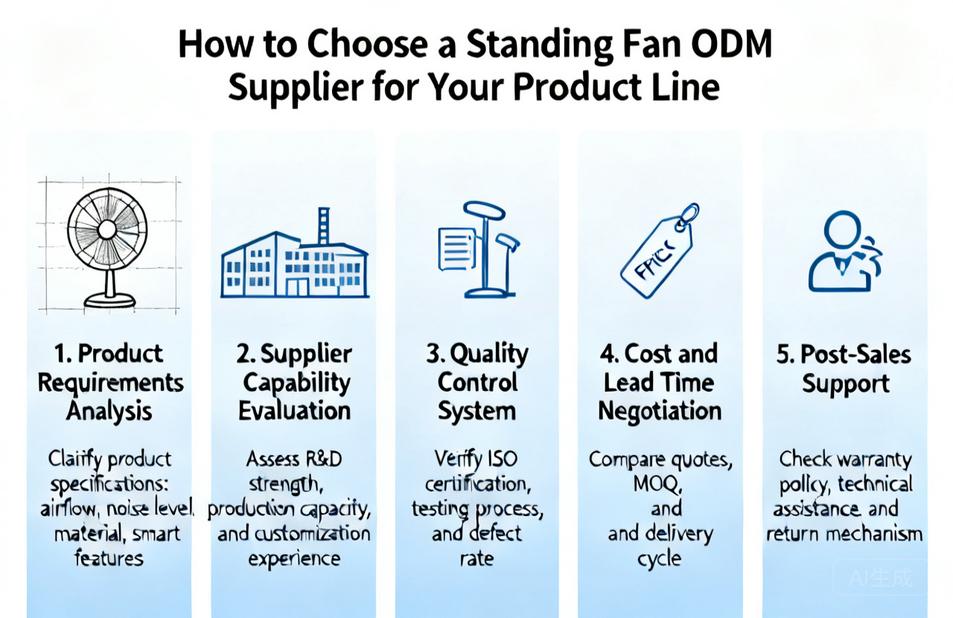
For distributors, retail brands and commercial buyers, working with a standing fan ODM supplier is often the fastest way to bring a differentiated cooling product to market. A standing fan, also called a pedestal fan or floor fan, is a free-standing air circulator with an adjustable height and oscillating head, used in homes, offices, shops, workshops, warehouses and light industrial spaces. Rather than simply reselling a catalog item, an ODM supplier helps you develop or adapt the product design, housing, control interface and packaging around your target market, so the finished fan matches your brand positioning and price band.
What an ODM Supplier Actually Provides
ODM stands for original design manufacturing. In practice, a standing fan ODM supplier maintains existing fan platforms, tooling and engineering resources, then modifies them for different buyers. That can include changing the motor and blade combination, adjusting the height of the stand, redesigning the base for stability, updating the control panel, adding remote control or timer functions, and preparing retail-ready packaging with your branding. The supplier typically manages the mechanical design, electrical layout, assembly process and quality control steps for the specific configuration you approve.
This model differs from pure OEM work, where the buyer supplies a complete design. ODM gives buyers a practical middle path: you get engineering input and a proven product platform without building a design team from scratch. Many importers use a custom standing fan program to test a market first, then move to more customized tooling once volumes justify the investment.
Product Overview and Key Features Buyers Look For
Most pedestal fan platforms share a common architecture: a motor housing at the top, a guard and blade assembly, an oscillation mechanism, a telescopic pole and a weighted base. Buyers evaluating a standing fan factory should look at how these parts are engineered together, because the balance between airflow, noise, energy use and mechanical stability determines whether the product sells well and stays out of warranty claims.
Airflow, Motor and Blade Design
Airflow performance depends on the motor, blade profile and guard design working as a system. Ask the supplier how the fan behaves across speed settings, whether the motor is designed for continuous operation, and how the blade geometry affects noise at higher speeds. A supplier that can explain these trade-offs clearly is usually better equipped to match a fan to your specific market, whether that market values quiet bedroom operation or strong airflow for a workshop.
Stand, Base and Mechanical Stability
The stand and base are frequent weak points in low-cost pedestal fans. Check the pole adjustment mechanism, the locking collar, the tilt and oscillation joints, and the weight distribution of the base. A wider or heavier base improves stability but affects shipping cost and retail handling. Custom standing fan projects often focus on this area, since a stable fan reduces tip-over complaints without adding unnecessary cost to the whole product.
Controls and User Interface
Control options range from simple rotary switches to button panels, remote control and app-based operation. More electronics can differentiate a product, but each added function increases component count and service complexity. Discuss with your supplier which control level fits your distribution channel, and whether spare parts and replacement controllers can be supplied for after-sales support.
Materials and Construction
Common construction choices include metal, engineering plastic and mixed builds. Metal guards and poles offer rigidity and a more industrial appearance, while plastic housings reduce weight and cost. Buyers should ask about surface treatment for metal parts, the thickness and finish of plastic components, and how joints and fasteners resist loosening over time. Material selection should follow the intended application: a fan for a humid coastal market needs different surface protection from one used in a dry, air-conditioned office.
Typical Applications
Standing fans serve a broad range of end uses, and each application places different demands on the product. Retail buyers often source pedestal fans for home and office use, where noise and appearance matter. Commercial buyers may need floor fans for shops, restaurants and waiting areas. Industrial applications include workshops, packing areas, warehouses and temporary workstations, where airflow, durability and continuous running are more important than styling. Understanding the end application early helps a supplier recommend the right motor, blade and stand configuration instead of forcing every buyer into the same specification.
Customization Options to Discuss
A capable standing fan ODM supplier can usually support several levels of customization. These may include brand logo placement, color matching, housing styling changes, control panel layout, voltage and plug configuration for different regions, packaging design and multilingual manuals. More advanced projects can involve new tooling for the guard, base or control housing. When discussing custom standing fan development, clarify which changes use existing tooling and which require new molds, because that distinction directly affects project cost and lead time planning.
It is also worth asking how the supplier handles documentation, spare parts kits and consistency across repeat orders. Buyers who plan to build a long-term product line should confirm that component sourcing, color matching and assembly standards remain stable from batch to batch.
How to Choose a Reliable Supplier
Supplier selection should go beyond a price list. Start with the supplier’s experience in air movement products and ask for a clear explanation of their design and assembly process. Review how they control incoming components, how they test finished fans, and how they handle non-conforming units. A factory visit or video audit can confirm whether production lines, testing stations and storage conditions match what was described during negotiation.
Communication quality is another useful signal. A supplier that asks detailed questions about your market, voltage, packaging and expected usage is more likely to deliver a product that fits. Also clarify responsibilities for tooling ownership, sample approval, packaging artwork and after-sales spare parts before placing a bulk order. For buyers comparing several candidates, a structured checklist covering engineering support, quality control, customization capability and order flexibility will make the comparison far more objective.
Buying Considerations for Importers
Before confirming an order, agree on the exact configuration in writing: fan size, speed settings, control type, oscillation range, stand adjustment, color, logo position, plug type, packaging and accessory contents. Request samples from the actual production configuration and test them under the conditions your customers will use. Plan shipping volume around packaging dimensions and base weight, since pedestal fans are bulky items and freight efficiency affects landed cost. Finally, keep spare parts and warranty terms in the contract so after-sales issues can be resolved without long delays.
Frequently Asked Questions
What is the difference between an ODM and an OEM standing fan supplier?
An OEM supplier builds to a design you provide, while an ODM supplier offers an existing design platform that can be modified for your brand. ODM work is often faster for buyers who do not have in-house fan engineering, while OEM work suits buyers with a fully developed product specification.
Can I customize the voltage and plug for my market?
Yes, this is a common requirement. Provide your target market, rated voltage, frequency and plug standard so the supplier can confirm the motor and electrical components match local requirements. Ask for the approved configuration to be documented before mass production.
How do I evaluate sample quality before ordering?
Test the sample for airflow, noise at each speed, stability of the stand and base, control response, oscillation smoothness and finish quality. Compare several units from the same batch to check consistency, and record the approved sample as the reference standard for production.
What information should I prepare before contacting a supplier?
Prepare your target market, expected application, preferred fan size, control functions, voltage and plug type, branding requirements, packaging expectations and estimated order quantity. Clear input helps the supplier propose a realistic configuration and identify which parts need custom tooling.
Conclusion
Choosing a standing fan ODM supplier is mainly a matter of matching product design, application needs and supply reliability. Focus on airflow and motor performance, stand stability, control configuration, material choices and the supplier’s ability to support customization without compromising consistency. Buyers who define their application and market requirements early usually get more accurate proposals and smoother production. If you are planning a pedestal fan program, contact the supplier with your specification, target application and customization needs so the team can recommend a suitable configuration and discuss OEM or custom development options.