
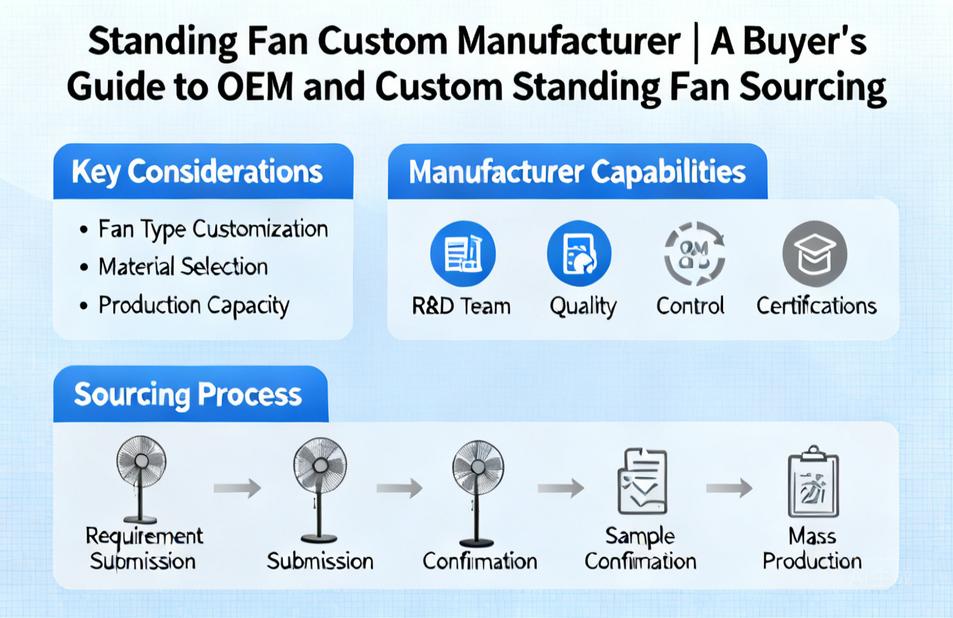
A standing fan custom manufacturer is a factory or supplier that produces pedestal and floor-standing fans to buyer specifications, and it is the right sourcing partner when standard catalog models do not match your market, brand, or application requirements. Standing fans are used in workshops, warehouses, offices, retail spaces, restaurants, gyms, and residential settings, and they are often purchased in volume by distributors, brand owners, and facility managers. Working with a custom standing fan manufacturer allows you to align fan size, airflow performance, control method, finish, and packaging with your target customers instead of adapting to off-the-shelf designs. This guide explains how custom standing fans are built, what to evaluate in a supplier, and how to structure an OEM or custom order.
Product Overview: What Custom Standing Fans Include
Standing fans, also called pedestal fans or floor fans, combine a fan head, a height-adjustable pole, and a weighted base. Because the fan stands on the floor, the design gives freedom in head diameter, oscillation range, airflow angle, and control placement. A custom standing fan manufacturer typically works with several configurations: AC motor fans for cost-sensitive volume programs, DC and brushless motor fans for energy efficiency and variable speed control, and rechargeable or battery-backed models for areas with unreliable power. Buyers can request manual controls, remote control, timer functions, or smart control modules depending on the target market.
Customization usually extends beyond the fan itself. Manufacturers can adjust grille design, blade material and shape, logo placement, color matching, packaging artwork, and user manuals. For distributors, this means a product line that fits local retail expectations. For industrial buyers, it means fans configured for dust, heat, or continuous operation in demanding spaces.
Key Features Buyers Usually Specify
Airflow performance is the first specification most buyers review. Airflow depends on blade diameter, blade pitch, motor speed, and grille openness, so a custom standing fan manufacturer will usually ask about the intended room size and mounting height. Oscillation angle and tilt range matter in workshops and large open areas where coverage matters more than a narrow direct stream. Noise level is another common requirement, especially for office, retail, and hospitality applications where fan noise affects staff and customers.
Control and safety features are equally important. Buyers may specify multiple speed settings, timer functions, remote control, and overload protection. For markets with specific regulatory expectations, the manufacturer should be able to discuss motor insulation, plug type, voltage and frequency matching, and label requirements. Because rules vary by country, the buyer should confirm applicable standards with the supplier rather than assume a single global configuration.
Materials and Construction
Standing fan construction affects durability, weight, and appearance. Common blade materials include metal and engineering plastics, each with different balance between airflow, noise, and cost. Grilles are typically metal wire or mesh, and the pole and base are usually steel or molded polymer. For industrial or humid environments, buyers often request powder-coated finishes and corrosion-resistant components. A custom standing fan factory can also adjust base weight and footprint to improve stability where the fan will be moved frequently or placed on uneven floors.
Packaging is part of construction for export orders. Buyers should confirm carton strength, internal protection for the fan head and base, and assembly instructions. When a product is customized for a brand, packaging artwork and manuals must be reviewed early to avoid delays at the production stage.
Industrial and Commercial Applications
Standing fans serve a wide range of applications beyond home use. In factories and warehouses, pedestal fans support air circulation in large spaces and help reduce heat buildup where fixed ventilation is limited. In workshops, the adjustable height and tilt allow airflow to be directed toward workstations. In commercial settings such as restaurants, gyms, and event venues, standing fans provide flexible cooling without permanent installation. Retail buyers also source custom standing fans for seasonal promotions, where color and branding can be adapted to a campaign.
For agricultural and outdoor covered areas, buyers may request models with higher airflow and robust housings, while for offices and studios, quieter operation and cleaner design are usually prioritized. Matching the fan configuration to the application is more important than choosing a single model for every market.
How to Choose a Standing Fan Custom Manufacturer
Start by reviewing the supplier’s product range and manufacturing focus. A factory that regularly produces pedestal and standing fans will understand motor selection, blade balancing, and assembly tolerances better than a trading company sourcing from multiple categories. Ask how the supplier handles tooling, sample development, and engineering changes, and confirm who owns the tooling if custom molds are involved.
Quality control is the next checkpoint. Buyers should ask about incoming component inspection, in-line assembly checks, and final testing procedures without assuming specific certifications. Request documentation for the standards that apply to your market and verify that labels and packaging meet local requirements. For OEM programs, clarify logo approval, packaging proofing, and pre-production sample sign-off.
Communication and order management matter as much as production capability. A reliable standing fan supplier should provide clear specifications, respond to technical questions, and explain lead time and order quantity expectations in writing. If the supplier cannot explain how motor, blade, and control choices affect performance, that is a warning sign for custom projects.
Customization Options and OEM Programs
Custom standing fan programs usually fall into three levels. The first is light customization, such as logo printing, color matching, cord and plug configuration, and retail packaging. The second is configuration customization, where buyers select motor type, speed settings, oscillation range, control method, and accessories. The third is structural customization, which may involve new grille designs, base shapes, or blade profiles and usually requires tooling investment and longer development time.
Buyers should define the target price, target market, and expected volume before requesting a quote. A custom standing fan manufacturer can then recommend a realistic configuration instead of over-specifying the product. For OEM brand owners, it is useful to prepare a specification sheet covering voltage, frequency, airflow expectations, noise level, control functions, finish, packaging, and labeling. Clear input reduces sample iterations and helps the factory quote accurately.
Frequently Asked Questions
What is the difference between a custom standing fan and a standard model?
A standard model is produced to a fixed design and sold from existing tooling. A custom standing fan is adjusted to buyer requirements, which may include motor type, control functions, color, logo, packaging, or structural changes. Light customization is usually faster, while structural changes require tooling and longer development.
Can a manufacturer support small trial orders before volume production?
Many factories accept trial orders or sample orders, but the minimum order quantity depends on the level of customization and the components involved. Buyers should discuss sample cost, tooling cost, and volume pricing separately so the total program cost is clear.
How do I confirm the right voltage and plug for my market?
Provide the destination country, required voltage, frequency, and plug type when requesting a quote. The supplier should confirm the motor and electrical configuration in writing. Buyers remain responsible for verifying local compliance and labeling requirements with the appropriate authority.
What information should I prepare before contacting a supplier?
Prepare the application, room size, desired airflow and noise level, control functions, target price, expected order quantity, and branding requirements. A clear specification sheet helps the factory recommend a suitable configuration and reduces back-and-forth during sampling.
Conclusion
Choosing a standing fan custom manufacturer comes down to matching product configuration with the application, verifying production and quality control practices, and agreeing on customization scope before sampling. Buyers who define airflow needs, control functions, electrical requirements, and branding early will get more accurate quotes and fewer surprises during production. If you are planning an OEM or custom standing fan program, contact the supplier with your specifications, target market, and order volume so the team can advise on suitable configurations and next steps.