
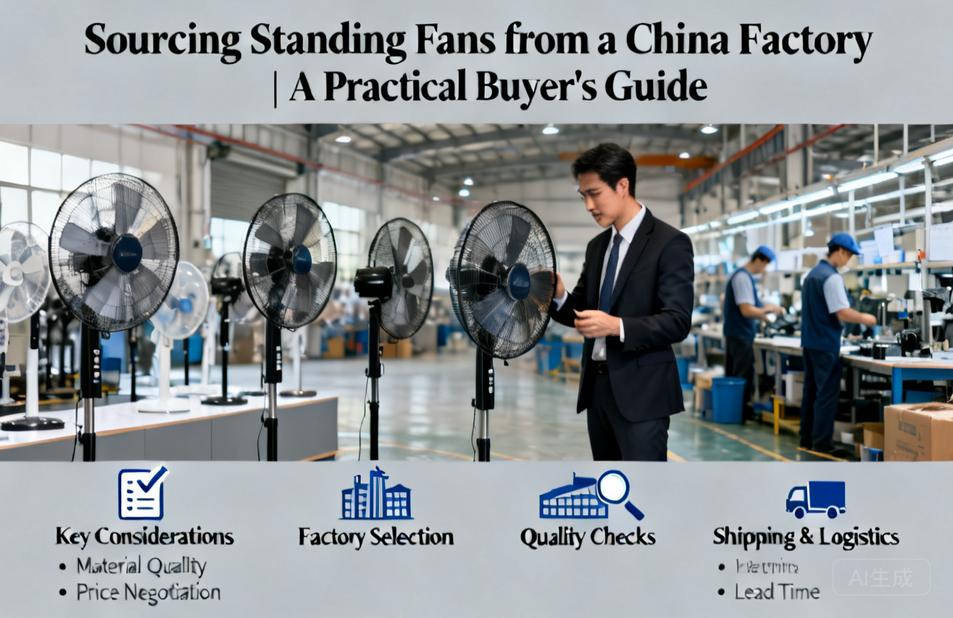
A standing fan is a freestanding air circulation appliance used in homes, offices, workshops, and light industrial spaces to move air and improve comfort. For importers, distributors, and private-label brands, working with a standing fan China factory can shorten the development cycle and provide access to a broad range of pedestal fan designs. This guide explains how these fans work, what to evaluate, and how to approach supplier selection and OEM or custom projects without overlooking the details that affect long-term product quality.
Understanding the Standing Fan Product Category
Standing fans, also called pedestal fans or floor fans, consist of a motor and blade assembly mounted on a height-adjustable stand with a weighted base. Most models offer oscillation, multiple speed settings, and adjustable tilt. Blades are commonly housed in a protective grille, and the stand may be telescopic or fixed depending on the design. Buyers often categorize products by blade diameter, control type, and intended use, which helps when comparing quotations from different suppliers.
In trade discussions, importers may refer to these products as floor-standing fans, pedestal fans, tower-style air circulators, or oscillating stand fans. Clear terminology matters when requesting samples, because a supplier may offer several platform families that differ in motor type, control interface, and assembly method.
How a Standing Fan Works
The motor drives the blades to displace air, and the grille directs the airflow while protecting users from the rotating parts. Oscillation is typically produced by a small gear mechanism that sweeps the head from side to side. Controls may be mechanical, remote-based, or electronic, and some designs include timer functions or adjustable height. For buyers, the key engineering considerations are motor durability, blade balance, stand stability, and ease of assembly for the target market.
Air performance depends on blade geometry, motor speed, and grille design. Rather than assuming that a larger blade always produces better results, buyers should compare performance expectations with the intended application, such as personal cooling in a bedroom or general air movement in a workshop.
Typical Configurations and Key Features
Standing fans are available in several practical configurations. Understanding these options helps purchasing teams define a specification that matches their market and price positioning.
- Blade diameter and grille style: different sizes suit domestic, commercial, or light industrial settings.
- Control type: mechanical knobs, push buttons, or electronic panels with remote control.
- Speed and oscillation settings: basic models may offer limited speed choices, while more advanced designs provide additional modes.
- Stand and base design: telescopic height adjustment, weighted bases, and cross-style bases affect stability and packaging.
- Motor and assembly details: buyers should ask about motor construction, bearing type, and expected service life based on the supplier’s own testing information.
Brands considering a private-label program should discuss grille finish, blade color, control labeling, and packaging graphics early, because these choices influence tooling and production planning.
Materials and Construction Considerations
Common visible materials include plastic and metal for blades and grilles, painted or plated steel for the stand, and molded plastic or metal for the base. Material selection affects weight, durability, appearance, and packaging cost. Buyers should ask the factory to clarify which components are molded in-house and which are sourced, since this influences quality control and lead-time planning.
For markets with specific regulatory or labeling expectations, confirm how the supplier documents product safety and electrical requirements. Avoid assuming that a product meets a given standard until the factory provides verifiable documentation for the exact model being purchased.
Where Standing Fans Are Used
Standing fans serve a wide range of applications. In households they provide seasonal comfort in living rooms and bedrooms. In offices and retail spaces they support general air movement. In workshops and light industrial areas they help circulate air where fixed ventilation is limited. Because pedestal fans are portable and height-adjustable, they are also used in waiting areas, gyms, and event spaces.
For commercial buyers, the intended application should guide specification. A fan designed for a bedroom may not be suitable for continuous operation in a busy workshop, and a robust floor fan may be heavier and more expensive than needed for domestic retail channels.
How to Choose a Standing Fan Supplier in China
Selecting a reliable manufacturer is as important as selecting the product. A practical evaluation process includes the following steps:
Define the product brief first
Prepare a clear specification covering blade size, control type, stand design, voltage and plug requirements for the destination market, packaging expectations, and any branding requirements. A precise brief helps suppliers quote comparable products.
Assess manufacturing capability
Ask how the factory handles motor assembly, blade balancing, and final testing. A supplier that can explain its production flow and quality checkpoints is easier to evaluate than one that only provides a catalog. Where possible, request samples from the actual production line rather than a specially prepared unit.
Review documentation and communication
Request product documentation, user manual drafts, and packaging artwork templates. Clear communication during sampling often indicates how a supplier will handle production follow-up and after-sales questions.
Compare total cost, not unit price alone
Packaging, carton size, assembly labor, and spare-part support all affect the landed cost. Buyers should compare quotations on a like-for-like basis and confirm what is included in the price.
OEM and Custom Options
Many standing fan factories in China support OEM and custom programs for importers and brands. Typical customization areas include logo placement, color matching, control panel labeling, grille design, packaging, and user manuals in the target language. More involved projects may involve changes to the stand, base, or blade design, which usually require tooling investment and longer development time.
Before committing, clarify ownership of tooling, minimum order quantities for custom colors, sample approval steps, and how changes are documented. A factory that asks detailed questions about the intended market and application is often better prepared to support a custom project than one that accepts every request without discussion.
Buying Considerations for Importers
Purchasing teams should plan for seasonal demand patterns, spare-part availability, and packaging durability for long-distance shipping. It is also useful to confirm how the supplier handles voltage variants and plug configurations for different regions. Buyers should request inspection criteria and agree on acceptance standards before mass production, and they should keep approved samples for reference.
When comparing suppliers, distinguish between trading companies and direct manufacturers by asking about production facilities and component sourcing. Neither model is automatically better, but the choice affects communication, flexibility, and cost structure.
Frequently Asked Questions
Can a China factory produce standing fans under our brand?
Many factories offer OEM and private-label programs covering logo, color, packaging, and manual customization. The scope depends on the supplier’s tooling and production setup, so buyers should confirm the exact customization options and related order requirements before proceeding.
What information should I provide when requesting a quotation?
Provide blade size, control type, voltage and plug standard, preferred materials, packaging requirements, target quantity, and any branding needs. Clear specifications help suppliers quote accurately and reduce back-and-forth during sampling.
How can I evaluate standing fan quality before mass production?
Request production-representative samples, review assembly quality and blade balance, and ask about the factory’s testing procedures. Agree on inspection criteria and keep an approved sample as the reference standard for bulk orders.
Are custom designs available for different markets?
Yes, suppliers can often adapt controls, labeling, manuals, and packaging for different regions. More significant design changes may require tooling and additional development time, so discuss the scope early in the project.
Conclusion
Sourcing standing fans from a China factory works best when buyers define the application, compare suppliers on capability and communication, and plan customization carefully. Focus on motor and assembly quality, stand stability, packaging, and documentation rather than unit price alone. If you are developing a standing fan program for your market, contact a supplier to discuss specifications, intended applications, OEM options, and custom requirements so the product matches your channel and customer expectations.