
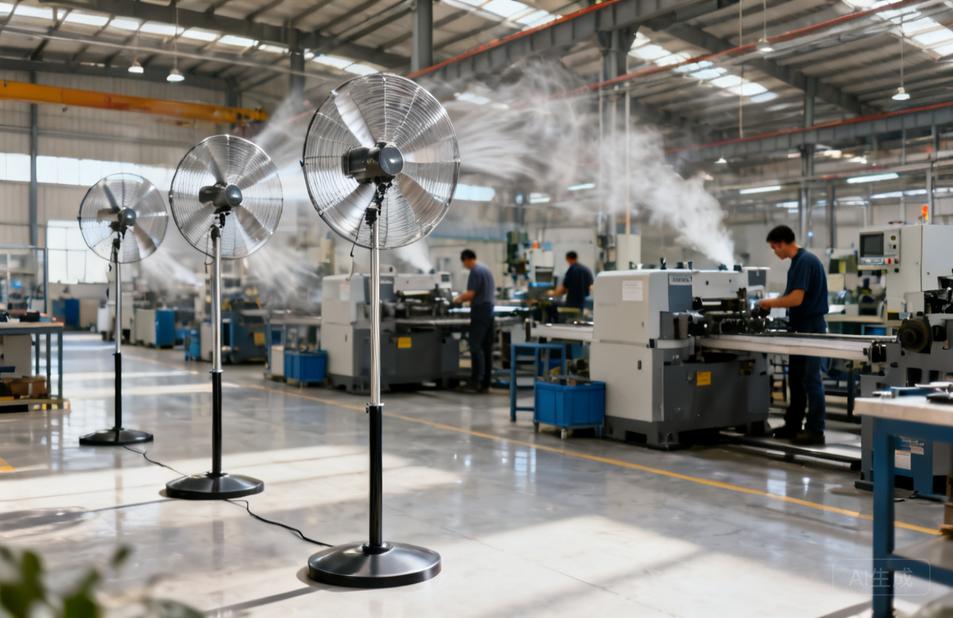
A standing air circulator manufacturer is a factory that produces pedestal-style fans designed to move air directionally for cooling and ventilation in commercial, industrial, or residential spaces. Buyers select a manufacturer based on verified production capabilities, component quality, safety compliance, and ability to meet OEM or private-label requirements.
What Is a Standing Air Circulator?
A standing air circulator, also known as a pedestal air circulator, is a freestanding fan with a tall adjustable stand that elevates the fan head above floor level. Unlike conventional pedestal fans, air circulators are engineered to produce a focused, high-velocity air stream that can travel greater distances. They typically feature a deeply pitched blade design and a directional grille or shroud to concentrate airflow. Common uses include workshops, warehouses, gyms, agricultural buildings, and large open commercial areas where air movement is needed without ductwork.
Why Source from a Dedicated Manufacturer?
Working directly with a standing air circulator manufacturer gives buyers control over specifications, component sourcing, and quality checkpoints. Dedicated factories have specialized tooling, assembly lines, and testing equipment for air movement products. They can support OEM projects, including custom blade profiles, motor specifications, voltage and plug configurations, and branding. For distributors and private-label brands, a manufacturer with experience in export markets can also provide documentation for safety and performance compliance, reducing the risk of shipment delays or rejections.
Key Evaluation Criteria for a Standing Air Circulator Manufacturer
When shortlisting suppliers, assess the following areas. Not every factory will excel in all of them, so prioritize based on your program’s needs.
1. Production Capability and Specialization
Confirm whether the factory focuses on air movement products or produces a broad mix of small appliances. Specialized manufacturers are more likely to have refined assembly processes, consistent motor sourcing, and in-house testing for airflow and noise. Ask for a list of current product types and general production capacity. Specifications vary by model, so request datasheets for the specific circulator platform you are considering.
2. Component Quality and Traceability
The performance and durability of a standing air circulator depend heavily on the motor, blades, and bearings. Discuss with the supplier how they source these components, whether they use copper or aluminum motor windings, and what bearing type is used. For long-duty cycles, bearing quality and thermal protection are important. Request details on any overload protection and the expected continuous operating limits, which should be confirmed in the model datasheet.
3. Safety and Compliance
Export markets require compliance with local electrical safety and electromagnetic compatibility regulations. Ask the manufacturer which certifications they can support for your target market and whether they can provide test reports from recognized laboratories. Do not assume that a certificate for one model covers all models; verify that the specific product you intend to import has valid documentation. Also review construction details such as grille spacing, guard strength, and stability of the stand, which affect user safety.
4. OEM and Customization Services
If you need private-label or customized products, clarify the manufacturer’s experience with OEM projects. This includes custom exterior colors, logo placement, packaging design, voltage and frequency variants, and plug types. Ask how they handle engineering changes and whether they can provide samples that reflect production specifications. For customized blades or motor modifications, request performance data to confirm the airflow and noise targets can be met.
5. Quality Control and Testing
Review the factory’s quality control process from incoming components to final inspection. Key checkpoints for air circulators include motor performance testing, blade balance, run-in tests, high-voltage insulation tests, and airflow verification. Ask whether they perform 100% functional testing or batch sampling. Also inquire about packaging drop tests and carton strength, as standing fans are bulky and prone to shipping damage.
6. Communication and Export Experience
A manufacturer accustomed to working with overseas buyers will understand documentation, shipping terms, and compliance requirements. Evaluate responsiveness during the inquiry stage and ask for references or examples of past export projects, if available. Clear communication about lead times, MOQ, and payment terms is essential; however, these details should be confirmed in a formal quotation rather than assumed from general statements.
What to Send a Supplier Before Requesting a Quote
To receive an accurate and comparable quotation, provide the supplier with a clear specification package. Include the following where applicable:
- Intended application and operating environment (e.g., workshop, warehouse, gym)
- Required voltage, frequency, and plug type
- Desired airflow and noise level, if known, or reference to a current model
- Stand height adjustment range and head oscillation requirements
- Material and finish preferences for blades, grille, and stand
- Speed control type (e.g., mechanical switch, remote, variable speed)
- Branding and packaging requirements for OEM or private label
- Target market and required compliance certifications
- Estimated annual volume and order frequency
Providing this information reduces back-and-forth and helps the manufacturer recommend a suitable platform or propose a custom solution.
Limitations and Trade-offs
Standing air circulators are effective for directional air movement but are not a substitute for air conditioning in high-heat environments. They can improve comfort through evaporative cooling on skin, but performance depends on humidity and ambient temperature. Compared with ceiling or wall-mounted fans, pedestal models occupy floor space and require stable placement to avoid tipping. Buyers should also consider that higher airflow often comes with increased noise, so model selection should balance these factors for the intended setting.
Buyer Checklist
Use this checklist to structure supplier evaluations:
- Verify the manufacturer’s product focus and production capacity.
- Request component specifications and datasheets for the exact model.
- Confirm compliance documentation for your target market.
- Ask for samples and inspect build quality and performance.
- Review quality control procedures and testing reports.
- Clarify OEM terms, MOQ, lead time, and payment conditions in writing.
- Check packaging and shipping arrangements for bulk orders.
By following a structured evaluation process, buyers can identify a standing air circulator manufacturer that meets technical, commercial, and compliance requirements.
Frequently Asked Questions
What is the difference between a standing air circulator and a regular pedestal fan?
A standing air circulator is designed to produce a focused, high-velocity air stream that travels farther, while a regular pedestal fan typically provides broader, gentler air movement. Circulators often have more aggressively pitched blades and a directional grille.
What certifications should I look for in a standing air circulator?
Certification requirements depend on your target market. Common ones include CE for Europe, UL or ETL for North America, and CCC for China. Always verify that the specific model has valid test reports from recognized laboratories.
Can standing air circulator manufacturers support custom voltage and plug types?
Many manufacturers offer voltage and plug customization for OEM orders. Confirm the available options and request samples to verify performance and safety compliance for the modified configuration.
What information should I provide to get an accurate quotation?
Provide details on intended use, required airflow and noise levels, voltage and plug type, stand height, speed control, material preferences, branding and packaging needs, target market certifications, and estimated order volume.
How can I verify the quality of a standing air circulator before placing a bulk order?
Request production-representative samples and inspect motor quality, blade balance, grille strength, and stand stability. Ask for test reports on airflow, noise, and electrical safety. If possible, visit the factory or arrange a third-party inspection.
Company Information and Technical Inquiries
Company: Dongguan Yanxuan Electrical Appliances Co., Ltd.
Address: No. 3, Liuhua Industrial Road, Dongcheng Subdistrict, Dongguan, Guangdong, China
Phone: +8613253611781
Email: 847317465@qq.com