
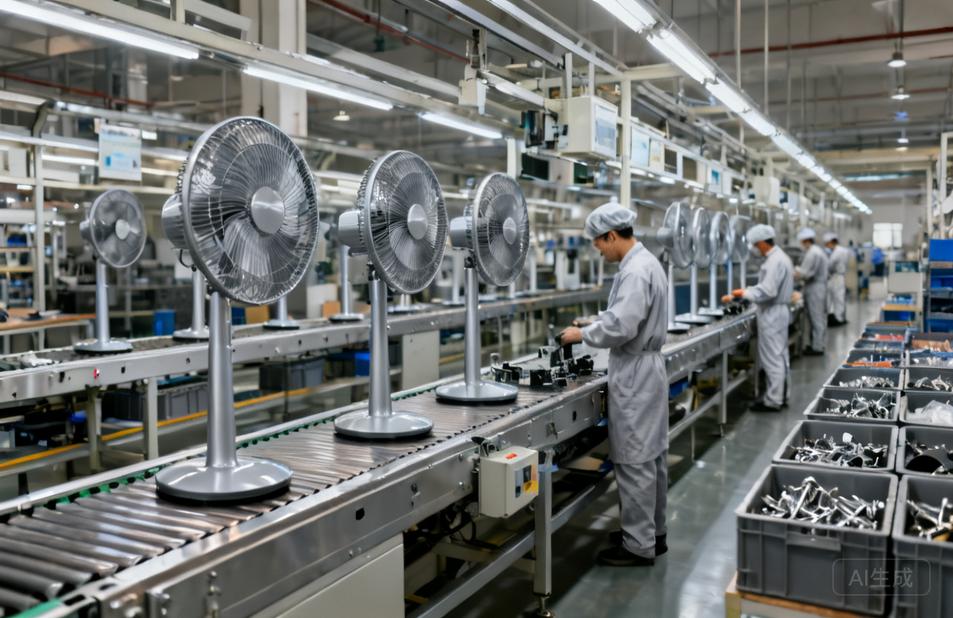
A standing air circulator factory is a manufacturing facility that designs and produces floor-standing fans engineered for directional, high-velocity airflow. These factories supply B2B buyers with standard or customized units for residential, commercial, and industrial cooling applications. Buyers evaluate factories on production capability, quality control, component sourcing, and customization support.
What a Standing Air Circulator Factory Does
Unlike a simple assembly workshop, a standing air circulator factory typically handles multiple stages: product design and engineering, mold making (for plastic parts), metal stamping and surface treatment, motor and blade assembly, final product testing, and packaging. Some factories specialize in a narrow range of circulator models, while others offer a broader portfolio that may include pedestal fans, wall-mounted fans, and industrial blowers.
The key output is a finished unit that meets the buyer’s specifications for airflow, noise, power consumption, safety, and durability. Factories may work from their own designs (stock models) or develop custom models based on a buyer’s requirements (OEM/ODM).
Key Considerations When Evaluating a Factory
Selecting a standing air circulator factory requires more than comparing price lists. Buyers should assess the following areas:
1. Production Capability and Capacity
Ask about the factory’s monthly output, number of assembly lines, and whether production is in-house or outsourced. A factory with in-house injection molding, motor winding, and testing equipment generally offers better control over quality and lead times. Verify that capacity aligns with your order volume and seasonal peaks.
2. Quality Control System
A robust quality control process includes incoming material inspection, in-process checks, and final product testing. Look for documented procedures and ask how the factory handles non-conforming units. Key tests for air circulators may include airflow measurement, power input, temperature rise, noise level, and safety checks such as insulation resistance and ground continuity. The specific tests and acceptance criteria should be confirmed in the factory’s quality manual and product datasheet.
3. Component Sourcing and Traceability
Motors, blades, switches, and power cords are critical components. Ask whether the factory uses branded or generic components and whether certificates of conformity are available. Traceability helps isolate issues if a batch fails. For buyers targeting markets with specific regulatory requirements, confirm that components carry the necessary approvals.
4. Customization and Engineering Support
If you need OEM or ODM service, evaluate the factory’s engineering team. Can they modify blade design, adjust motor speed settings, change housing colors, or add features like oscillation or remote control? Ask for examples of past custom projects (without disclosing confidential details) and clarify the process for design reviews, prototyping, and validation.
5. Certifications and Compliance
Standing air circulators are subject to electrical safety and EMC regulations in most markets. Common certifications include CE (Europe), UL or ETL (North America), and CCC (China). Confirm that the factory can provide valid test reports and certificates for the exact models you intend to import. Certifications are model-specific and must be verified; do not assume a certificate covers all products from a factory.
6. Communication and Project Management
Responsiveness, English-language capability, and a clear escalation path are practical indicators of a reliable partner. Ask for a dedicated account manager and a sample project timeline. Poor communication during the evaluation phase often signals problems during production.
Applications and Suitability
Standing air circulators are used where air needs to be moved efficiently over a distance—often in workshops, warehouses, gyms, garages, and large living spaces. They differ from conventional pedestal fans in that they prioritize directed airflow and higher air velocity rather than wide-area gentle cooling. Buyers should match the circulator’s airflow pattern and noise level to the intended environment. For example, a factory floor may tolerate higher noise but require robust construction, while a retail space may prioritize quiet operation and appearance.
Selection Criteria: What to Verify Before Ordering
Before committing to a factory, gather and verify the following:
- Product specifications: Airflow (m³/h or CFM), power input (W), voltage/frequency, speed settings, noise level (dB), and dimensions. These vary by model and must be confirmed in the datasheet.
- Bill of materials: Request a BOM for the proposed model to understand component quality and identify potential cost drivers.
- Certification documents: Valid certificates and test reports for the target market.
- Sample evaluation: Order pre-production samples and test them against your requirements. Document any deviations.
- Factory audit: Conduct a video or on-site audit covering production lines, testing equipment, and quality records.
- Commercial terms: MOQ, lead time, payment terms, and warranty. These are negotiable and should be confirmed in writing.
Limitations and Trade-offs
No factory is ideal for every buyer. A factory with low MOQs and strong customization may have higher unit costs or longer lead times. A large-scale factory may offer competitive pricing but require higher order volumes and offer limited flexibility. Buyers should prioritize the factors most critical to their business model—whether that is speed, cost, certification support, or design flexibility.
What Information to Send to a Supplier
To get an accurate response, prepare a brief that includes: target market and required certifications, desired airflow and power specifications (or reference samples), estimated order quantity, customization requirements (logo, packaging, color), and target delivery date. Clear input reduces back-and-forth and helps the factory quote realistically.
Frequently Asked Questions
What is the difference between a standing air circulator and a pedestal fan?
A standing air circulator is designed to produce a focused, high-velocity air stream for directional cooling or ventilation, while a pedestal fan typically provides broader, gentler air movement. Circulators often have deeper blades and a more enclosed grill to direct airflow.
How can I verify a factory’s quality control?
Request a factory audit (on-site or video) and review their quality manual. Ask for records of incoming inspection, in-process checks, and final testing. Evaluate pre-production samples and compare them to the specifications.
What certifications should a standing air circulator have?
Certifications depend on the target market: CE for Europe, UL or ETL for North America, and CCC for China. Confirm that certificates are valid for the specific model and that test reports are available.
Can factories customize standing air circulators for OEM orders?
Many factories offer OEM and ODM services, including custom branding, packaging, color, and some design modifications. Capabilities vary; discuss your requirements and request samples to verify.
What information should I provide to get a quote?
Provide target market and certifications, desired specifications (airflow, power, noise), order quantity, customization details, and delivery timeline. Clear requirements help factories quote accurately.
Company Information and Technical Inquiries
Company: Dongguan Yanxuan Electrical Appliances Co., Ltd.
Address: No. 3, Liuhua Industrial Road, Dongcheng Subdistrict, Dongguan, Guangdong, China
Phone: +8613253611781
Email: 847317465@qq.com