
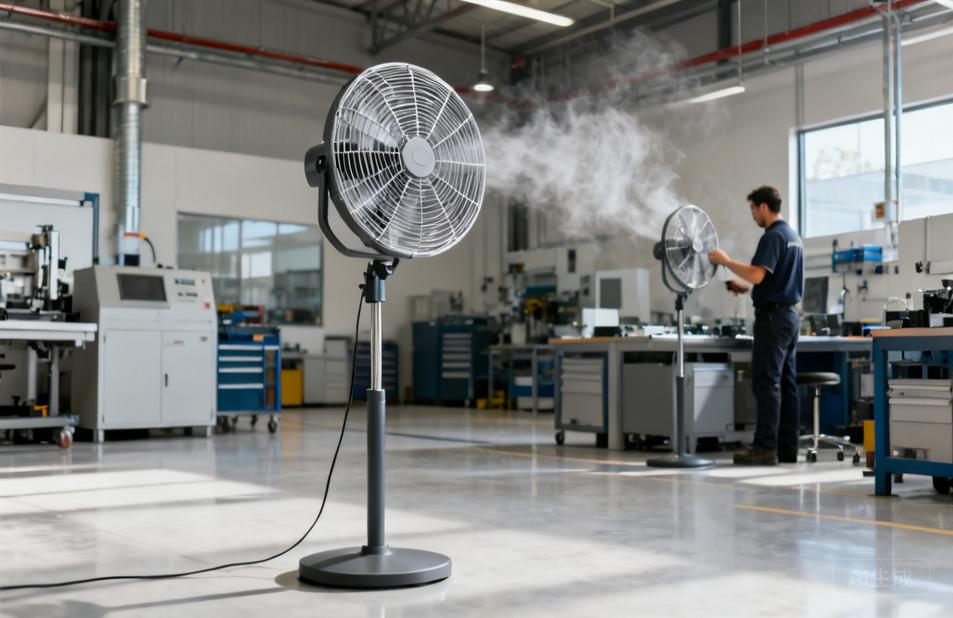
A standing air circulator supplier provides pedestal-style fans designed to move air efficiently across a room or workspace. Buyers select a supplier by verifying product specifications, quality control processes, and ability to meet their commercial or OEM requirements.
Unlike a standard pedestal fan that primarily cools people in its immediate airflow, a standing air circulator is engineered to produce a focused, high-velocity air stream that promotes air mixing throughout a space. This distinction makes the circulator suitable for commercial rooms, workshops, and large open areas where consistent air movement is needed. However, performance depends on correct sizing, placement, and operating conditions, so buyers should evaluate suppliers on technical transparency and documentation rather than marketing claims.
What a Standing Air Circulator Does
A standing air circulator uses a large-diameter fan blade and a specially shaped grille or housing to direct air in a concentrated pattern. The goal is not necessarily to cool the air temperature but to increase air velocity and circulation, which can improve perceived comfort and help distribute conditioned air more evenly. Typical features include adjustable height, tilt or oscillation, multiple speed settings, and sometimes remote control or timer functions. Buyers should confirm whether the model is intended for continuous commercial use or intermittent household use, as duty cycle and motor construction affect suitability.
Key Considerations When Evaluating a Supplier
Supplier evaluation should go beyond price lists. The following factors help distinguish a capable supplier from one that may struggle with consistency or communication.
Product Specification Transparency
Request detailed datasheets for each model. Look for clear information on fan diameter, airflow (often stated in cubic meters per hour or cubic feet per minute), power consumption, voltage and frequency options, speed settings, noise level (if available), and materials. Be cautious if a supplier provides only vague descriptions. Ask whether specifications are typical values or guaranteed minimums, and confirm test conditions. Because specifications vary by model and market, always verify the final datasheet for the exact model you intend to order.
Quality Control and Testing
Ask how the supplier controls quality during production. A structured process typically includes incoming component inspection, in-process checks, and final functional testing. Inquire about testing equipment and procedures for motor performance, blade balance, electrical safety, and packaging drop tests. For commercial buyers, documentation of test records and traceability can be important. Avoid suppliers who cannot describe their QC steps in specific terms.
Certifications and Compliance
Depending on your market, the product may need to meet specific electrical safety, electromagnetic compatibility, or energy efficiency requirements. Ask the supplier which certifications they currently hold for the models you are considering and whether they can provide test reports from recognized laboratories. Do not assume that a certificate for one model covers all models; confirm scope and validity. As a buyer, you remain responsible for verifying that the product meets your local regulations.
Customization and OEM Capability
If you need private label or custom specifications, discuss the supplier’s experience with OEM projects. Topics include custom voltage and plug types, branding on the product and packaging, color matching, and modifications to controls or features. Ask for examples of previous customization work (without disclosing confidential client details) and clarify the minimum order quantity and tooling requirements. Be wary of suppliers who claim unlimited flexibility without explaining engineering constraints or additional costs.
Communication and Responsiveness
Clear, timely communication is a practical indicator of supplier reliability. Pay attention to how quickly and thoroughly the supplier answers technical questions, whether they provide documentation promptly, and whether they can communicate in your language. Ambiguous or delayed responses during the evaluation stage may signal future difficulties during production or shipping.
Applications and Suitability
Standing air circulators are commonly used in commercial spaces, workshops, warehouses, gyms, and large rooms where air movement is needed. They can help improve comfort in areas without adequate HVAC distribution or supplement existing systems. However, they are not a substitute for air conditioning or ventilation that removes heat, humidity, or contaminants. In environments with high dust, flammable atmospheres, or strict hygiene requirements, standard circulators may not be suitable; specialized models or alternative solutions should be considered. Buyers should match the circulator’s airflow pattern and duty rating to the specific environment.
Limitations and Trade-offs
Higher airflow often comes with increased noise, so consider the noise level relative to the application. For noise-sensitive spaces such as offices or retail areas, quieter models or lower speed settings may be necessary. Energy consumption should be evaluated against airflow delivered; a more efficient motor may cost more initially but reduce operating costs. Physical size and stability also matter, especially in areas with foot traffic. Buyers should request dimensions, weight, and center-of-gravity information to assess tip resistance. Finally, availability of spare parts and after-sales support varies by supplier; clarify these terms before committing.
Buyer Checklist: Information to Request
Before selecting a standing air circulator supplier, gather the following information:
- Complete technical datasheets for each model, including performance curves if available.
- Certification documents and test reports applicable to your target market.
- Quality control process description and sample inspection reports.
- Customization options, minimum order quantities, and tooling costs.
- Packaging specifications and shipping terms.
- Warranty terms and spare parts availability.
- References or case studies from similar markets or applications, if available.
Provide the supplier with your target market, required certifications, estimated order volume, and any custom requirements. This helps them respond accurately and reduces the risk of misalignment. By focusing on verified specifications and transparent processes, you can select a standing air circulator supplier that meets your commercial needs.
Frequently Asked Questions
What is the difference between a standing air circulator and a regular pedestal fan?
A standing air circulator is designed to produce a focused, high-velocity air stream for air mixing, while a regular pedestal fan typically provides a softer, more diffuse airflow for personal cooling. Circulators often have larger blades and shaped grilles to direct air over longer distances.
What specifications should I request from a standing air circulator supplier?
Ask for fan diameter, airflow rate, power consumption, voltage and frequency, speed settings, noise level, materials, and dimensions. Also request certification documents and test reports for your target market.
Can standing air circulators be used in industrial environments?
They can be used in some industrial settings such as workshops and warehouses, but suitability depends on the environment. Standard models are not designed for flammable atmospheres or high-dust areas without appropriate protection. Check the duty rating and IP rating if applicable.
How do I verify a supplier’s quality control?
Ask for a description of their QC process, including incoming inspection, in-process checks, and final testing. Request sample inspection reports and, if possible, arrange a factory audit or third-party inspection.
What customization options are typical for OEM orders?
Common customizations include voltage and plug type, branding on the product and packaging, color, and control features. Minimum order quantities and tooling costs vary by supplier and should be confirmed in writing.
Company Information and Technical Inquiries
Company: Dongguan Yanxuan Electrical Appliances Co., Ltd.
Address: No. 3, Liuhua Industrial Road, Dongcheng Subdistrict, Dongguan, Guangdong, China
Phone: +8613253611781
Email: 847317465@qq.com