
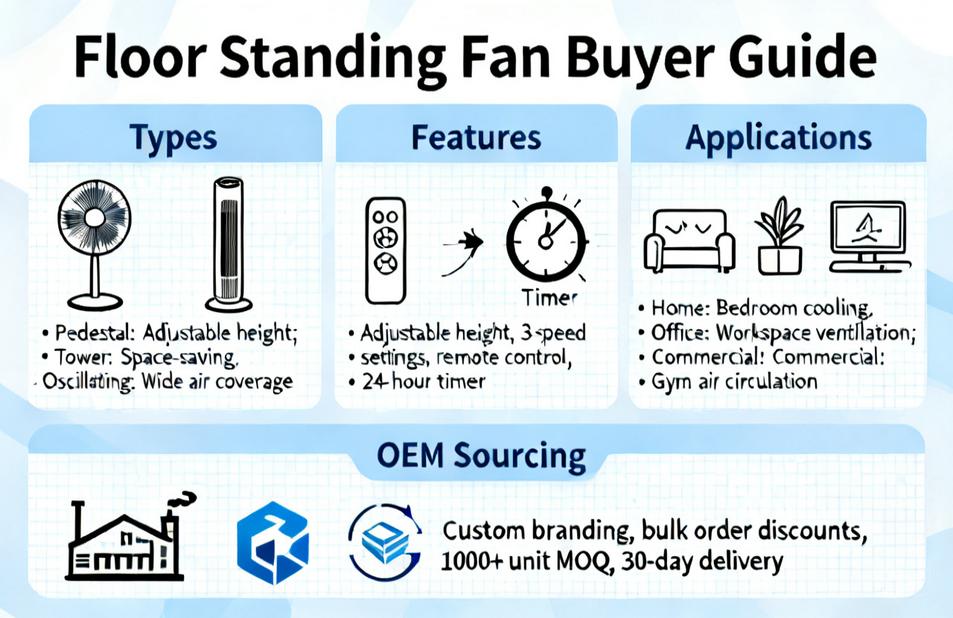
A floor standing fan is a freestanding air circulation unit that moves large volumes of air across workshops, warehouses, garages, retail spaces and other open areas without permanent installation. Unlike ceiling or wall mounted units, it can be repositioned to match changing production layouts or seasonal ventilation needs. For overseas buyers, this guide explains how these fans work, the features that matter in industrial and commercial settings, and what to check before choosing a manufacturer or supplier for an OEM program.
Product Overview and Working Principle
A typical floor standing fan combines a motor, a fan blade assembly, a protective guard and a pedestal stand. The motor rotates the blades, drawing air in from behind and pushing it forward in a directed stream. Most units offer several speed settings and an adjustable head angle, allowing the airflow to be aimed at workstations, aisles or equipment clusters. Pedestal height adjustment is common on commercial models so the air stream can be set at standing, seated or machinery level.
In industrial environments, the airflow requirement is usually higher than in a home setting. Buyers often look at air delivery volume, motor input power and blade diameter together, because these three factors determine how much air the unit can move and how far the stream reaches. A floor standing fan is not a substitute for a properly designed ventilation system, but it is a practical way to improve local air movement, reduce heat buildup and support worker comfort in large open spaces.
Key Features Buyers Commonly Evaluate
Motor and Speed Control
The motor is the core of any pedestal fan. Copper winding motors are generally preferred for continuous duty because they handle longer running hours better than low-grade alternatives. Buyers should confirm the rated voltage, frequency and input power for their target market, along with the number of speed settings and whether a thermal protection device is included.
Blade Design and Air Delivery
Blade count, diameter and pitch shape affect airflow and noise. Larger diameter blades move more air at lower rotational speed, which often helps keep noise down. Metal blades are common in workshops and factories where durability matters, while reinforced plastic blades are used in lighter commercial applications. Buyers should request airflow data measured under defined test conditions rather than relying on descriptive claims.
Guard and Safety
A close-mesh front and rear guard protects operators from the rotating blades. Buyers serving markets with strict safety expectations should review guard spacing, fastening method and whether the guard can be removed for cleaning without tools. Stability of the base is also important, particularly when the fan runs at higher speeds or on uneven floors.
Stand and Mobility
Pedestal stands vary from simple tripod bases to weighted round bases with casters. Casters make it easier to reposition a floor standing fan between bays or work zones, while weighted bases reduce the chance of tipping. Buyers should match the stand type to how the fan will actually be moved and used on site.
Materials and Construction
Construction directly affects service life in dusty or humid environments. Common body materials include powder-coated steel and painted metal for the stand and guard, with ABS or similar plastics used for some blade and housing components. For factories, workshops and agricultural buildings, buyers should ask about surface treatment and corrosion resistance rather than assuming a generic finish is suitable. Motor housings should be checked for sealing quality if the fan will operate in dusty areas. Requirements vary by application, so buyers should discuss the operating environment with the supplier before confirming a specification.
Industrial and Commercial Applications
- Manufacturing and assembly workshops where local air movement improves comfort at workstations.
- Warehouses and distribution centers where air can become stagnant in large open bays.
- Garages, maintenance shops and service areas where temporary ventilation is needed.
- Retail and exhibition spaces where quiet operation and appearance matter.
- Agricultural buildings and greenhouses where air circulation supports a healthier environment.
- Event venues, temporary structures and seasonal facilities without fixed HVAC systems.
Each industrial application has its own airflow and noise priorities. A warehouse may prioritize high air volume and portability, while a retail floor may prioritize quieter operation and a clean finish. Providing the supplier with the room size, ceiling height, ambient conditions and worker positioning helps narrow the specification quickly.
How to Choose the Right Floor Standing Fan
Start with the space. Estimate the floor area, ceiling height and how many air changes or how much local airflow are needed. Then identify the mounting position and whether the unit must be moved during the day. Next, define the power supply available at the site, because voltage and frequency must match local requirements. Buyers should also decide on acceptable noise levels, blade material and guard type before requesting quotations.
It is worth asking for dimensional drawings, motor specifications and test parameters so different offers can be compared on equal terms. A supplier who can explain airflow, power draw and noise together is usually easier to work with during later customization. Buyers who need volume should also confirm whether the factory can support consistent production runs and spare parts supply.
Customization and OEM Options
Many suppliers offer OEM and custom programs for floor standing fans. Typical customization areas include voltage and plug type for different markets, blade diameter, stand height, color and finish, logo placement, packaging and user manual language. Some factories can also adjust speed control configuration or add features such as oscillation or remote operation, depending on the platform. When discussing a custom order, buyers should provide a written specification, target market, expected order quantity and any labeling or packaging requirements. Requesting samples or pre-production units helps confirm details before mass production, and it is reasonable to ask the supplier to document agreed changes in the order confirmation.
Buying Considerations and Supplier Selection
When comparing a fan manufacturer or supplier, look beyond the unit price. Check whether the factory has experience with your target market and can provide relevant product documentation. Ask how incoming components and finished units are inspected, and how quality issues are handled after shipment. Confirm lead times for both samples and bulk orders, and clarify warranty terms and spare part availability.
Communication quality is a useful signal. A reliable supplier responds to technical questions with specific information rather than vague statements. Buyers should also clarify whether the supplier is a trading company or a factory, since this affects customization flexibility and technical support. Visiting the factory or requesting a video walkthrough can help verify production capability. For long-term sourcing, consistency of specification across repeat orders is often more valuable than a slightly lower first price.
Frequently Asked Questions
What should I check when buying a floor standing fan for industrial use?
Focus on motor quality, rated voltage and frequency, airflow at each speed, noise level, blade material and guard design. Also confirm stand stability, surface finish and suitability for the dust or humidity level in the working area.
Can floor standing fans be customized for my market?
Many factories offer customization for plug type, voltage, color, branding, packaging and manual language. Provide a written specification and target quantity so the supplier can confirm which options are feasible for your order.
How do I compare airflow between different suppliers?
Request airflow figures measured under the same test conditions, along with blade diameter, motor power and speed setting. Comparing units only by blade size or motor wattage can be misleading because design differences affect actual air delivery.
What information should I give a supplier before requesting a quotation?
Share the application, room size, power supply, required airflow or noise level, portability needs and any OEM or packaging requirements. This helps the supplier recommend a suitable model and prepare an accurate quotation.
Conclusion
Choosing a floor standing fan comes down to matching airflow, motor quality, construction and safety features to the actual working environment. Buyers who define the application and power requirements early can compare supplier offers more effectively and reduce the risk of specification mismatches. If you are evaluating options for a commercial or industrial project, contact a supplier with your room details, target market and customization needs, and ask for the technical documentation needed to make a confident sourcing decision.