
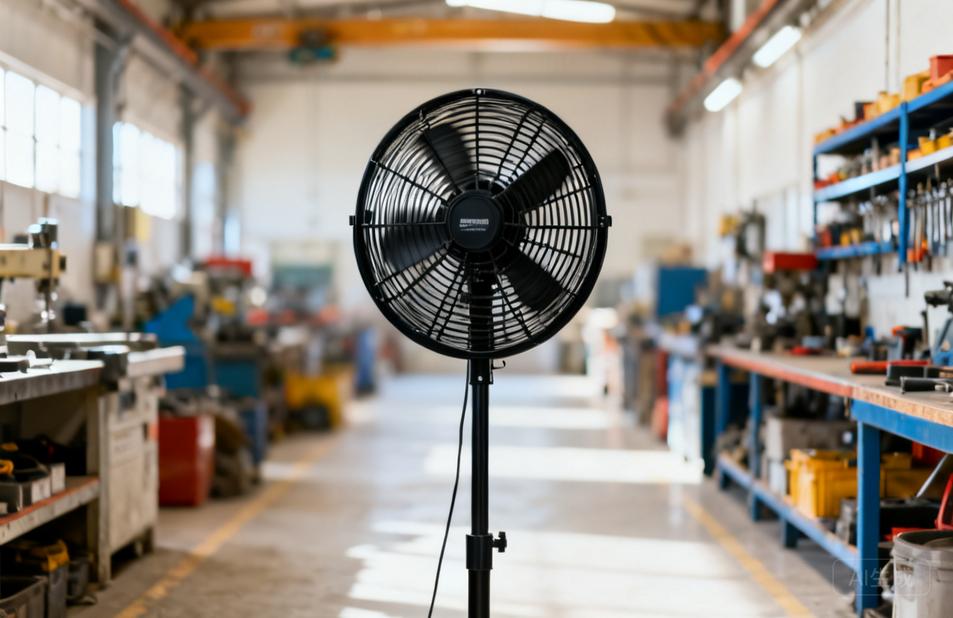
A standing air circulator is a pedestal-mounted fan designed to project a focused, high-velocity air stream across a room rather than cool only the people directly in front of it. Buyers use standing air circulators to improve air movement in workshops, warehouses, retail areas, and other spaces where ceiling mounting is impractical.
How a Standing Air Circulator Differs from a Standard Pedestal Fan
Both products share a floor stand, a motor housing, and a guard, but they are engineered for different jobs. A conventional pedestal fan typically moves a broad, gentle flow toward nearby people. An air circulator uses a deeper blade pitch, a more enclosed shroud, and a directional head to create a collimated jet that travels farther before dissipating.
That difference matters in sourcing. If your customers expect personal cooling, a circulator’s concentrated stream may feel too forceful at close range. If they need to stir stratified air, dry a floor, or push air down a long aisle, a circulator is usually the more suitable format. Many suppliers offer both through the same platform, so confirming the intended function before sampling prevents mismatched expectations.
Why Air Movement Matters in Commercial and Industrial Spaces
Stagnant air creates uneven temperatures, condensation risk, and uncomfortable work zones. A standing circulator addresses this by keeping a volume of air in motion, which can help equalize temperature between high and low areas and improve perceived comfort during warm periods.
It is important to be clear about limits: a circulator moves air, it does not refrigerate it. In hot, dry conditions the benefit is evaporative and convective; in humid spaces, airflow alone may not solve moisture problems. Buyers should align product claims with the actual mechanism rather than marketing language.
Typical Applications
- Workshops and production floors: directing air along workstations where heat builds up from machinery.
- Warehouses and logistics areas: moving air down long aisles and reducing stagnant pockets near racking.
- Commercial interiors: retail floors, gyms, garages, and event spaces where ceiling fans are not an option.
- Drying and ventilation support: assisting air exchange after cleaning or in semi-open industrial buildings.
- Seasonal and temporary use: portable placement where fixed HVAC is unavailable or insufficient.
Key Selection Criteria
Airflow Pattern and Throw
The most important characteristic is how far and how wide the air stream travels. Ask suppliers for airflow and throw information supported by documented test conditions, and note that values vary by model and speed setting. Do not compare figures from different suppliers unless the measurement basis is stated.
Head Adjustment Range
Vertical tilt and horizontal oscillation determine coverage. Fixed-head models suit directed airflow at a specific zone; oscillating models distribute air across a wider area. Confirm the adjustment range and whether oscillation can be locked off.
Speed Control and Motor Type
Multiple speeds allow users to balance noise against airflow. Buyers should confirm whether the motor is AC or DC, which affects speed options and efficiency, and request the electrical specification for the target market.
Stand and Height Adjustability
Pedestal height affects where the air stream is aimed. Telescopic stands offer flexibility but introduce a stability consideration. Check base diameter, base weight, and stability under oscillation, especially for models with large heads.
Guard and Blade Design
Guard spacing and material affect safety and cleanability. In dusty industrial settings, a guard that is difficult to remove becomes a maintenance problem. Ask how the guard, blade, and motor housing are assembled and cleaned.
Noise Level
Circulators can be louder than comfort fans at comparable sizes because of higher air velocity. Request noise data with the test distance and speed setting stated, and match it to the installation environment.
Electrical and Regional Considerations
Voltage, frequency, plug type, and certification requirements differ by destination market. Specifications vary by model and must be confirmed in the datasheet rather than assumed from a web listing. Buyers should provide the target country, supply voltage and frequency, intended indoor environment, and any required certification documentation before requesting samples.
Limitations and Trade-offs
- High velocity can produce noticeable noise and drafts; not ideal for quiet offices with sensitive occupants.
- Pedestal formats occupy floor space and can be a trip hazard in narrow aisles.
- Airflow alone does not control humidity or temperature; expectations should be set accordingly.
- Large heads on lightweight bases may show movement during oscillation; stability should be verified in samples.
Buyer Checklist Before Requesting Samples
- Define the application, room size, and desired airflow direction.
- Confirm voltage, frequency, plug type, and required documentation for the destination market.
- Request datasheets with airflow, speed, power, and noise figures and their test basis.
- Check head adjustment, oscillation control, and stand stability details.
- Ask about guard removal and cleaning procedure for maintenance planning.
- Clarify packaging, carton dimensions, and whether OEM labeling or documentation customization is offered.
- Inspect samples for assembly quality, finish, and noise before committing to a program.
Suppliers such as Dongguan Yanxuan Electrical Appliances Co., Ltd. publish product information online at yanxuanfan.com; buyers should confirm current model specifications directly before design or procurement decisions.
Frequently Asked Questions
What is a standing air circulator used for?
It moves a focused, high-velocity air stream across a space to improve air circulation in workshops, warehouses, retail areas, and other locations where ceiling mounting is impractical.
Is an air circulator the same as a pedestal fan?
No. A pedestal fan generally delivers a broad, gentle flow to nearby people, while a circulator uses a more directional head and blade design to project air farther across the room.
Does a standing air circulator cool the air?
It does not refrigerate air. It increases air movement, which can improve perceived comfort and help equalize temperatures, but it does not lower the actual room temperature.
What specifications should buyers verify?
Confirm airflow and throw with test conditions, speed control, motor type, head adjustment and oscillation, noise data, stand stability, and the electrical specification for the destination market.
What information should be sent to a supplier?
Provide the application, room or aisle dimensions, target voltage and frequency, plug type, required certification documents, preferred control type, and intended OEM or private-label requirements.
Company Information and Technical Inquiries
Company: Dongguan Yanxuan Electrical Appliances Co., Ltd.
Address: No. 3, Liuhua Industrial Road, Dongcheng Subdistrict, Dongguan, Guangdong, China
Phone: +8613253611781
Email: 847317465@qq.com