
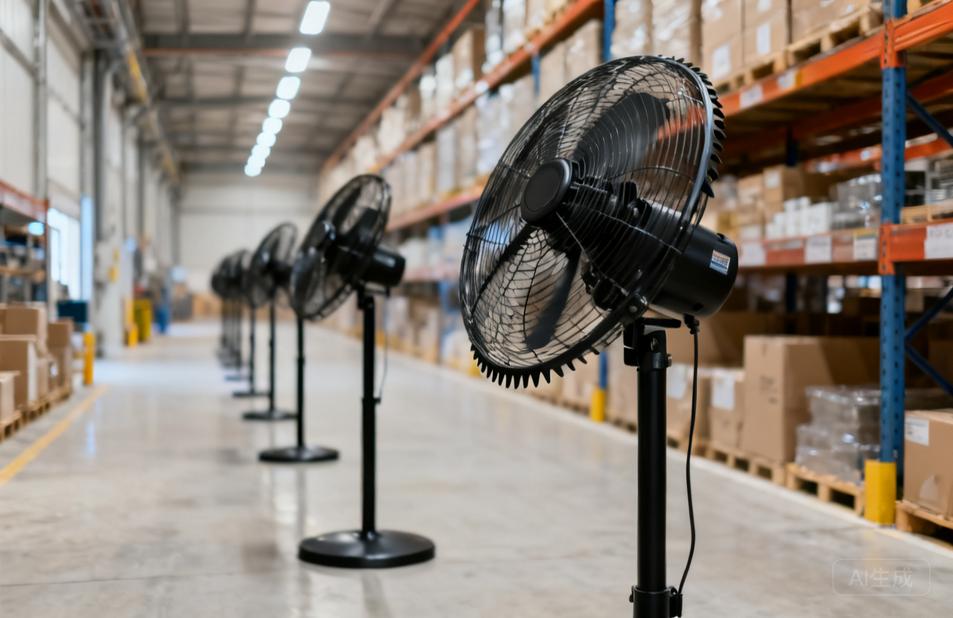
A standing air circulator bulk supplier is a manufacturer or trading company that supplies pedestal-style air circulators in volume to distributors, retailers, contractors, and OEM brands. Buyers use these units to move air over longer distances in workshops, warehouses, gyms, and commercial interiors, and should select suppliers on verified airflow data, motor construction, safety features, and documentation rather than price alone.
This guide explains how to compare suppliers for bulk orders. It focuses on the product characteristics that determine whether a standing air circulator suits a given site, and on the information a buyer should request before committing to a purchase order. Individual models differ substantially, so specifications must always be confirmed against the current datasheet.
What Separates an Air Circulator from a Standard Pedestal Fan
The two product types are often confused, and the distinction matters when specifying for bulk supply. A conventional pedestal fan is designed to cool people nearby, with a wide, soft airflow pattern and an oscillating head. A standing air circulator is engineered to project a more concentrated column of air over a longer distance, so it can support whole-room air movement rather than only local comfort.
Typical design features associated with air circulators include deeper fan blades or a shrouded blade profile, a directional head that can be angled upward or downward, and multiple speed settings. The practical benefit is improved air mixing: stale or stratified air is pushed through the space instead of simply being stirred near the fan.
Because these characteristics vary by model, buyers should request the airflow rate, throw distance if stated, blade diameter, and speed settings in writing. Suppliers should be able to explain how their product is tested and under what conditions figures are quoted.
Key Selection Criteria for Bulk Buyers
1. Airflow and Application Fit
Start with the space the product will serve. Ceiling height, room volume, obstructions, and the number of units planned all affect the required airflow. A buyer sourcing for a warehouse aisle has different needs from one sourcing for a small retail floor or a gym. Ask the supplier for the airflow specification at each speed setting and confirm the measurement method.
2. Motor and Construction
Motor type, bearing arrangement, and housing material influence service life and maintenance requirements. Buyers should confirm whether the motor is AC or DC, the rated voltage and frequency for the destination market, the insulation class where declared, and the housing and guard materials. For humid or dusty sites, ask about moisture and dust protection ratings where the product carries them.
3. Controls and Speed Settings
Control options range from mechanical push buttons to remote control and timer functions. For commercial buyers, consider who will operate the unit: simple controls reduce training and service calls, while remote control can suit installations where the fan is mounted high or placed behind a counter. Confirm whether control interfaces can be adapted for OEM programs.
4. Safety and Stability
Standing units are tall and can be tipped, so base weight and stability matter, particularly in public or high-traffic areas. Verify guard spacing, the locking mechanism for the tilt function, cord length, and plug type for the destination country. Where the product carries safety certifications for a target market, request copies of the relevant documents rather than relying on verbal assurances.
5. Documentation and Compliance
For regulated markets, buyers need product labels, instruction manuals, and declaration documents in the correct language. Electrical approvals differ by region, and buyers should confirm which certificates the supplier can actually provide for the exact model being quoted. Do not assume that a certificate held for one model applies to another.
Comparing Suppliers: Practical Evaluation Steps
- Define the requirement first. Prepare a short specification covering voltage, frequency, plug type, airflow expectation, control type, colour, and packaging. Send the same document to every supplier so quotations are comparable.
- Request model-level datasheets. Ask for data for the specific model offered, not a general catalogue.
- Ask about factory capability relevant to the order. Assembly, motor sourcing, packaging, and testing arrangements can be discussed; the supplier should describe them clearly without overstating capacity.
- Review sample quality. Check blade balance, noise at each speed, guard rigidity, base stability, and finish. A sample review catches issues that a datasheet cannot.
- Confirm packaging for export. Carton strength, drop protection, and master carton configuration affect damage rates in sea freight.
- Agree inspection and acceptance criteria. Define what constitutes a defect and how it will be handled before production begins.
MOQ, price, lead time, and payment terms are commercial variables that must be confirmed directly with each supplier for the specific order; they should not be assumed from a website.
OEM and Private-Label Considerations
Many bulk buyers source standing air circulators for their own brand. Customisation can include colour, housing finish, control layout, packaging design, and manuals. Before placing an order, clarify which elements the supplier can change and which require new tooling or minimum volumes. Also confirm who owns the artwork and packaging files, and what approval steps apply before mass production.
For regulated destinations, customised labelling must still meet local requirements. The supplier should confirm how model numbers and ratings will appear on the nameplate.
Common Limitations and Trade-offs
Air circulators are not a substitute for air conditioning. They improve air movement and perceived comfort but do not reduce temperature or humidity. In very large or partitioned spaces, several units may be needed, and placement matters as much as product choice. Higher airflow settings usually mean more noise, so sites with strict acoustic limits may need to run units at lower speeds or select models designed for quieter operation.
Buyers should also account for maintenance: guards and blades require cleaning, and in dusty environments that service interval shortens.
Buyer Checklist Before Ordering
- Written specification agreed for every model and variant
- Datasheet confirmed for voltage, frequency, plug, airflow, and speeds
- Safety documentation verified for the target market
- Sample inspected and approved
- Packaging and labelling approved
- Inspection criteria and defect handling agreed
- Warranty terms and spare parts availability clarified
Dongguan Yanxuan Electrical Appliances Co., Ltd. is based in Dongguan, Guangdong, China, and can be contacted through its published website and contact details for product enquiries. Buyers should request current specifications and commercial terms directly.
Frequently Asked Questions
What is the difference between a standing air circulator and a pedestal fan?
An air circulator is designed to project a more directed, longer-throw airflow for room air mixing, while a pedestal fan typically provides broader, softer local cooling. Designs vary by model, so confirm airflow data in the datasheet.
What information should I send to a standing air circulator supplier?
Send destination voltage and frequency, plug type, required airflow or room size, control preference, colour, packaging requirements, expected annual volume, and any certification or labelling needs for your market.
Can standing air circulators be supplied with custom branding?
Many suppliers offer OEM and private-label options such as custom colour, housing finish, packaging, and manuals. Confirm which changes are available for the chosen model, since tooling and minimum volumes may apply.
Do air circulators reduce room temperature?
No. Air circulators move air and improve perceived comfort and air mixing but do not lower temperature or humidity. Mechanical cooling is required to reduce room temperature.
How do I verify product specifications for a bulk order?
Request a current datasheet for the exact model, review a sample, and confirm critical figures such as airflow, speed settings, voltage, and safety documentation in writing before production.
What should I check about packaging for export orders?
Confirm carton strength, inner protection, master carton configuration, and labelling. Agree who is responsible for damage claims and how pre-shipment inspection will be conducted.
Company Information and Technical Inquiries
Company: Dongguan Yanxuan Electrical Appliances Co., Ltd.
Address: No. 3, Liuhua Industrial Road, Dongcheng Subdistrict, Dongguan, Guangdong, China
Phone: +8613253611781
Email: 847317465@qq.com