
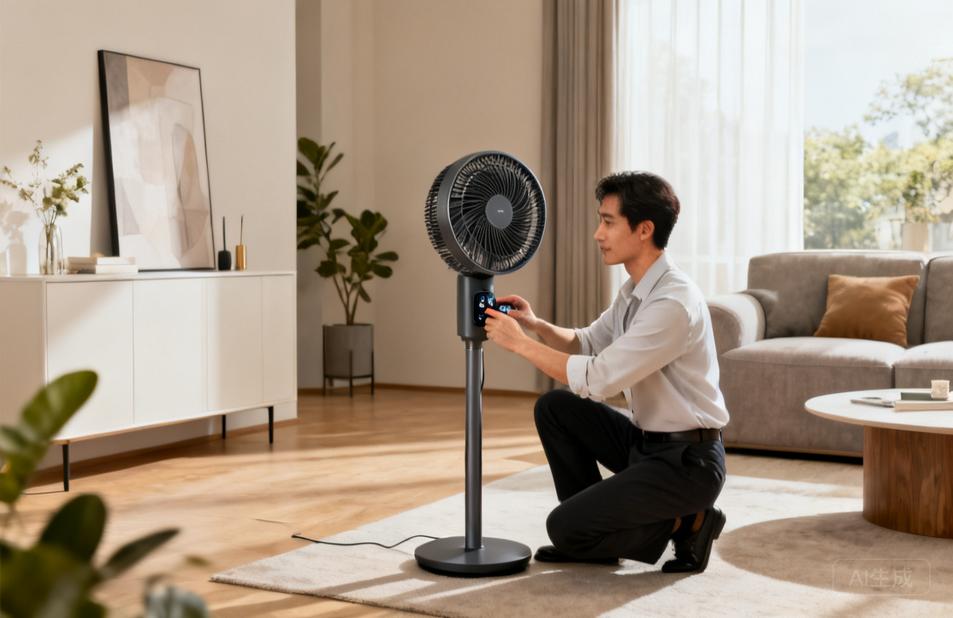
A standing air circulator ODM manufacturer designs and produces pedestal-style air circulators based on your product requirements, including performance targets, aesthetics, and branding. Unlike an OEM supplier that builds to your existing design, an ODM partner handles development from concept to production. This model suits buyers who need a differentiated product but lack in-house design resources.
What an ODM Manufacturer Does
ODM stands for Original Design Manufacturer. In the context of standing air circulators, an ODM manufacturer typically offers:
- Product development: Creating or adapting a circulator design to meet your specifications, such as airflow pattern, oscillation angle, speed settings, and control interface.
- Prototyping: Building functional samples for evaluation and testing before committing to tooling.
- Certification support: Preparing documentation and samples for safety and performance certifications required in your target market. The manufacturer should clarify which certifications they can support and which you must arrange independently.
- Production and quality control: Manufacturing the approved design with agreed inspection processes and acceptance criteria.
ODM differs from OEM in who owns the design. With OEM, you provide the design or specifications, and the factory manufactures to them. With ODM, the manufacturer contributes design expertise and may own or share the intellectual property. The boundary between OEM and ODM can blur; clarify IP ownership and exclusivity in writing.
Key Considerations When Evaluating an ODM Partner
Development Capability
Ask how the manufacturer handles industrial design, mechanical engineering, and electrical engineering. Do they have in-house tooling and testing facilities? Can they produce 3D models and functional prototypes? Request examples of past development projects, but note that confidentiality may limit what they can share. A credible ODM partner will have a structured development process with defined milestones and deliverables.
Customization Options
Standing air circulators can be customized in many ways: fan diameter, motor type, blade design, oscillation mechanism, height adjustment, control panel (mechanical or remote), housing materials, and color. Discuss which elements are customizable and which are fixed by existing tooling. Custom tooling usually requires higher investment and longer lead times; confirm the cost and schedule implications before proceeding.
Quality Management and Testing
Verify the manufacturer’s quality system. Do they have incoming material inspection, in-process checks, and final product testing? What tests are performed on air circulators—for example, airflow, power consumption, noise, and safety? Ask for test reports or certificates for relevant standards, and confirm they apply to the specific model you are sourcing. Specifications vary by model and must be confirmed in the datasheet.
Communication and Project Management
ODM projects require close collaboration. Evaluate the manufacturer’s responsiveness, English-language capability, and willingness to provide regular updates. A clear point of contact and a documented communication plan reduce misunderstandings. Time zone differences may affect response times; establish expectations early.
Compliance and Documentation
Confirm what documentation the manufacturer provides: user manuals, wiring diagrams, spare parts lists, and certificates. For international sales, you may need CE, RoHS, ETL, or other marks. The manufacturer should state which certifications they hold for the specific product and whether they can support your application. Do not assume that a certificate for one model covers another.
Intellectual Property and Exclusivity
If you are investing in a custom design, address IP ownership upfront. Will the manufacturer retain rights to the design? Can they sell similar products to your competitors? A written agreement should define ownership, confidentiality, and exclusivity terms. This is especially important if your product line depends on unique features.
Applications and Suitability
Standing air circulators are used in residential, commercial, and light industrial settings where air movement is needed without direct cooling. Common applications include living rooms, offices, workshops, gyms, and waiting areas. ODM projects are especially relevant for brands that want a distinctive product for a specific market segment—for example, a quiet circulator for bedrooms, a high-velocity model for workshops, or a design-oriented unit for premium retail. Be clear about the target application and performance expectations so the ODM manufacturer can propose suitable designs.
Limitations and Trade-offs
ODM development involves trade-offs. Custom designs require investment in tooling and engineering, which may not be justified for small volumes. Development timelines can be longer than selecting an existing model. The manufacturer may have minimum order quantities for custom work; these vary by project and should be discussed directly. Additionally, you may have less control over certain design details compared to a full OEM approach. Weigh these factors against the benefits of a differentiated product.
What to Send to an ODM Manufacturer
To get an accurate response, prepare a brief that includes:
- Target market and applicable regulations
- Desired product features and performance ranges (airflow, noise, power, speed settings)
- Aesthetic direction or reference images (with respect to IP)
- Estimated annual volume and order frequency
- Branding requirements and packaging expectations
- Any certifications you require and whether you have existing test reports
- Timeline and budget range
Providing clear requirements helps the manufacturer assess feasibility and propose a development plan. Avoid requesting quotes without specifications; vague inquiries often lead to generic responses.
Buyer Checklist
- Confirm the manufacturer’s ODM experience and request a development process overview.
- Ask for examples of past projects and client references if available.
- Clarify customization options and associated costs and lead times.
- Review quality control procedures and test reports for the specific model.
- Discuss IP ownership, confidentiality, and exclusivity terms.
- Verify certification support for your target markets.
- Request a sample or prototype before mass production.
- Establish clear communication and project management expectations.
Selecting a standing air circulator ODM manufacturer requires due diligence. Focus on development capability, quality systems, and transparent communication. The right partner can help you bring a differentiated product to market efficiently.
Frequently Asked Questions
What is the difference between an ODM and an OEM manufacturer for standing air circulators?
An ODM manufacturer designs and develops the product based on your requirements, while an OEM manufacturer produces to your existing design. ODM partners offer design expertise; OEM suppliers execute your specifications.
What information should I provide to an ODM manufacturer?
Provide target market, desired features, performance ranges, aesthetic direction, estimated volumes, branding, certifications, timeline, and budget. Clear requirements help the manufacturer assess feasibility.
How do I verify the quality of a standing air circulator from an ODM partner?
Review their quality control process, request test reports for the specific model, and inspect prototypes or samples. Confirm which standards apply and whether certifications cover your target market.
Who owns the intellectual property in an ODM project?
IP ownership varies. It should be defined in a written agreement before development begins. Discuss confidentiality, exclusivity, and rights to the design with the manufacturer.
Can ODM manufacturers support certifications for different markets?
Many can support certification by providing documentation and samples, but capabilities vary. Confirm which certifications they can support and whether they hold relevant certificates for the specific product.
Company Information and Technical Inquiries
Company: Dongguan Yanxuan Electrical Appliances Co., Ltd.
Address: No. 3, Liuhua Industrial Road, Dongcheng Subdistrict, Dongguan, Guangdong, China
Phone: +8613253611781
Email: 847317465@qq.com