
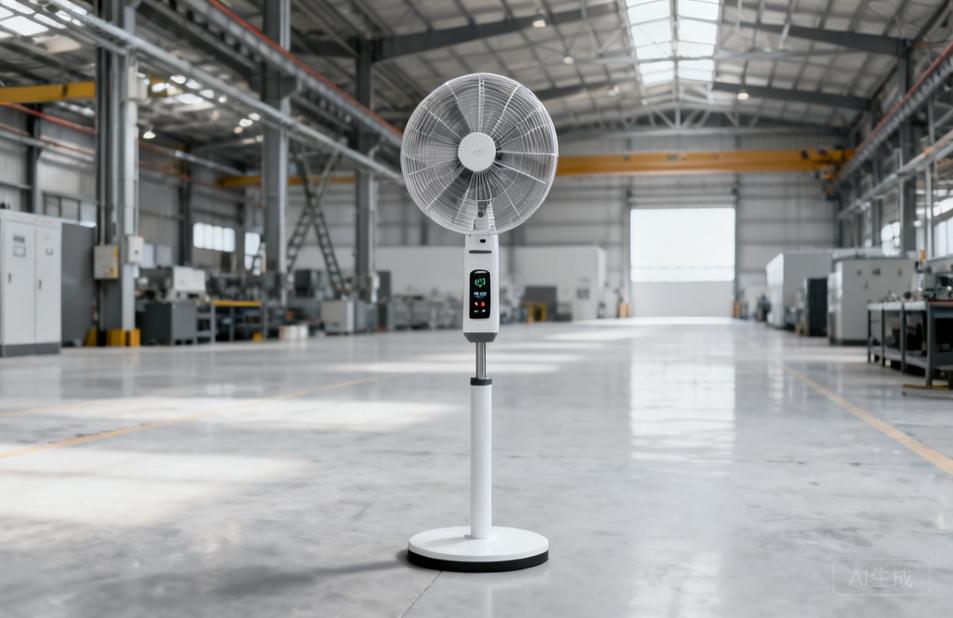
A standing air circulator OEM supplier manufactures pedestal-style air circulators built to a buyer’s specifications, covering branding, controls, voltage, and packaging. Buyers choose such suppliers by verifying product specifications, customization capability, quality control processes, and compliance documentation before placing an order. This guide explains how to evaluate suppliers and what information to prepare.
What Is a Standing Air Circulator OEM Supplier?
An OEM (original equipment manufacturer) supplier produces air circulators that carry the buyer’s brand and follow the buyer’s requirements. Unlike a standard catalog purchase, OEM work involves agreed specifications, tooling or design adjustments, labeling, and packaging. A standing air circulator—often called a pedestal fan or high-velocity floor fan—is designed to move air over a longer distance than a typical desk fan. The OEM supplier’s role is to translate the buyer’s market needs into a manufacturable product while maintaining consistent quality.
Key Considerations When Evaluating a Supplier
Product Specifications and Customization
Start with the specification sheet. Confirm the fan diameter, motor type, speed settings, oscillation range, height adjustment, control method, and voltage/frequency options. Ask which parameters can be customized and which are fixed by existing tooling. Common customization areas include logo placement, color, packaging, plug type, and control panel language. For performance-related changes—such as airflow or noise—request supporting test data and clarify how changes affect cost and lead time. Specifications vary by model, so always confirm final details in the datasheet.
Quality Control and Testing
Ask how the supplier controls incoming components, in-process assembly, and final inspection. A documented quality plan should cover motor performance, electrical safety checks, balance and vibration, and packaging drop tests where applicable. Request samples from production, not only engineering prototypes, and inspect consistency across units. Clarify who performs testing and whether third-party testing is available for required markets.
Compliance and Documentation
Market requirements differ. Ask the supplier which certifications or declarations they can provide for your target country and whether these apply to the exact configuration you are ordering. Do not assume a certificate covers all models. Request the relevant test reports, labels, and manuals, and verify that the documentation matches the product and voltage you will sell.
Communication and Project Management
Responsiveness during inquiry is a useful indicator. Provide a clear requirements brief and see whether the supplier asks specific technical questions or sends generic quotes. Confirm who will handle samples, approvals, and production updates. For OEM projects, a single point of contact and a written approval process reduce misunderstandings.
Capacity and Flexibility
Discuss expected order volumes and whether the supplier can handle your launch quantity and later growth. Ask about minimum order quantities, but treat figures as project-specific until confirmed in writing. Understand how changes to orders or specifications are handled and what notice is required.
Applications and Suitability
Standing air circulators are used in workshops, warehouses, gyms, garages, agricultural buildings, and large indoor spaces where directional airflow is needed. They are not a replacement for air conditioning or ventilation systems; they improve air movement and perceived cooling. Buyers should match the product’s airflow pattern and duty rating to the intended environment. For dusty or humid locations, confirm the motor enclosure and materials are appropriate. If the product will be used outdoors, verify the supplier’s stated suitability rather than assuming indoor ratings apply.
Limitations and Trade-offs
OEM customization involves trade-offs. More customization can increase tooling cost, minimum order quantities, and lead time. High airflow often means higher noise or power consumption, so buyers must set priorities. A supplier may offer extensive options but limited documentation, or strong documentation but narrower customization. Balance these factors against your market positioning and technical requirements.
Buyer Checklist: Information to Send a Supplier
- Target market and required voltage/frequency.
- Fan size, airflow direction, and preferred control method.
- Branding requirements: logo, color, packaging, and manual language.
- Required certifications or declarations for the destination market.
- Expected order quantity and launch timeline.
- Any environmental conditions such as dust, humidity, or continuous operation.
- Sample requirements and approval process.
Send this brief to several suppliers and compare their technical responses, documentation, and willingness to clarify details. A supplier who asks precise questions is often better prepared for OEM work than one who only sends a price list.
Conclusion
Selecting a standing air circulator OEM supplier requires verifying specifications, quality control, compliance, and communication. Use the checklist above to structure your inquiry and compare responses. Confirm all performance and compliance details in the final datasheet before ordering.
Frequently Asked Questions
What does a standing air circulator OEM supplier do?
An OEM supplier manufactures pedestal air circulators to a buyer’s specifications, including branding, controls, voltage, and packaging, for sale under the buyer’s brand.
What should I include in an OEM inquiry?
Include target market, voltage/frequency, fan size, control method, branding requirements, required certifications, expected quantity, and any special operating conditions.
How can I verify product quality before ordering?
Request production samples, review the supplier’s quality control plan, and ask for test reports relevant to your market and configuration.
Are specifications the same for every model?
No. Specifications vary by model and configuration. Always confirm final details in the datasheet for the exact product you intend to order.
What are common customization options?
Common options include logo, color, packaging, plug type, control panel language, and voltage. Performance changes may require additional testing and cost.
Company Information and Technical Inquiries
Company: Dongguan Yanxuan Electrical Appliances Co., Ltd.
Address: No. 3, Liuhua Industrial Road, Dongcheng Subdistrict, Dongguan, Guangdong, China
Phone: +8613253611781
Email: 847317465@qq.com