
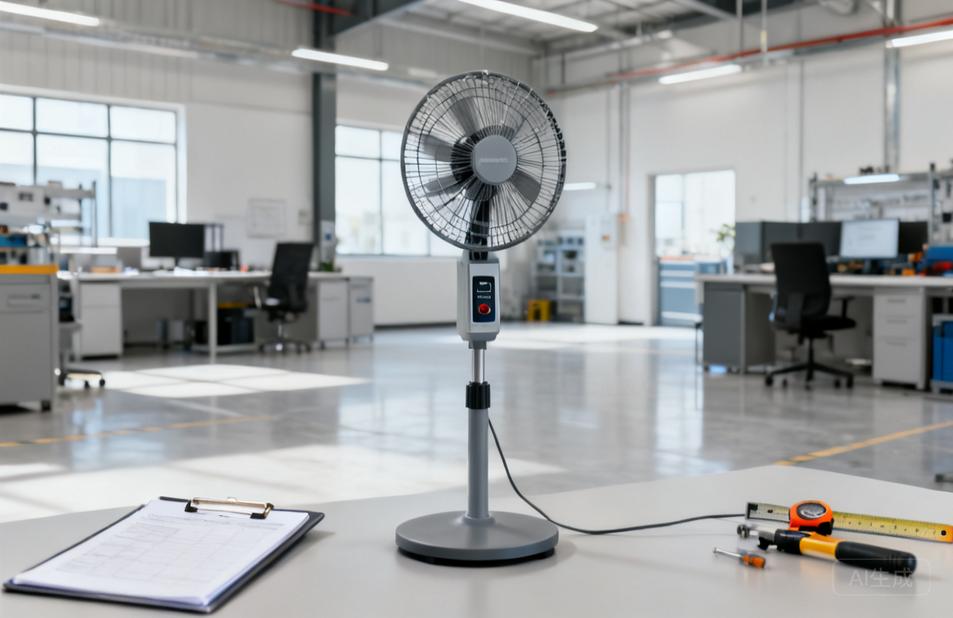
A standing air circulator ODM supplier designs and develops the product on your behalf, typically covering airflow and motor selection, housing and tooling, control interface, packaging, and documentation. That differs from a pure OEM arrangement, where the buyer supplies a mature design and the factory builds to it. ODM sourcing suits distributors and brands that want a differentiated floor-standing or pedestal air circulator without maintaining an in-house design team.
What ODM Means in Practice for Air Circulators
In a genuine ODM relationship, the supplier owns or adapts a platform design and modifies it for your market. Typical adaptation points include voltage and plug type, airflow settings and speed control, oscillation angle, height adjustment, grille and blade geometry, and branding on the housing and controls. Some buyers only take a platform unit with a new color and label; others fund new tooling for a distinct housing.
Clarify early which model applies to you. Platform adaptation is faster and usually less costly, but other buyers may use similar-looking units. New tooling gives differentiation but adds development time, tooling investment, and validation work. Neither path is inherently better; the right choice depends on your channel, price position, and how much differentiation your market requires.
How to Judge Design and Engineering Capability
Ask how the supplier approaches airflow performance. A useful air circulator balances air volume, velocity, noise, and power consumption; improving one usually affects the others. A capable ODM partner should be able to explain the trade-offs it made in an existing platform and show measured data for it.
- Motor type and expected service life, with supporting test information.
- Blade and grille design rationale and its effect on noise and reach.
- Speed control method (mechanical or electronic) and its reliability implications.
- Oscillation and tilt mechanism design, including wear points.
- Available test documentation: airflow, noise, power, and endurance.
Specifications vary by model and must be confirmed in the datasheet. Treat verbal performance claims without a test reference as unverified.
Compliance and Documentation to Verify
Standing air circulators are electrical products, so market access depends on applicable safety and electromagnetic requirements in your destination. Do not assume a supplier’s certificates cover your configuration; voltage, plug, motor, and control changes can affect a certificate’s validity.
Request the following and check that model numbers, ratings, and factory details match the unit you intend to buy:
- Certificates or test reports relevant to your target market, with scope and validity dates.
- Confirmation of which factory and production line will build your order.
- Bill of materials transparency for safety-critical parts such as motor, wiring, and power components.
- Labels, warnings, and manuals in the required language.
- Packaging test information for the shipping method you will use.
Where a requirement is unclear, ask the supplier to state in writing whether it applies and how it will be met. A supplier that answers precisely is easier to work with than one that answers broadly.
Quality Control and Pre-Shipment Verification
Ask how incoming components, in-process assembly, and finished units are checked. For air circulators, common checkpoints include motor function, speed settings, oscillation and tilt operation, noise screening, electrical safety tests, and cosmetic inspection.
A practical approach is to agree on an inspection plan before production: sampling basis, test items, acceptance criteria, and who signs off. If you use a third-party inspection service, confirm the supplier’s experience with inspections and the documents it will make available. Also agree on how defects are handled, including replacement or rework responsibility.
Tooling, Sampling, and Development Steps
For a new housing or major change, expect a staged process: specification agreement, design review, prototype or sample, validation, tooling, trial production, and mass production. Ask for a written schedule with milestones and confirm which party owns tooling and design files. Ownership of molds and drawings should be documented, not assumed.
Samples are a decision tool, not a formality. Test them against your own checklist: airflow feel, noise at each speed, control ergonomics, stability, assembly quality, and packaging protection. Record what you tested so later production can be compared against the same reference.
What to Send an ODM Supplier
A clear brief shortens development and reduces rework. Prepare:
- Target market, voltage, plug type, and required certifications.
- Intended use: household, office, workshop, or commercial space.
- Desired airflow character, noise expectations, and number of speeds.
- Height and size constraints, plus any appearance or color direction.
- Control preferences and whether remote or timer functions are needed.
- Packaging, labeling, and manual language requirements.
- Estimated order volume and target launch window.
MOQ, tooling cost, sample lead time, and production lead time are supplier- and project-specific. Ask for them in writing rather than relying on general figures.
Limitations and Trade-offs
ODM sourcing is not ideal for every buyer. If your market demands a highly proprietary design, full control of the bill of materials, or certification for an unusual configuration, a deeper development relationship or OEM route may fit better. Platform ODM also means your product may share components with other brands, which can limit perceived exclusivity.
Another constraint is communication depth: design changes need technical discussion, so a supplier with engineering staff who can respond to drawings and test questions is more useful than one that only quotes prices.
Buyer Checklist
- Confirm whether the offer is platform adaptation or new tooling.
- Obtain datasheets with model-specific ratings and performance data.
- Verify certificates match your configuration and destination market.
- Agree inspection criteria and defect handling before production.
- Document tooling and design file ownership.
- Test samples against a written checklist and keep the reference unit.
- Put MOQ, lead time, and change procedures in the contract.
To discuss a specific project, buyers can reach Dongguan Yanxuan Electrical Appliances Co., Ltd. at No. 3, Liuhua Industrial Road, Dongcheng Subdistrict, Dongguan, Guangdong, China, by phone at +8613253611781 or email at 847317465@qq.com.
Frequently Asked Questions
What is the difference between an ODM and an OEM standing air circulator supplier?
An ODM supplier designs or adapts the product platform for your brand, while an OEM supplier builds a design you provide. ODM is useful when you lack in-house design; OEM gives more control if you already have a mature design.
What should I send to a standing air circulator ODM supplier?
Send target market, voltage and plug type, required certifications, intended use, airflow and noise expectations, size and appearance direction, control features, packaging and manual language, estimated volume, and launch timing.
Can I get a custom housing for a standing air circulator?
Yes, but custom housing usually requires new tooling, samples, and validation. Confirm tooling cost, schedule, and ownership in writing, and expect longer development than platform adaptation.
How do I verify compliance for an ODM air circulator?
Ask for certificates or test reports that match your exact model, voltage, plug, and destination market, and confirm which factory will produce the order. Do not assume a certificate covers a modified configuration.
Are MOQ and lead time fixed for ODM orders?
No. MOQ, tooling cost, sample time, and production lead time vary by supplier, platform, and customization level. Request written figures for your specific project rather than relying on general claims.
Company Information and Technical Inquiries
Company: Dongguan Yanxuan Electrical Appliances Co., Ltd.
Address: No. 3, Liuhua Industrial Road, Dongcheng Subdistrict, Dongguan, Guangdong, China
Phone: +8613253611781
Email: 847317465@qq.com