
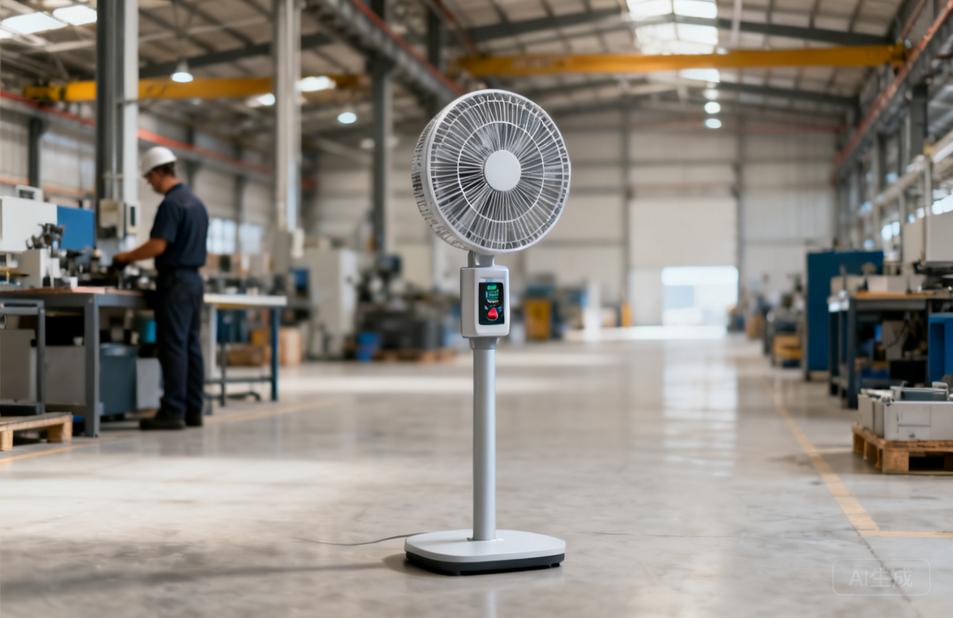
A standing air circulator private label manufacturer is a factory that produces pedestal-style air circulators and applies a buyer’s brand, packaging, and documentation. Buyers select one by verifying product specifications, compliance evidence, branding capability, and quality-control processes rather than by price alone.
What Private Label Means for Standing Air Circulators
Private label sits between buying a stock product and full custom development. The manufacturer supplies an existing or configurable air circulator platform, and the buyer applies its own brand through logo placement, color choices, control-panel graphics, packaging, and manuals. The buyer does not usually design the motor, blade, or housing from scratch. This shortens development time and reduces tooling risk, but it also means the buyer must confirm what can and cannot be changed. Some factories allow grille color, blade color, stand finish, and carton design changes; others only allow logo printing. The scope should be written into the quotation and sample approval.
Key Considerations Before Choosing a Supplier
Product specifications and performance
Standing air circulators vary in airflow, oscillation angle, speed settings, motor type, and noise level. Ask for the datasheet for each model and confirm which values are typical and which are guaranteed. Specifications vary by model and must be confirmed in the datasheet; do not rely on catalog photos or verbal claims. If your market requires specific airflow or power input, request test reports or third-party verification.
Compliance and documentation
Requirements depend on the destination market. Common areas to clarify include electrical safety, electromagnetic compatibility, plug type, voltage and frequency, and labeling language. Ask the supplier which certificates and test reports they can provide for the exact model and configuration you intend to order. Confirm whether the certificate covers your private label version, because a certificate for a different model or brand may not apply. Do not assume that a supplier’s general statement of compliance covers your order.
Branding and packaging capability
Clarify the available branding methods: logo printing on the motor housing, grille badge, base plate, control panel, remote control, manual, and carton. Ask for artwork templates and dieline files. Confirm minimum order quantities per model and per branding method, and whether mixed models can be combined in one order. Packaging should be designed for the shipping method; confirm carton drop-test reports if your channel requires them.
Quality control and sampling
Ask how incoming components, assembly, and finished goods are checked. A documented inspection plan, functional testing at the end of the line, and a pre-shipment inspection option are practical indicators. Request a sample of the exact configuration you plan to sell, not a generic model. During sample approval, check airflow feel, oscillation smoothness, speed control, noise, stability of the stand, and finish quality. Record approved sample details in writing so mass production can be compared against them.
Communication and project management
Private label projects involve artwork approvals, sample rounds, packaging proofs, and production scheduling. Ask who will be your contact, how changes are documented, and how problems are escalated. Clear written communication reduces the risk of mismatched logos, incorrect voltage, or packaging errors.
Applications and Suitability
Standing air circulators are used where directed airflow is needed over a distance or across a room: workshops, warehouses, garages, gyms, event spaces, and large living areas. They are not a replacement for air conditioning and do not filter air. For home use, buyers should consider noise and safety features. For commercial use, buyers should consider duty cycle, cord length, and whether the stand is stable on uneven floors. Private label programs suit distributors, retailers, and online brands that already have a customer base and want a branded product without developing a new design.
What Information to Send a Potential Supplier
- Target market and required voltage, frequency, and plug type
- Desired airflow, speed settings, oscillation, and control method
- Preferred materials and finish, and any color requirements
- Branding elements: logo files, packaging style, manual language
- Compliance documents required for your market
- Estimated order quantity per model and per year
- Sample deadline and target production window
Limitations and Trade-offs
Private label is not the same as full custom design. Major changes to motor, blade, or housing usually require tooling investment and longer lead times. A lower-priced supplier may use lower-grade components or offer fewer branding options. Buyers should balance unit price against documentation, sample quality, and the cost of rework if a shipment does not match the approved sample. Also consider logistics: a heavier stand or larger carton increases freight cost, which can offset a lower unit price.
Buyer Checklist
- Datasheet for each model, with key specifications marked as typical or guaranteed
- Sample of the exact private label configuration
- Written confirmation of branding scope and artwork approval process
- Compliance documents covering the ordered model and market
- Quality-control plan and pre-shipment inspection option
- Packaging dieline and carton test report if required
- Clear quotation covering product, branding, packaging, and testing
Use this checklist to compare suppliers on the same basis. When specifications are unclear, ask for clarification in writing before approving samples or placing orders.
Frequently Asked Questions
What is a standing air circulator private label manufacturer?
It is a factory that produces pedestal-style air circulators and applies a buyer's brand, packaging, and documentation to an existing or configurable product platform.
What can be customized in a private label air circulator?
Typical customizations include logo placement, colors, control-panel graphics, remote control branding, manual content, and carton design. The exact scope varies by supplier and should be confirmed in writing.
How do I verify product specifications?
Request a datasheet for the exact model and configuration, confirm which values are guaranteed, and check them against an approved sample. Specifications vary by model and must be confirmed in the datasheet.
What compliance documents should I request?
Requirements depend on your market. Ask for certificates and test reports covering the exact model and private label version, and confirm they apply to your order.
What should I check in a private label sample?
Check airflow feel, oscillation smoothness, speed control, noise, stand stability, finish quality, logo accuracy, and packaging. Record approved details in writing for mass production reference.
Company Information and Technical Inquiries
Company: Dongguan Yanxuan Electrical Appliances Co., Ltd.
Address: No. 3, Liuhua Industrial Road, Dongcheng Subdistrict, Dongguan, Guangdong, China
Phone: +8613253611781
Email: 847317465@qq.com