
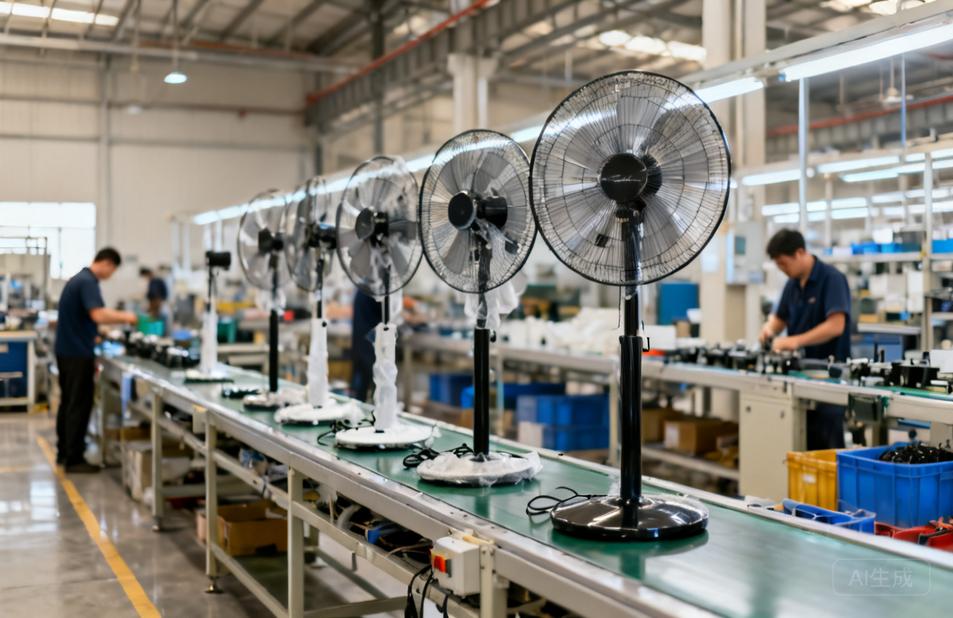
A standing air circulator custom manufacturer is a factory that produces pedestal-style air circulators to buyer specifications, offering modifications in airflow performance, motor type, controls, materials, and branding. These manufacturers serve distributors, OEM brands, and commercial buyers who need products tailored to specific markets, applications, or private-label requirements.
This guide explains the customization options typically available, how to evaluate a manufacturer’s capabilities, and the practical checks that reduce sourcing risk.
What Customization Usually Covers
Customization in this category generally falls into several areas. Buyers should confirm which options a given manufacturer actually supports, as capabilities vary widely.
- Performance and motor: Airflow output, motor type (AC or DC), speed settings, and oscillation range. These are often limited to specific platforms the factory already produces.
- Controls and features: Mechanical or electronic controls, remote control, timer functions, and speed memory. Availability depends on the control board and firmware.
- Materials and finish: Housing material (plastic or metal), grille design, blade material, and color matching to brand guidelines.
- Branding and packaging: Logo printing, custom labels, user manuals, and retail packaging design.
- Compliance and plug type: Regional plug standards, voltage/frequency variants, and documentation required for the target market.
Not every manufacturer offers full customization. Many work from existing tooling and offer limited changes to color, branding, and controls. Deep changes to airflow or motor design may require new tooling and higher minimum order quantities.
How to Evaluate a Custom Manufacturer
Evaluation should go beyond a catalog and price list. The following criteria help separate capable custom manufacturers from trading companies or assemblers.
1. Engineering and Communication
Ask how the manufacturer handles specification changes. A capable custom manufacturer will have a process for reviewing drawings, providing feedback on feasibility, and documenting agreed changes. Request a sample of the communication process: can they provide dimensioned drawings, exploded views, or material specifications? Prompt, clear responses during inquiry are a useful indicator of how they will handle issues during production.
2. Production Scope and In-House Capability
Clarify which processes are done in-house and which are outsourced. Motor winding, injection molding, metal stamping, assembly, and testing may be split across suppliers. In-house control over critical components can improve consistency, but it is not mandatory. What matters is whether the manufacturer can verify and control the quality of outsourced parts.
3. Quality Control and Testing
Ask for the routine tests performed on every unit and the sampling tests performed per batch. Typical checks include motor performance, airflow, power consumption, safety checks, and a visual inspection. Confirm whether the factory can provide test reports for the agreed specifications. Avoid manufacturers who cannot explain their testing process or who dismiss requests for documentation.
4. Certifications and Market Compliance
Certification requirements depend on the destination market. Ask the manufacturer which certifications they currently hold for comparable products and whether they can support the specific certification your market requires. Do not assume a certificate for one model covers another; certificates are model-specific. Verify certificate scope and validity directly with the issuing body where possible.
5. Customization Boundaries
Request a clear statement of what can be changed without new tooling, what requires new tooling, and what is not possible. This helps set realistic expectations and avoid late-stage surprises. For example, changing the blade design to alter airflow usually requires new molds, while changing the color or logo typically does not.
6. Minimum Order Quantity and Sampling
MOQ varies by model and customization level. Ask for MOQ for the base model and for each customization option. Confirm whether pre-production samples are available, the sample cost, and whether the sample cost is refundable against a bulk order. MOQ and sample policies are commercial terms that should be negotiated and documented.
7. Documentation and Traceability
Request a product specification sheet, a bill of materials for key components, and packaging specifications. These documents support your own compliance checks and after-sales planning. A manufacturer who can provide organized documentation is generally easier to work with over the long term.
Applications and Suitability
Custom standing air circulators are used in residential, commercial, and light industrial settings where directed airflow is needed. Common applications include:
- Retail and showroom spaces requiring consistent air movement
- Workshops and light assembly areas where heat buildup is a concern
- Hospitality and event spaces needing temporary or supplemental airflow
- Residential use in markets where pedestal circulators are preferred over ceiling or wall-mounted units
Buyers should match the product rating to the environment. Standard residential models may not be suitable for dusty, humid, or high-temperature industrial environments. Confirm the IP rating (if any) and operating temperature range with the manufacturer, as these vary by model.
Limitations and Trade-offs
Custom manufacturing involves trade-offs that buyers should weigh before committing:
- Cost vs. differentiation: Deep customization increases unit cost and MOQ. A private-label program based on an existing platform is often more economical than a fully new design.
- Tooling investment: New molds or motor designs require upfront investment and longer development time. This is only justified for volumes that support it.
- Certification lead time: New configurations may require re-testing for safety and performance certifications, adding time and cost.
- Flexibility limits: Many factories cannot accommodate frequent design changes after tooling is complete. Finalize specifications early.
Buyer Checklist: Information to Send a Manufacturer
To get an accurate response, prepare the following information before contacting a custom manufacturer:
- Target market and required certifications
- Voltage, frequency, and plug type
- Required airflow, speed settings, and control type
- Material and finish preferences
- Branding requirements (logo, packaging, manual language)
- Estimated annual volume and initial order quantity
- Any specific test or documentation requirements
Providing clear requirements reduces back-and-forth and helps the manufacturer give a realistic assessment of feasibility. Remember that specifications vary by model and must be confirmed in the datasheet or with the manufacturer directly.
Frequently Asked Questions
What is a standing air circulator custom manufacturer?
A standing air circulator custom manufacturer is a factory that produces pedestal-style air circulators with modifications to performance, controls, materials, or branding to meet buyer specifications.
What customization options are typically available?
Common options include motor type, speed settings, control type, housing material and color, logo and packaging, and regional plug and voltage variants. Availability varies by manufacturer and model.
How do I verify a manufacturer's quality control?
Ask for their routine and batch testing procedures, request test reports for agreed specifications, and review their documentation practices. A manufacturer unable to explain these processes may not have robust quality control.
What information should I provide to get a quote?
Provide target market and certifications, voltage and plug type, required performance and features, branding needs, estimated volumes, and any specific test or documentation requirements.
Are certifications transferable between models?
No. Certifications are typically model-specific and may not cover modifications. Confirm the scope of any certificate and whether re-testing is needed for your customized product.
What are the limitations of custom manufacturing?
Custom manufacturing often involves higher MOQs, tooling investment, longer lead times, and reduced flexibility after tooling is complete. It is best suited to buyers with clear specifications and sufficient volume.
Company Information and Technical Inquiries
Company: Dongguan Yanxuan Electrical Appliances Co., Ltd.
Address: No. 3, Liuhua Industrial Road, Dongcheng Subdistrict, Dongguan, Guangdong, China
Phone: +8613253611781
Email: 847317465@qq.com